The ultimate safety hazard for electric vehicles remains battery pack intrusion during high-speed collisions, where internal mechanical perforation triggers rapid Thermal Runaway. While traditional Nickel-Manganese-Cobalt (NMC) chemistries undergo violent combustion under catastrophic internal short circuits, BYD redefined energy storage safety with its Blade Battery architecture.
This technical guide evaluates the crystalline bond stability of Lithium Iron Phosphate (LiFePO4 - LFP), the mechanical engineering of modular-free Cell-to-Pack (CTP) integration, and the thermodynamic dynamics governing the industry-standard Nail Penetration Test.
1. The Nail Penetration Test: NMC vs. LFP Thermal Runaway Physics
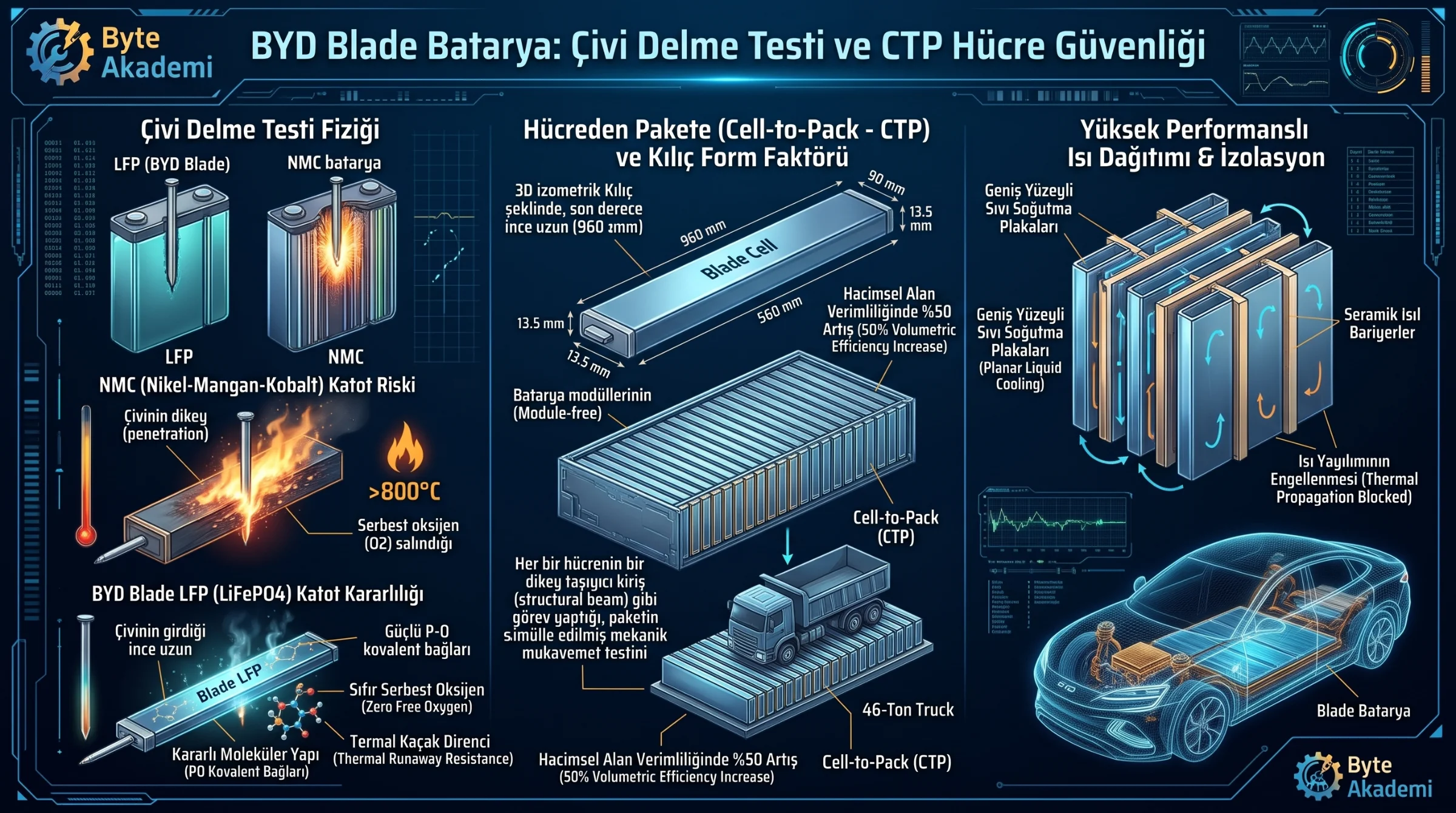
The nail penetration test simulates an acute internal short circuit by driving a 5 mm to 8 mm steel rod vertically through a fully charged (100% SoC) cell. The steel nail connects positive and negative electrode foils directly, generating massive localized short-circuit currents.
The outcome is governed strictly by cathode decomposition chemistry:
- NMC Cathode Instability: At temperatures near 200°C, nickel-oxygen bonds break down, releasing free gaseous oxygen (O2) into the sealed cell. The presence of flammable hydrocarbon liquid electrolyte, high internal heat, and free oxygen completes the combustion triangle, causing explosive thermal runaway exceeding 800°C within seconds.
- BYD Blade LFP (LiFePO4) Stability: In lithium iron phosphate crystals, oxygen atoms are bound tightly to phosphorus via covalent P-O bonds. This molecular structure remains thermally stable beyond 500°C without releasing free oxygen. Deprived of oxygen, internal short-circuit energy dissipates purely as moderate ohmic heat.
  [NAIL PENETRATION THERMAL RESPONSE]

  NMC Cell     : [Puncture] ---> Free Oxygen Released (200°C) ---> Explosive Fire (>800°C)
  BYD Blade LFP: [Puncture] ---> Stable P-O Bonds (Zero Oxygen) ---> Surface Temp: 30°C - 60°C
During verified nail tests, the Blade cell's surface temperature stabilized between 30°C and 60°C, exhibiting zero ignition, smoke plumes, or explosion.
The unbreakable phosphorus-oxygen bond of LFP chemistry starves internal short circuits of oxygen, proving that geometric cell packaging can solve both thermal runaway and volumetric energy density.
2. Cell-to-Pack (CTP) Mechanics: The 960mm Blade Geometry
LFP historically suffered from roughly 30% lower gravimetric energy density compared to high-nickel cells. BYD counteracted this chemistry constraint through structural Cell-to-Pack (CTP) packaging optimization.
Blade cells feature a distinct form factor: 960 mm long, 90 mm high, and 13.5 mm thick. This geometry enables several architectural advantages:
- Volumetric Utilization Past 60%: Traditional packs arrange cells into modules, which are bolted into an outer chassis frame, reducing usable space to roughly 40%. The Blade approach eliminates intermediate modules, sub-wiring harnesses, and bolted connectors, elevating volumetric pack efficiency above 60%.
- Cell-as-Structural-Beam: Due to its 960 mm aluminum enclosure, each Blade cell acts as an internal structural cross-member. Arrayed side-by-side, the cells reinforce the battery enclosure against lateral intrusion and torsional loads.
- 46-Ton Truck Crush Endurance: To validate shear resistance, BYD subjected a fully assembled Blade Battery pack to a 46-ton truck rollover test. The pack sustained zero leakage, smoke, or structural collapse, and functioned normally when re-installed into a test vehicle.
3. Heat Dissipation and Thermal Propagation Barriers
The high surface-area-to-thickness ratio of the 13.5 mm thin blade ensures that core heat travels only a fraction of the distance required in cylindrical cells before reaching external cooling surfaces:
- Planar Liquid Cooling: Large-surface aluminum cooling plates interface directly with the broad sides of each blade, rapidly drawing heat away during continuous fast charging.
- Inter-Cell Ceramic Thermal Buffers: High-temperature ceramic insulation sandwiches adjacent blades, physically blocking thermal propagation if an individual cell experiences localized mechanical stress.