Pulling an electric vehicle up to an ultra-fast DC charger only to watch charging speeds throttle from 250 kW down to 70 kW after a few minutes is a direct manifestation of electrical engineering's most stubborn physical barrier: Joule Heating (I2R).
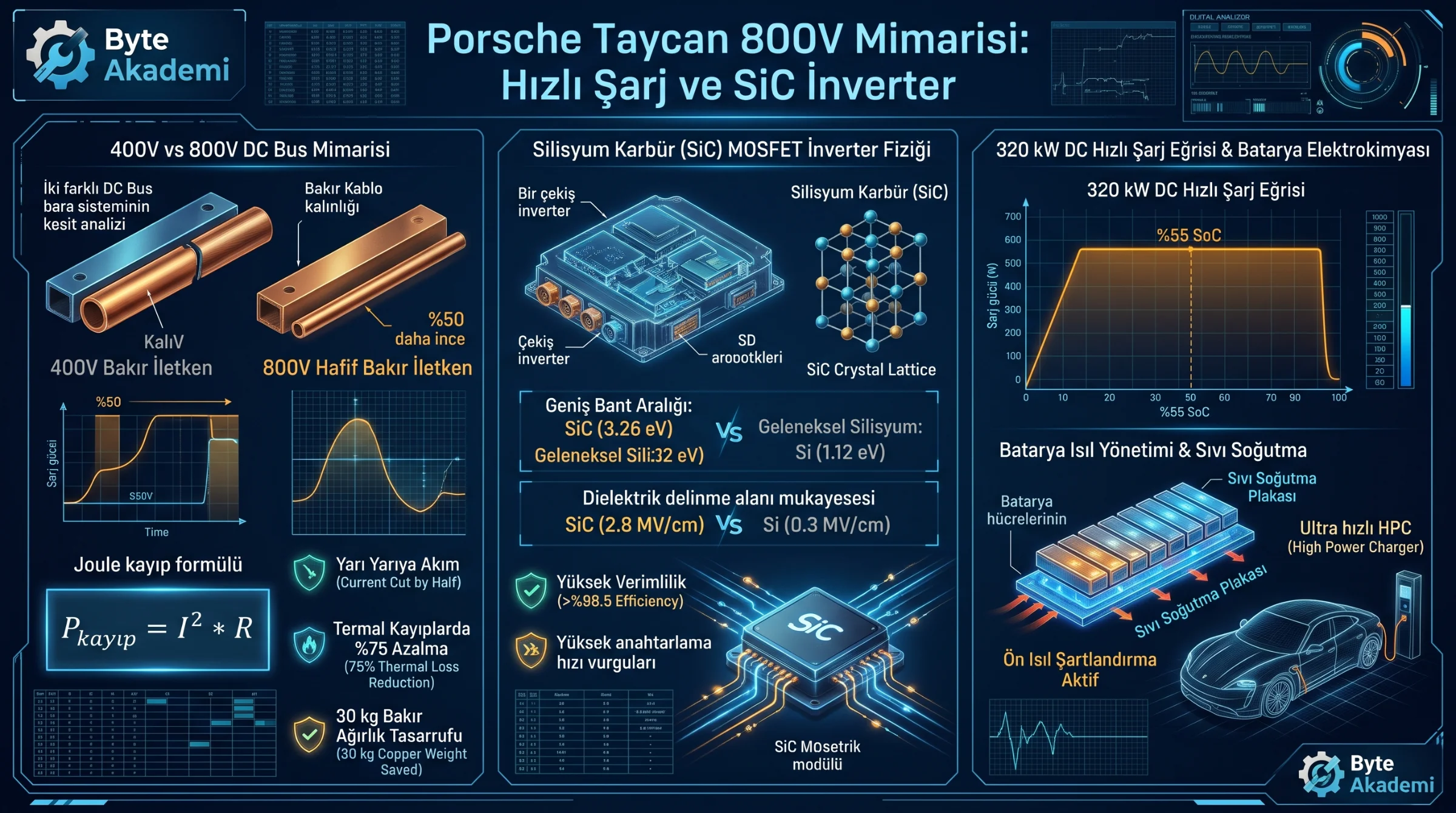
For years, EV manufacturers operated within standard 400V architectures. When engineers push for higher charging throughput at 400V, increasing current remains the only lever—which causes thermal dissipation in cables, busbars, and battery cells to climb exponentially. Porsche broke this paradigm with the Taycan, introducing the industry's first production 800V High-Voltage Architecture. This article explores the mathematical reduction of resistive copper losses, the solid-state physics of Silicon Carbide (SiC) power stages, and the thermal control strategies enabling continuous 320 kW charging throughput.
1. The Mathematics of 800V: Slashing I2R Losses and Harness Weight
Electrical power transmission relies on the fundamental relationship:
P = V * IDelivering 320 kW into an EV battery pack reveals a stark contrast between voltage topologies:
- 400V System: I = 320,000 / 400 = 800 Amperes
- 800V System (Porsche Taycan): I = 320,000 / 800 = 400 Amperes
Halving the current fundamentally changes thermal behavior due to Joule's first law:
P_loss = I^2 * RBecause resistive losses scale with the square of the current, cutting current in half drops total thermal dissipation to (1/2)2 = 1/4—a 75% reduction in copper heat generation. The engineering benefits ripple across the vehicle platform:
- Copper Weight Reduction: Carrying 400A instead of 800A permits significantly smaller conductor cross-sections, trimming approximately 30 kg of copper from the wiring harness and improving chassis mass distribution.
- Reduced Thermal Stress: Lower I2R generation across busbars and cell interconnects delays the onset of thermal throttling, preserving peak power transfer for extended durations.
- Cooling Efficiency: Reduced cable heating allows vehicle HVAC chillers to focus thermal capacity directly on electrochemical core conditioning.
  [400V vs. 800V DC BUS CURRENT AND HEAT LOSS COMPARISON]

  POWER LEVEL  : 320 kW

  400V System  : [==== 800A Current ====] ===> Heat Dissipation: 16x Units (P_loss = I^2 * R)
  800V Taycan  : [== 400A Current ==]     ===> Heat Dissipation: 4x Units  (75% Heat Reduction!)
Doubling system voltage does far more than shorten charge times; under the physics of Joule heating, it slashes resistive losses to one-fourth, unlocking sustained thermal endurance and high-power consistency.
2. Silicon Carbide (SiC) Inverter Physics: Beyond Silicon IGBTs
Transforming 800V DC into balanced 3-phase AC for permanent magnet synchronous motors (PSM) requires semiconductors capable of rapid high-voltage switching. Porsche utilizes Silicon Carbide (SiC) MOSFETs within the traction inverter rather than conventional Silicon IGBTs.
| Material Property | Silicon (Si) | 4H-Silicon Carbide (SiC) | Engineering Impact |
|---|---|---|---|
| Bandgap Energy | 1.12 eV | 3.26 eV (Wide Bandgap) | Prevents unwanted thermal carrier excitation at high voltages. |
| Critical Breakdown Field | 0.3 MV/cm | 2.8 MV/cm (~10x) | Withstands 800V potential across a significantly thinner drift layer. |
| Thermal Conductivity | 1.5 W/m·K | 4.9 W/m·K (~3x) | Accelerates heat conduction away from the junction into cold plates. |
| On-Resistance (RDS(on)) | High | Ultra-Low | Minimizes static conduction losses during sustained high-torque demand. |
The wider bandgap and elevated breakdown field of SiC permit switching frequencies above 10–20 kHz with minimal dynamic switching losses. The result is an inverter conversion efficiency exceeding 98.5%, directly reducing cooling demands and extending track-use repeatability.
3. 320 kW Charging Dynamics & Electrochemical Conditioning
The Taycan's Performance Battery Plus utilizes high-nickel pouch cells configured to sustain a 10% to 80% state-of-charge (SoC) replenishment in 18 minutes.
While standard EVs demonstrate narrow peak power spikes that fall off rapidly after 20% SoC, the Taycan sustains a high-power charging plateau surpassing 300 kW well past 50% SoC. Three subsystems support this profile:
- Pre-conditioning Thermodynamics: Selecting a High Power Charger (HPC) via navigation activates active thermal conditioning, bringing cell core temperatures to 30°C–35°C before plug-in to eliminate lithium plating risks.
- Dual-Sided Cooling Infrastructure: Laser-welded cooling plates integrated beneath cell modules maintain internal thermal gradients within a tight 5°C envelope.
- Elevated C-Rate Capability: The battery cell architecture safely supports continuous charging rates exceeding 3.0C, supported by optimized internal foil geometries and reduced internal impedance.