1. Alloy Anatomy: From Stamped Automotive Sheet Metal to Tesla's Cold-Rolled 30X (HFS) Exoskeleton
Conventional passenger vehicles are stamped from 0.7 mm – 0.8 mm mild low-carbon steel or 6000-series aluminum coils. Because bare carbon steel oxidizes rapidly in humid air, automakers rely on massive, energy-intensive Paint Shops to apply a 100 to 150-micrometer multi-layer chemical barrier consisting of zinc phosphate, electrocoat (E-coat), primer, basecoat, and UV clearcoat.
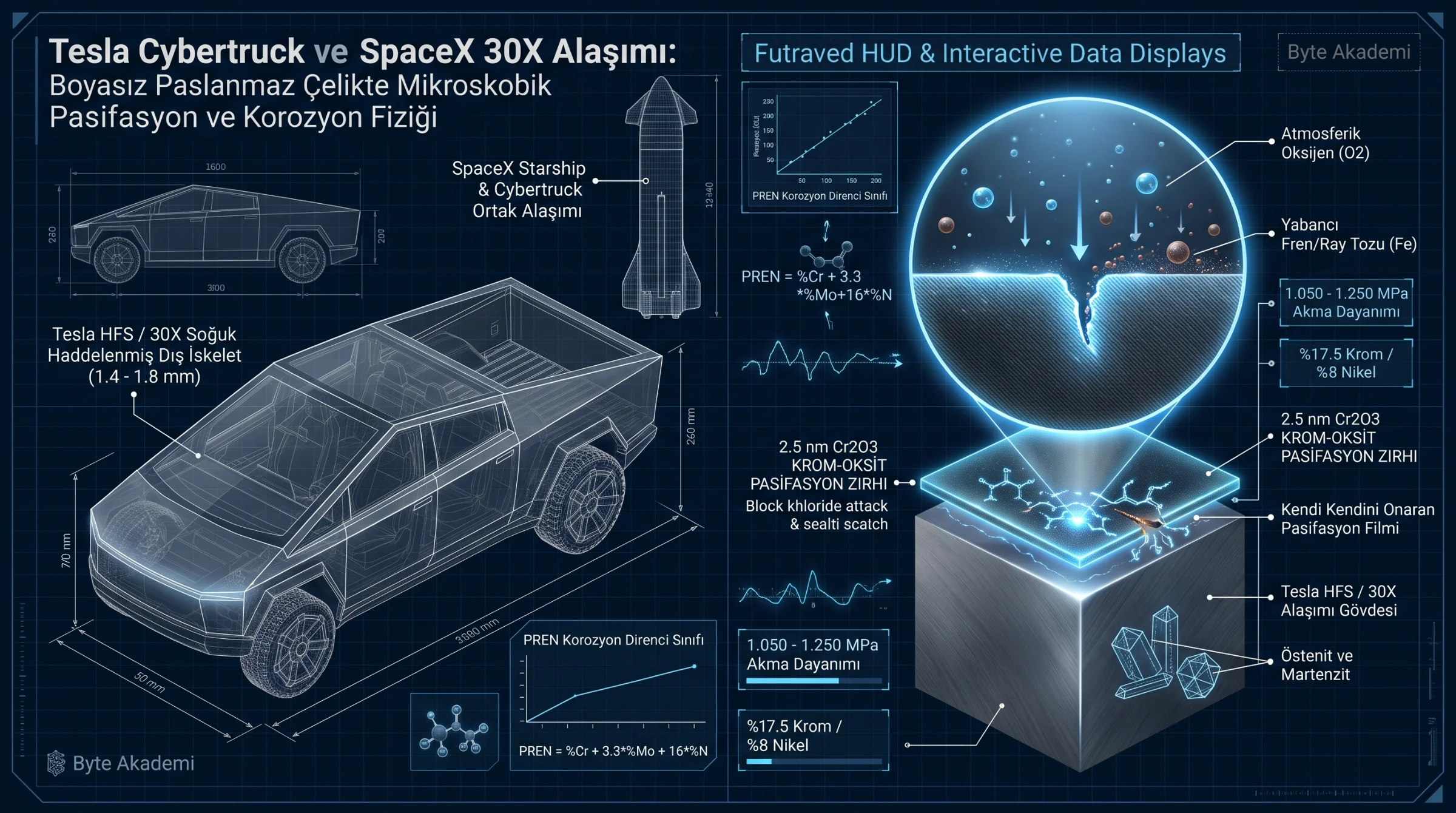
Elon Musk eliminated the paint shop entirely when engineering both the SpaceX Starship orbital vehicle and the Tesla Cybertruck electric pickup. Built around a structural Exoskeleton architecture, the Cybertruck utilizes 1.4 mm to 1.8 mm thick, full-hard cold-rolled 300-series austenitic-martensitic stainless steel (proprietary Tesla HFS / 30X alloy). Left completely bare and unpainted, this armor-grade skin stops 9mm subsonic projectiles while resisting atmospheric corrosion via a self-healing, 2-to-3-nanometer Chromium-Oxide (Cr2O3) passivation film.
Standard annealed 304L stainless steel offers excellent corrosion resistance but suffers from a low yield strength (~210 MPa), denting easily upon impact. Tesla metallurgists precisely balanced Chromium (17%–18%), Nickel (7%–9%), Molybdenum (Mo), and interstitial Nitrogen (N), subjecting the coil to severe cold rolling (work hardening). This process transforms a controlled fraction of the microstructure into strain-induced α'-martensite, boosting yield strength past 1,050 MPa – 1,250 MPa without requiring brittle post-forming heat treatment.
What protects an unpainted stainless steel exoskeleton from rusting is not 150 microns of automotive clearcoat, but an invisible 2.5-nanometer chromium-oxide shield that self-heals in milliseconds when scratched.
2. Chemical Reaction Kinetics: Self-Healing Passivation, Chloride Pitting, and the "Rail Dust" Myth
In materials science, "stainless steel" does not mean an inert metal that never reacts; rather, it is a highly reactive alloy that immediately arrests its own oxidation via a quantum-thin ceramic skin. When the Cybertruck's bare exterior encounters atmospheric oxygen (O2), acid rain, road de-icing salts, and airborne metallic particulates, three distinct electrochemical processes occur:
- Spontaneous Chromium-Oxide Passivation (Self-Healing Shield): Because the alloy's chromium content exceeds the critical 10.5% threshold (~17.5% in HFS), surface chromium atoms react with ambient oxygen orders of magnitude faster than iron. This forms a continuous, non-porous, transparent Chromium(III) Oxide (Cr2O3) layer just 15 to 30 Angstroms (1.5 – 3.0 nm) thick. If a rock chip or key scratches the door panel, freshly exposed chromium atoms instantaneously bind with atmospheric oxygen, self-healing the passive barrier in milliseconds.
- Airborne Free-Iron Contamination ("Rail Dust" & Brake Fallout): When Cybertruck owners notice tiny orange specks after driving in rain, the stainless steel panel itself is not rusting. Microscopic cast-iron particles shed from automotive brake rotors (brake dust) or railway wheels (rail dust) embed into the micro-grain of the brushed stainless surface. Exposed to moisture, these foreign carbon-steel particles oxidize into hydrated iron oxide (Fe2O3·nH2O) on top of the intact passive film.
- Chloride Ion Attack & Pitting Corrosion Resistance (PREN): Highway de-icing salts (NaCl / CaCl2) and coastal marine aerosols deploy aggressive chloride ions (Cl-) that attempt to penetrate microscopic defects or crevices beneath trapped dirt. Alloying additions of Molybdenum (Mo) and Nitrogen (N) stabilize the passive film against localized breakdown, elevating the alloy's Pitting Resistance Equivalent Number (PREN).
// 1. SPONTANEOUS SELF-HEALING PASSIVATION KINETICS ON BARE HFS EXTERIOR:
4Cr (Alloy Matrix) + 3O_2 (Ambient Air) --> 2Cr_2O_3 (2.5 nm Protective Passive Film)
Delta_G (Gibbs Free Energy) = -1058 kJ/mol (Thermodynamically Spontaneous!)

// 2. PITTING RESISTANCE EQUIVALENT NUMBER (PREN EQUATION):
PREN = %Cr + 3.3 * (%Mo + 0.5 * %W) + 16 * %N

%Cr : Chromium Mass Fraction (~17.5%)
%Mo : Molybdenum Fraction (Suppresses Chloride Pitting & Crevice Attack)
%N  : Interstitial Nitrogen (Boosts Both Yield Strength & Pitting Immunity)
3. Field Test Benchmarks & Metallurgical Comparison Table
The table below compares Tesla's cold-rolled 30X (HFS) exoskeleton alloy against conventional painted automotive steel, 6000-series aluminum body panels, and standard commercial stainless grades under ASTM B117 Salt Spray and mechanical duress:
| Engineering & Corrosion Metric | Painted Mild Auto Steel (DC04 / Bake-Hardened) | Automotive Aluminum (6016-T6) | Commercial 304L Stainless Steel | Tesla 30X / HFS Cold-Rolled Exoskeleton |
|---|---|---|---|---|
| Panel Gauge & Structural Role | 0.7 – 0.8 mm (Cosmetic Skin Only) | 0.9 – 1.1 mm (Cosmetic Skin) | Industrial Sheet | 1.4 – 1.8 mm (Load-Bearing Exoskeleton) |
| Yield Strength (MPa) | 210 – 280 MPa | 240 – 260 MPa | 210 – 240 MPa (Soft) | 1,050 – 1,250 MPa (Ultra-High-Strength) |
| Surface Protection Mechanism | 120 µm Paint + Clearcoat (Rusts if Chipped) | Al2O3 + Paint (Galvanic Risk) | Native Cr2O3 Film | 2.5 nm Self-Healing Cr2O3 + Mo/N Passivation |
| Pitting Resistance Index (PREN) | 0 (Immediate Red Rust if Bare) | N/A (Filiform Blistering) | 18.0 – 19.5 | 21.5 – 24.0 (Enhanced Atmospheric Immunity) |
| Surface Hardness (Vickers - HV) | ~110 HV (Dents Easily) | ~95 HV | ~160 HV | 380 – 420 HV (9mm Ballistic & Door-Ding Proof) |
| Detailing, PPF & Insurance Repair | Body Filler + Repaint + Clearcoat Blending | Specialized Al Welding + Paint | Acid Pickling | Citric/Oxalic Chemical Passivation or Colored PPF Wrap |
4. Summary Infographic: Nanometric Shielding on an Unpainted Exoskeleton
The architectural diagram below illustrates how the 2.5-nanometer passive barrier isolates the high-strength austenitic-martensitic core from corrosive environmental fallout:
  [NANOMETRIC PASSIVATION & CORROSION DYNAMICS ON TESLA 30X (HFS) STAINLESS STEEL]

      Atmospheric Oxygen (O2)         Airborne Brake/Rail Dust (Fe)    Highway De-Icing Salt (Cl-)
               |                                 |                                |
               v  (Millisecond Self-Healing)     v  (Surface Spec - Wipeable)     v  (Blocked by Mo/N)
  =============================================================================================
  [   2.5 nm Cr2O3 CHROMIUM-OXIDE PASSIVE SHIELD (Transparent, Non-Porous, Self-Repairing)    ]
  =============================================================================================
  |   Nickel & Molybdenum Enriched Sub-Interface (Stops Anodic Metal Dissolution)             |
  ---------------------------------------------------------------------------------------------
  |                                                                                           |
  |        TESLA HFS / 30X COLD-ROLLED SUBSTRATE MATRIX (1.4 mm - 1.8 mm Thick)               |
  |        [ Austenite + Strain-Induced Martensite Lattice | Yield Strength: >1,050 MPa ]     |
  |                                                                                           |
  +-------------------------------------------------------------------------------------------+