1. Introduction (Macro Approach): From 70 Stamped Parts to a Single Megacasting
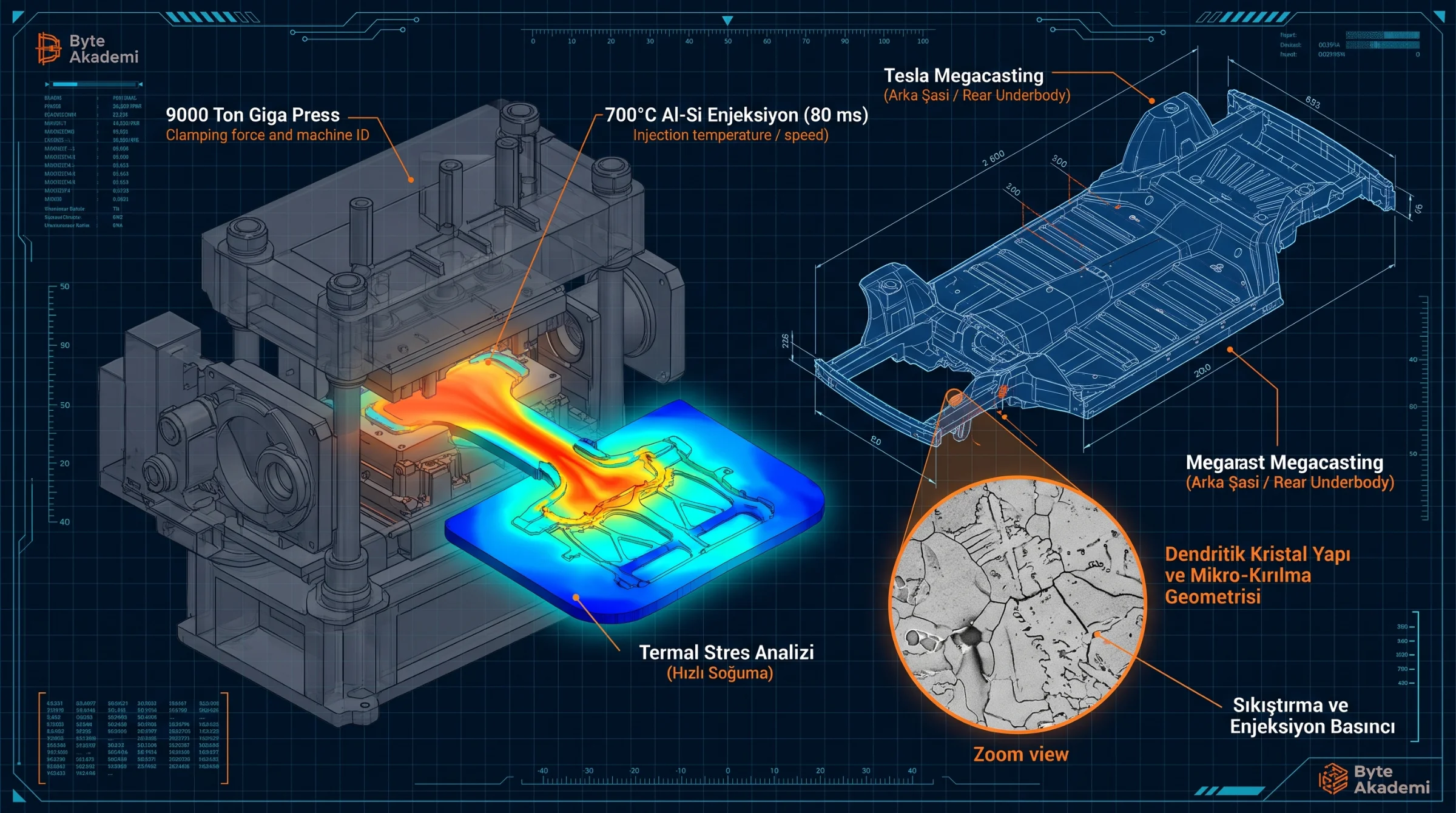
In conventional automotive manufacturing, a vehicle's rear underbody is assembled from 70 to 100 individual stamped steel or aluminum panels joined via thousands of spot welds, self-piercing rivets, and structural adhesives. Every weld introduces a heat-affected zone (HAZ) and cumulative dimensional tolerances. Tesla revolutionized this architecture by deploying custom 6,000 to 9,000-ton Giga Press High-Pressure Die Casting (HPDC) machines developed in partnership with IDRA.
Inside these house-sized presses, a single 80 to 130 kg shot of molten aluminum alloy at 700°C – 720°C is injected into the die cavity at gate velocities reaching 100 m/s, filling the entire mold in just 80 to 100 milliseconds. Yet this macroscopic manufacturing triumph triggers an extreme microscopic materials science challenge: thermal shock, dendritic solidification, and molecular residual stress dynamics.
Conventional structural aluminum castings require a T6 heat treatment (solution heating above 400°C followed by water quenching) to relieve internal stress and achieve yield strength. However, quenching a thin-walled, 1.5-meter monoblock chassis causes severe thermal warping. Tesla metallurgists formulated a custom hypoeutectic Al-Si-Mg-Cu alloy that achieves structural yield strength as-cast without post-casting furnace treatment.
When 700°C molten aluminum slams into a steel die in 80 milliseconds, chassis integrity is decided not by 9,000 tons of clamping force, but by micrometer-scale dendritic shrinkage stresses.
2. Metallurgical Phase Changes: Rapid Solidification and Micro-Crack Geometry
When 700°C liquid metal strikes H13 tool-steel die surfaces cooled to 200°C, it experiences extreme cooling rates ranging from 50°C to 500°C per second (K/s). This rapid liquid-to-solid phase transformation creates distinct microstructural zones and fracture mechanisms:
- Chill Skin Layer and Fine Equiaxed Grains: Within the outer 0.5 – 1.0 mm contacting the die wall, massive undercooling nucleates ultra-fine primary alpha-Al (α-Al) crystals. This dense skin provides exceptional fatigue resistance.
- Dendritic Growth and Eutectic Silicon Morphology: Toward the core, cooling rates drop and α-Al crystals grow as tree-like dendrites surrounded by an Al-Si eutectic phase. Without precise strontium (Sr) modification, silicon forms sharp, needle-like (acicular) plates that act as internal stress concentrators, initiating micro-cracks under load.
- Volumetric Shrinkage and Hot Tearing: Aluminum contracts by 6% to 7% by volume during solidification. As thin 3 mm ribs freeze in milliseconds while thicker 18 mm suspension nodes remain semi-solid (the mushy zone), tensile contraction pulls apart the liquid film along grain boundaries—creating jagged intergranular micro-crack geometries (hot tears).
// HALL-PETCH STRENGTHENING & THERMAL RESIDUAL STRESS EQUATIONS
// 1. Grain Size Effect on Yield Strength (Hall-Petch):
sigma_y = sigma_0 + (k_y / sqrt(d_grain))

// 2. Rapid Quenching Thermal Residual Stress:
sigma_thermal = E * alpha * Delta_T / (1 - nu)

sigma_y       : Yield Strength (MPa)
d_grain       : Mean Crystal Grain Diameter (micrometers)
E             : Young's Modulus (~70 GPa for Aluminum)
alpha         : Coefficient of Thermal Expansion (~23 x 10^-6 /K)
Delta_T       : Instantaneous Temperature Gradient Between Skin and Core (K)
nu            : Poisson's Ratio (~0.33)
3. Stress Analysis Profiles and In-Cavity Solidification Dynamics
Tracking cavity pressure, temperature gradients, and von Mises tensile stresses across the 0 to 5-second casting cycle reveals why Phase 3 (Intensification) is critical to preventing structural failure.
  [In-Cavity Pressure & Molecular Tensile Stress vs. Time Profile]

  Pressure / Stress (MPa)
   120 |                        ___________________  <-- Plunger Intensification (100-120 MPa)
   100 |                       /                   \     (Compresses shrinkage pores)
    80 |                      /                     \
    60 |                     /      .-'''-.          \___  <-- Locked Residual Stress (~45 MPa)
    40 |         Fill       /     .'       '.            \_________________
    20 |        (80 ms)    /    .'  Hot Tear '.          (Die Opening & Distortion Window)
     0 |________.---------'___.'   Risk Zone   '.___________________________
       0 ms    20 ms    100 ms     500 ms     1500 ms    3000 ms         5000 ms (Time)
|-- Phase 1: Injection --|-- Phase 2: Solidification & Intensification --|| Chassis Zone & Wall Thickness | Cooling Rate (K/s) | SDAS (Dendrite Arm Spacing) | Dominant Stress State | Micro-Defect & Crack Risk |
|---|---|---|---|---|
| Thin Stiffening Ribs (2.5 – 3.5 mm) | 300 – 500 K/s (Ultra-Fast) | 8 – 12 µm (Ultra-Fine) | Compressive / Shear Flow | Cold Shut Flow Lines |
| Main Structural Walls (4.0 – 6.0 mm) | 80 – 150 K/s (Moderate-Fast) | 18 – 25 µm (Balanced) | Balanced Thermal Stress | Micro Gas Porosity (<1%) |
| Suspension Tower Nodes (12 – 20 mm) | 15 – 40 K/s (Slow) | 35 – 55 µm (Coarse Grains) | High Triaxial Tensile Stress | Shrinkage Void & Hot Tearing |
| Ingate / Runner Interface | Turbulent / Erosive | Sheared Dendrite Fragments | Hydrodynamic Shear (100 m/s) | Die Steel Soldering / Erosion |
To eliminate hot tearing in thick mounting nodes, Giga Presses utilize High-Vacuum evacuation (<50 mbar) prior to injection and actuate localized hydraulic Squeeze Pins that drive directly into semi-solid bosses during solidification, forging the dendritic network shut.
4. Future Projection: 16,000-Ton Single-Piece Underbodies & AI Metallurgy
- 16,000+ Ton Single-Shot Underbody Casting: Integrating the front megacasting, rear megacasting, and structural battery tray into a single unified floorplan cast in one shot.
- Acoustic Emission Digital Twins: Embedding piezoelectric ultrasonic sensors inside the steel die to listen to microscopic crack propagation in real time as the casting cools, replacing slow X-ray CT scans.
- Functionally Graded Crash Zones: Using 3D-printed conformal cooling channels and localized electromagnetic stirring to cast ultra-rigid cabin pillars alongside ductile, energy-absorbing crush rails within the exact same alloy shot.