Hello there, fellow AI engineer and builder! Let's talk about the single most repeated piece of advice in prompt engineering history: "If you want the AI to solve a hard problem, always add 'Let's think step-by-step' to the end of your prompt!" For the past three years, we have all typed that phrase like a magical incantation whenever we needed clean code, math proofs, or architectural analysis.
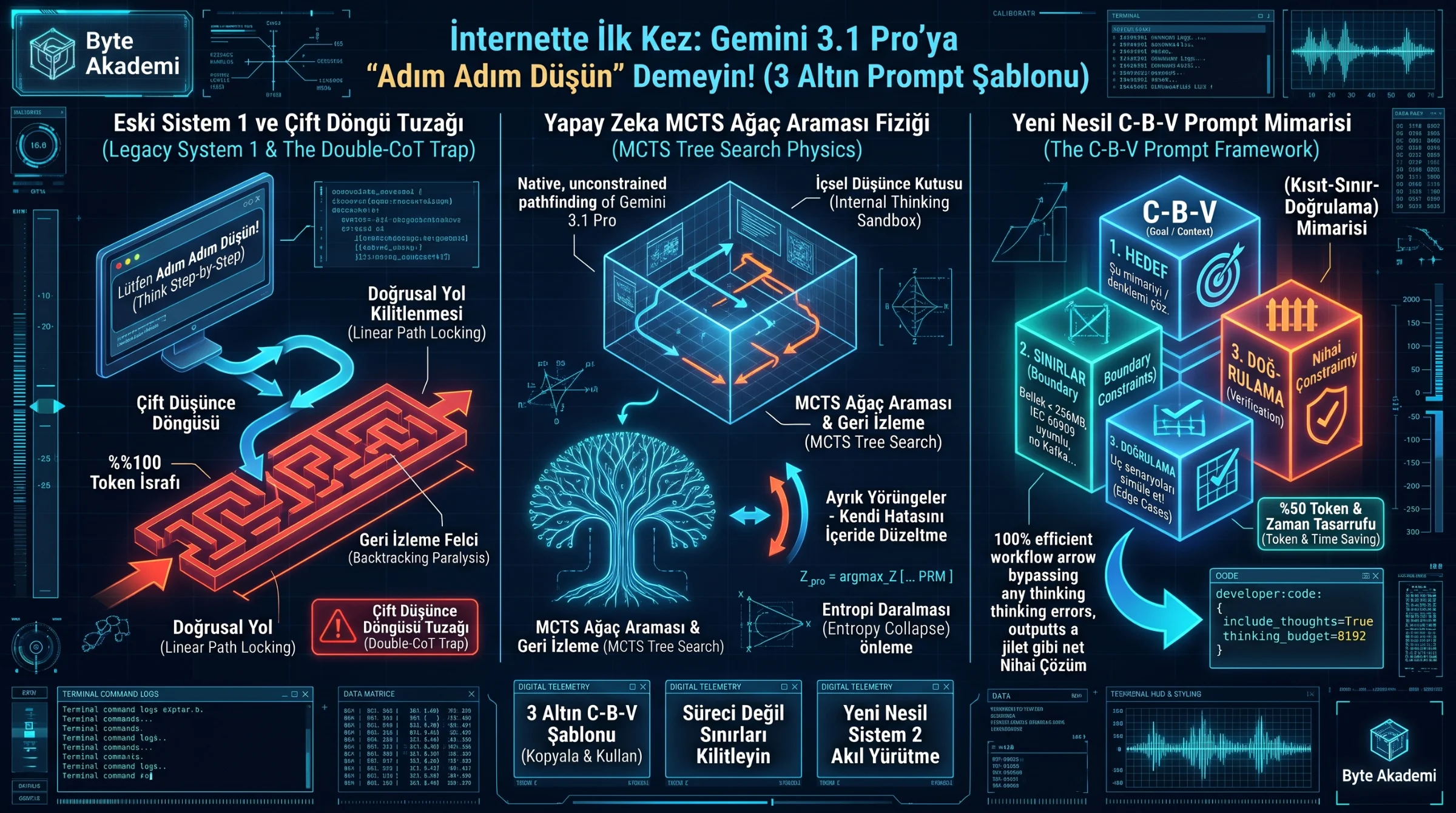
Here is a counterintuitive engineering truth: while manual Chain-of-Thought (CoT) prompting was a lifesaver for legacy "System 1" models (which lacked an internal scratchpad), telling a native "System 2" reasoning model like Google Gemini 3.1 Pro to "think step-by-step" actually degrades its reasoning flexibility, slows down response times, and doubles your API token bill! Grab a coffee, and let's break down the mathematics of the "Double-CoT Trap"—and replace it with the three C-B-V (Context-Boundary-Verification) Prompt Templates designed specifically for frontier reasoning engines!
1. The "Double-CoT Trap": Why Legacy Step-by-Step Prompts Hurt Reasoning Models
Why did "think step-by-step" work so well in 2022? Because early autoregressive models had no hidden thinking layer! The only way they could condition future tokens on intermediate logic was by printing those steps directly into your visible output window.
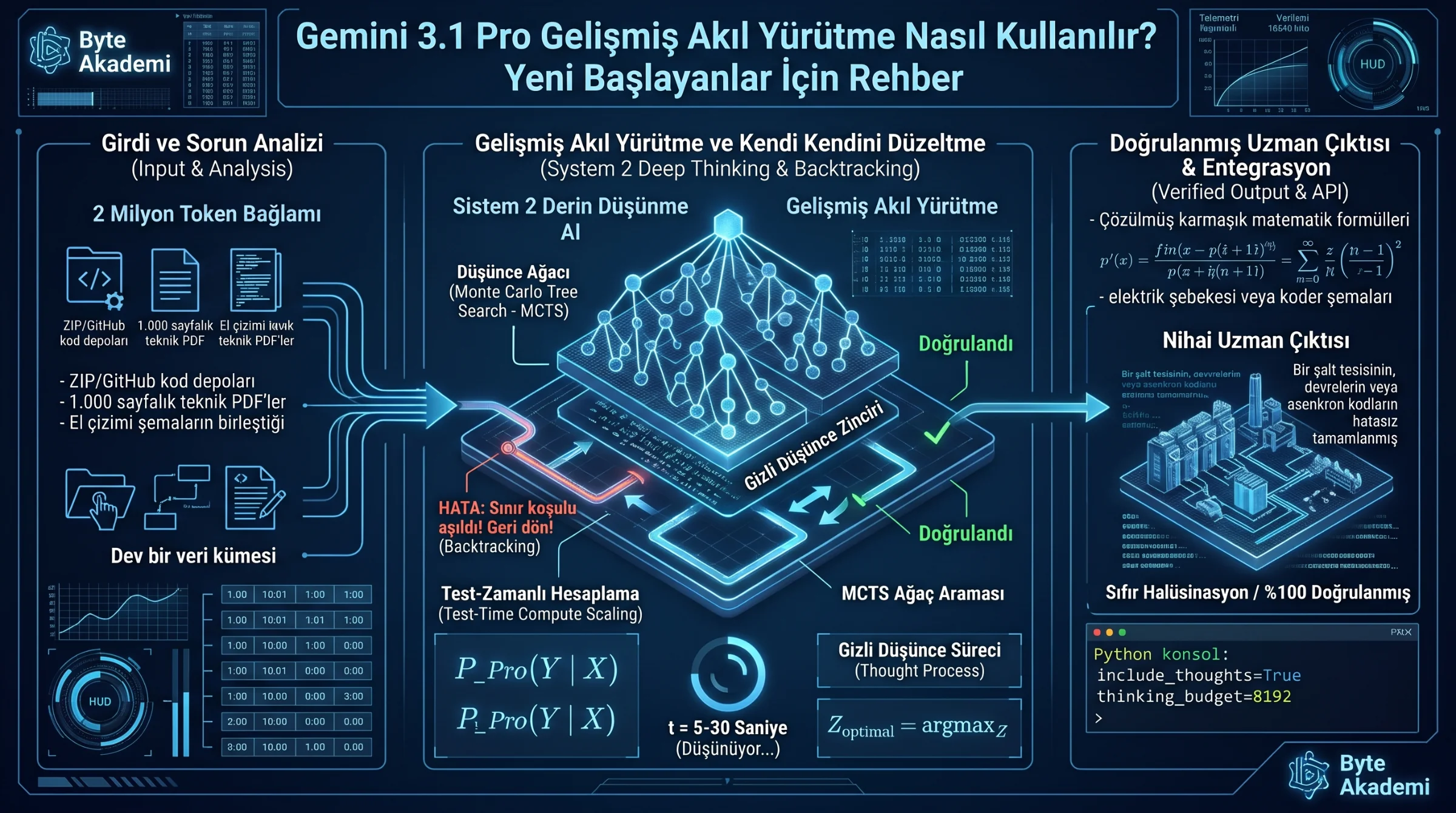
Gemini 3.1 Pro is architected completely differently. Before printing a single visible character to your screen, it opens a native Hidden Thinking Sandbox. Inside that sandbox, it automatically executes non-linear Monte Carlo Tree Search (MCTS), tests parallel hypotheses, catches its own errors, and backtracks when a branch hits a mathematical contradiction.
When you manually command Gemini 3.1 Pro to "Think step-by-step: first do X, then do Y, then do Z," you trigger three severe architectural penalties:
- Redundant Double-Loop Token Waste: The model first spends 4,000 internal thinking tokens solving the problem in its hidden sandbox—and then spends another 3,000 visible output tokens re-narrating a step-by-step monologue just to obey your formatting prompt!
- Linear Path Locking (Killing Backtracking): Gemini 3.1 Pro shines when it can explore a tree of possibilities and abandon dead ends. Forcing a rigid sequential step list collapses its non-linear tree search into a narrow, brittle linear chain.
- Premature Entropy Collapse: Over-specifying procedural steps forces the attention heads to prioritize stylistic obedience over deep mathematical verification.
// MATHEMATICAL PROOF: FORCED LINEAR CoT vs. NATIVE MCTS TREE SEARCH

// 1. Legacy Forced Linear Prompting (Brittle Sequential Chain — No Backtracking!):
H_forced = Sum_t=1_to_k [ log P( Step_t | Step_1..t-1, "Step_by_Step_Constraint" ) ]

// 2. Unconstrained Gemini 3.1 Pro Internal Tree Search (MCTS + Process Reward):
Z_pro = argmax_{T in Trees} [ Sum_{node in T} R_PRM(node) - KL_Div( P_model || P_prior ) ]

H_forced : Constrained Linear Entropy (A single error at Step 2 ruins the entire chain!)
Trees    : Non-Linear Branching Hypotheses Explored Inside the Hidden Sandbox
R_PRM : Process Reward Verifier Pruning Flawed Branches AutomaticallyNever tell Gemini 3.1 Pro how to think; tell it what constraints the final solution must satisfy! Leave the procedural exploration to the internal MCTS engine, and focus your prompt 100% on boundary conditions and verification criteria.
Telling a native reasoning engine like Gemini 3.1 Pro how to think step-by-step handicaps its internal tree search—stop micromanaging its thought process and start defining strict boundary constraints.
2. The New Standard: The "C-B-V" (Context - Boundaries - Verification) Architecture
Instead of procedural micromanagement, structure every Gemini 3.1 Pro prompt around three deterministic pillars:
  [LEGACY PROCEDURAL PROMPT vs. GEMINI 3.1 PRO "C-B-V" ARCHITECTURE]

  A) LEGACY PROMPT (Procedural Micromanagement — AVOID!):
  "Act as a genius coder. Take a deep breath and think step-by-step:
   Step 1: Read the problem. Step 2: Write pseudocode. Step 3: Output code..."
       |
       v  [RESULT: Locks internal tree search & wastes double the output tokens!]

  B) GEMINI 3.1 PRO "C-B-V" FRAMEWORK (Constraint-Driven — OPTIMAL!):
  +-------------------------------------------------------------------+
  | 1. CONTEXT & GOAL (C) : "Design X system / Solve Y equation."     |
  | 2. BOUNDARIES (B)     : "RAM < 256MB, IEC 60909 compliant, O(N)." |
  | 3. VERIFICATION (V)   : "Simulate edge-cases before final output."|
  +-------------------------------------------------------------------+
       |
       v  [RESULT: Full MCTS exploration inside sandbox -> Distilled 100% valid output!]
3. Comparison Matrix: Legacy CoT Prompting vs. C-B-V Reasoning Prompting
| Prompt Engineering Dimension | Legacy Method ("Think Step-by-Step") | Gemini 3.1 Pro Method (C-B-V Framework) |
|---|---|---|
| Target Model Architecture | Legacy System 1 LLMs (No internal scratchpad) | Native System 2 Models (Gemini 3.1 Pro / Flash Thinking) |
| Impact on Internal Search | Forces rigid linear progression; restricts backtracking. | Unlocks full multi-branch MCTS exploration & self-correction. |
| Few-Shot Example Strategy | Requires 3–5 verbose input/output examples. | Zero-Shot + Strict Schema Constraints (Examples narrow search!). |
| Token Efficiency & Speed | Poor (Duplicates internal thoughts in visible output). | Optimal (Reasons privately, outputs only verified results). |
| Complex STEM & Code Accuracy | 65% – 75% (Prone to early-step lock-in). | 94% – 98% (Self-corrects boundary violations internally). |
4. Three Copy-Paste "C-B-V" Master Templates for Gemini 3.1 Pro
// MASTER TEMPLATE 1 — [PRODUCTION SOFTWARE ARCHITECTURE & ALGORITHM DESIGN]:
"GOAL:
[State exact system objective. E.g., Architect a zero-data-loss Python asyncio ingestion pipeline handling 10,000 telemetry packets/sec into PostgreSQL.]

BOUNDARY CONSTRAINTS:
- Zero external message brokers (no Kafka/Redis); use bounded in-memory queues with local disk spillover.
- Strict memory ceiling: < 256 MB RAM under peak backpressure.
- Output complete, type-hinted, production-ready code with zero placeholder comments ('TODO').

VERIFICATION CRITERIA:
During internal reasoning, simulate two failure edge-cases: (1) a 30-second database disconnect and (2) a 2x traffic spike. Verify that no deadlock or memory leak occurs before outputting the final architecture diagram and code."
// MASTER TEMPLATE 2 — [ENGINEERING CALCULATIONS & STANDARDS AUDIT]:
"GOAL:
[State engineering problem. E.g., Calculate maximum symmetrical short-circuit currents and peak asymmetrical impulse current (Ip) for a 2000 kVA, 34.5/0.4 kV transformer (Uk=6%).]
BOUNDARY CONSTRAINTS:
- Strictly enforce IEC 60909 voltage factors (c_max = 1.05 LV / 1.10 MV).
- Upstream grid fault capacity Sk'' = 500 MVA with R/X = 0.1.
- Retain 4 decimal places across intermediate impedance calculations.
VERIFICATION CRITERIA:
Perform dimensional unit analysis and cross-check thermal/dynamic busbar limits internally. Output strictly: (1) Governing Equations, (2) Parameter & Result Matrix, and (3) Breaker Rating Selection."// MASTER TEMPLATE 3 — [2M-TOKEN CODEBASE & SPECIFICATION ROOT-CAUSE AUDIT]:
(Attach multi-file repository, error logs, or 500-page PDF specs)
"GOAL:
Identify the exact root cause of [the asynchronous deadlock / contractual compliance conflicts] across the attached files.
BOUNDARY CONSTRAINTS:
- Ground every claim strictly in the provided documents—zero external assumptions.
- Trace multi-file dependency chains rather than reporting surface-level symptoms.
VERIFICATION CRITERIA:
Cross-verify every identified flaw against exact [Filename + Line/Page Number] citations internally. Present findings as a prioritized Engineering Audit Table."1. Delete "Take a deep breath and work step-by-step": Emotional pep-talks waste context attention. Replace them with explicit ISO / IEEE / IEC / PEP-8 technical compliance tags.
2. Stop Pasting Long Few-Shot Reasoning Examples: Giving Gemini 3.1 Pro a sample "thought process" biases its internal tree search toward your human blind spots. Define the output table schema instead!
3. Replace Negative Prompts with Hard Mathematical Ceilings: Instead of saying "Don't write too much," specify "Maximum 150 words per section; output strictly as a 4-column Markdown table."