Hello there, fellow engineer and problem solver! Have you ever noticed what happens when you hand a traditional Large Language Model a gnarly multi-variable calculus proof, a 20,000-line race-condition bug, or a power-grid protection coordination puzzle? Standard models start streaming words onto your screen within milliseconds—before thinking the problem through! Just like an impulsive student writing down the first guess that pops into their head, if a standard LLM makes a subtle algebraic slip in sentence two, it spends the next four paragraphs confidently defending that mistake!
In cognitive science, Nobel laureate Daniel Kahneman famously separated human thought into "System 1" (fast, instinctive reflex) and "System 2" (slow, deliberate, analytical deduction). To bring true System 2 intelligence to artificial intelligence, Google DeepMind engineered its flagship heavy-compute powerhouse: Gemini 3.1 Pro (Advanced Reasoning). Instead of blurting out the statistically most likely next word, Gemini 3.1 Pro pauses, opens an internal scratchpad, tests competing hypotheses, backtracks when it hits a contradiction, and only outputs the verified solution. Grab a coffee, and let's unlock the Test-Time Compute physics, Python SDK controls, and constraint-driven prompting strategies for Gemini 3.1 Pro!
1. Beyond Next-Token Prediction: The Physics of Test-Time Compute & Backtracking
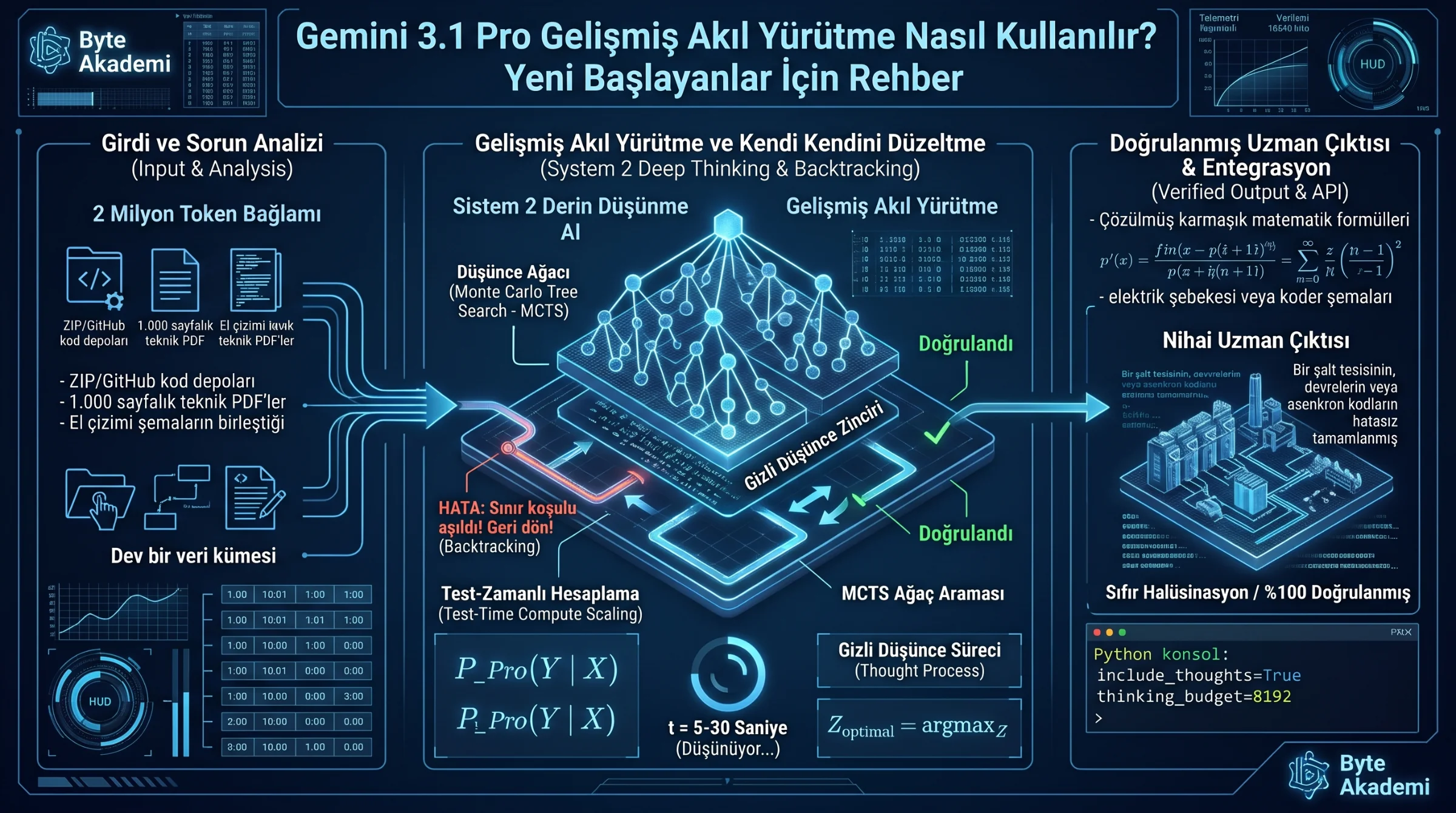
Why do standard autoregressive models stumble on novel engineering problems? Because they allocate a fixed, uniform amount of compute to every single token—spending the exact same effort predicting the word "the" as they do solving a differential equation! Gemini 3.1 Pro shatters this limitation through a three-stage Analytical Reasoning Architecture:
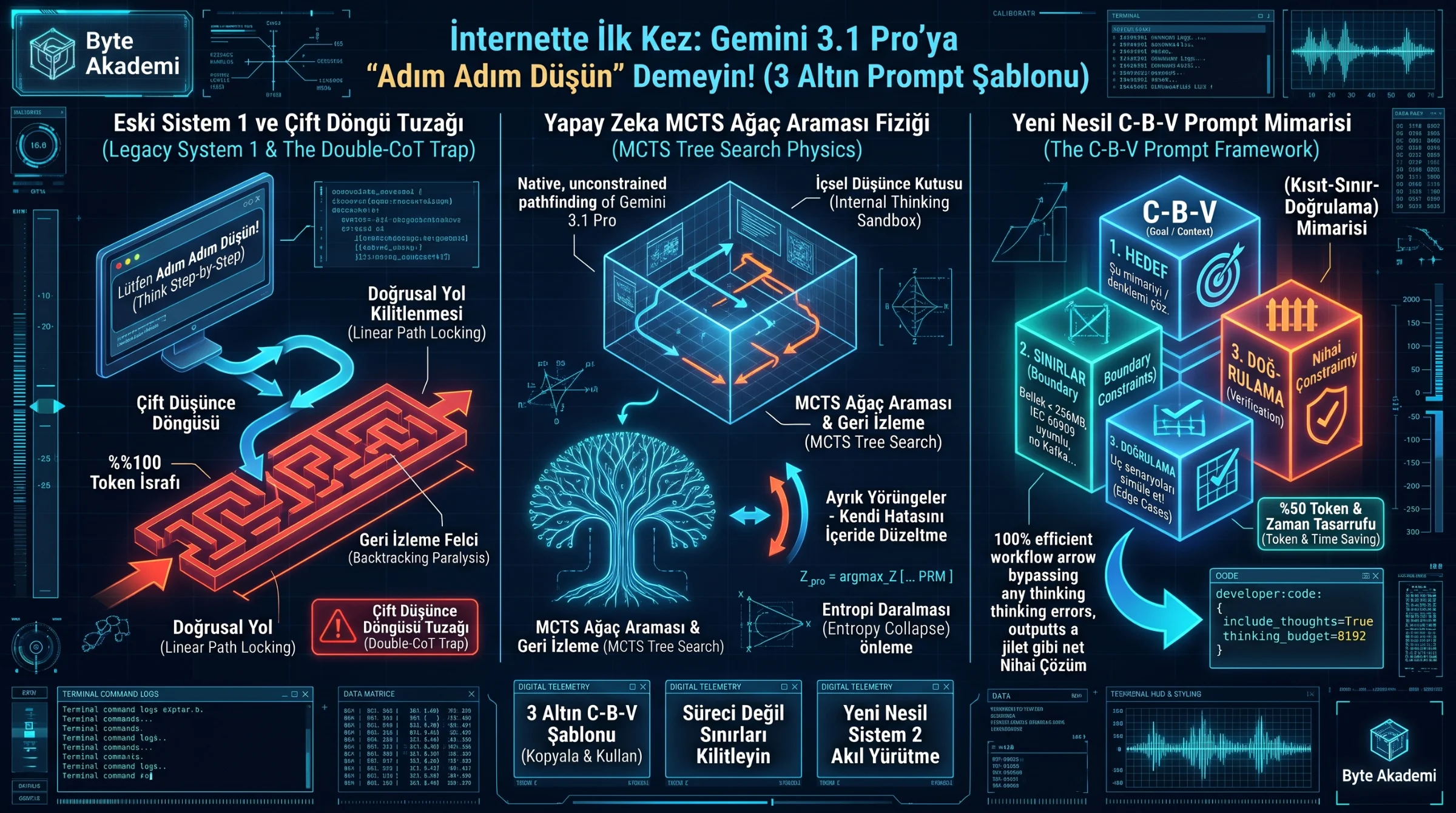
- Test-Time Compute Scaling: Rather than relying solely on memorized pre-training weights, Gemini 3.1 Pro dynamically scales inference-time compute—allocating thousands of internal reasoning tokens proportional to the logical depth of your prompt.
- Internal Tree Search & Self-Correction (Backtracking): Inside its hidden "Thinking" block, the model decomposes your problem into sub-goals. If Hypothesis A violates a boundary condition at Step 4, the model explicitly recognizes the dead end, backtracks to Step 2, and explores Hypothesis B before you ever see the final response.
- Process Reward Verification (PRM): Trained via reinforcement learning over multi-step mathematical and coding trajectories, an internal verifier evaluates the logical validity of each intermediate step rather than just guessing the final answer.
// GEMINI 3.1 PRO: SYSTEM 2 TREE-OF-THOUGHT & PROCESS VERIFICATION MATHEMATICS

// 1. Classical System 1 Autoregressive Decoding (Zero Lookahead):
P(Y | X) = Product_from_i=1_to_N [ P_theta( y_i | X, y_1..i-1 ) ]

// 2. Gemini 3.1 Pro System 2 Marginalization Over Verified Thought Trajectories (Z):
P_Pro(Y | X) = Sum_over_Z [ P_theta( Y | X, Z_optimal ) * P_PRM( Z_1 -> Z_2 -> ... -> Z_k | X ) ]

// 3. Optimal Reasoning Trajectory Selection with Self-Correction:
Z_optimal = argmax_Z [ Sum_t=1_to_k ( R_verifier(X, z_t) ) - lambda * Cost(Tokens_Z) ]

X           : Complex Multi-Constraint Engineering or Architecture Prompt
Z_1..Z_k    : Hidden Internal Chain-of-Thought Tokens (Hypothesis Testing & Backtracking)
R_verifier  : Step-Wise Process Reward Score Validating Logical & Mathematical Soundness
Y : Final Distilled, Verified Production OutputWhen you see the "Thinking..." indicator spinning, the connection isn't lagging! During those 10 seconds, Gemini 3.1 Pro is writing 2,000 to 16,000 words of internal engineering scratchpad notes—running mental unit tests, checking boundary equations, and pruning flawed code branches so your final output arrives rock-solid on the first try.
Standard LLMs speak before they think—Gemini 3.1 Pro simulates, verifies, and prunes thousands of internal reasoning branches before printing a single validated token to your screen.
2. Step-by-Step Workflow: Using Gemini 3.1 Pro Like a Principal Architect
- Step 1 (Select the Pro Reasoning Tier): In the Gemini web app or Google AI Studio (aistudio.google.com), switch your model selector to Gemini 3.1 Pro.
- Step 2 (Inspect the "Show Thinking" Drawer): Always expand the "Show thinking" dropdown above the generated answer. Auditing how the model broke down your equations or software architecture lets you verify its assumptions instantly.
- Step 3 (Feed the Entire 2-Million-Token Context): Do not spoon-feed small snippets! Upload your entire 50-file codebase, 1,000-page regulatory PDF, and system schematics at once so the cross-attention heads can detect system-wide dependencies.
- Step 4 (Prompt with Constraints, Not Micromanagement): Define your target outcome, strict boundary conditions, and verification criteria—then let the reasoning engine chart its own multi-step path.
  [GEMINI 3.1 PRO: INTERNAL HYPOTHESIS TESTING & BACKTRACKING PIPELINE]

  1. INPUT: Complex Engineering Problem + 2M-Token Codebase / Schematics
       |
       v
  +-------------------------------------------------------------------------+
  | 2. HIDDEN SYSTEM 2 REASONING SANDBOX (Internal Thought Tokens)          |
  |  * Step A: Decompose problem into formal mathematical constraints.      |
  |  * Step B: Test Path 1 -> [CONFLICT DETECTED: Violates thermal limit!]  |
  |  * Step C: Backtrack & Test Path 2 -> [Verified via Python Sandbox!]    |
  +-------------------------------------------------------------------------+
       |
       v (Validated Solution Trajectory)
  +-------------------------------------------------------------------------+
  | 3. FINAL PRODUCTION OUTPUT                                              |
  |  * Zero-Hallucination Codebase / Complete Engineering Proof & Tables    |
  +-------------------------------------------------------------------------+
3. Complete Gemini Family Decision Matrix: 3.5 Flash-Lite vs. 3.8 Flash vs. 3.1 Pro
| Engineering Dimension | Gemini 3.5 Flash-Lite | Gemini 3.8 Flash | Gemini 3.1 Pro (Flagship) |
|---|---|---|---|
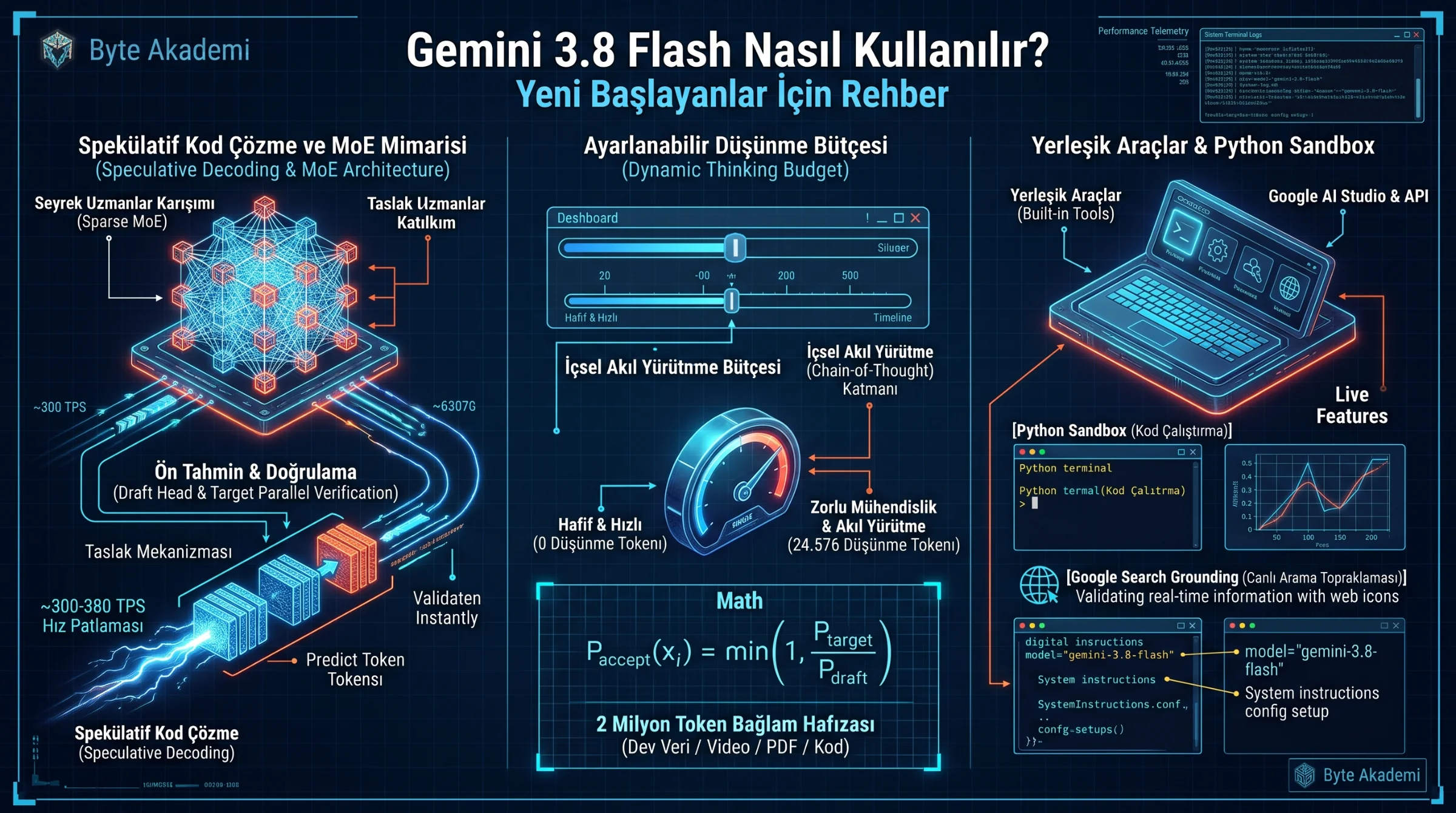
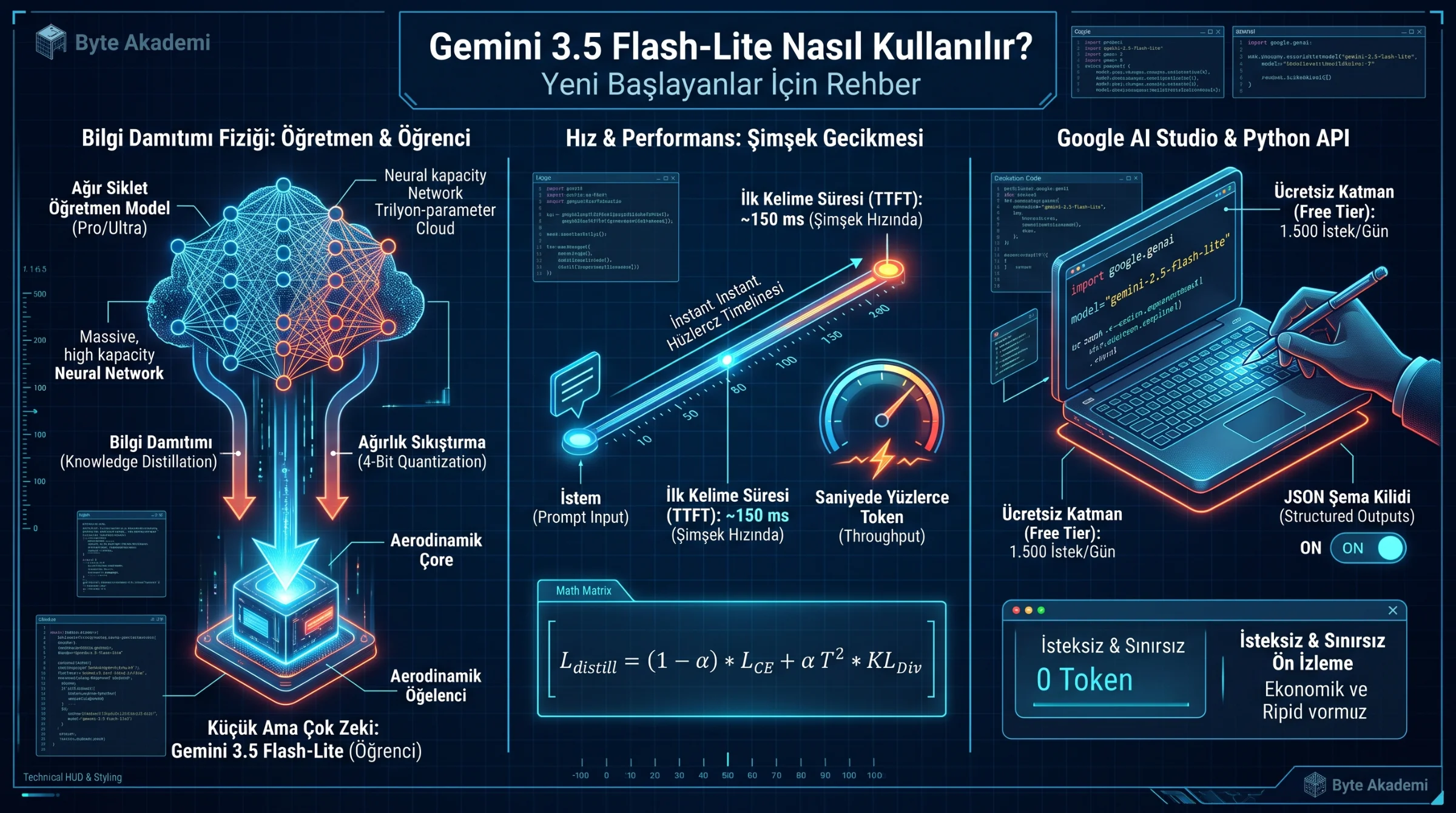
| Cognitive Architecture | System 1 (Instant Reflex) | Hybrid (Fast + Tunable Thinking) | Full System 2 (Deep Tree Search & Backtracking) |
| STEM, Calculus & Theorem Proofs | Basic | Strong (Everyday Engineering) | Frontier Olympiad & R&D Grade (95%+ Accuracy) |
| Multi-File Codebase Architecture | Single functions & formatting | Full-stack components & scripts | Repository-wide refactoring & novel algorithm design |
| Pre-Response Reasoning Time | ~150 ms (Immediate) | 0.5 – 3 seconds | 5 – 30 seconds (Deep internal verification) |
| Ideal Production Workload | High-volume classification & chat | Daily coding & multimodal agents | Zero-error architecture, R&D, security audits & quantitative finance |
4. Python SDK Quickstart: Extracting Internal "Thought Summaries" via API
# GEMINI 3.1 PRO: ADVANCED REASONING & THOUGHT EXTRACTION (google-genai SDK)
# Install: pip install google-genai

from google import genai
from google.genai import types

client = genai.Client(api_key="YOUR_GEMINI_API_KEY")

prompt = """
Design a fault-tolerant protection coordination scheme (ANSI 50/51/51N/87T) for a 34.5 kV
industrial substation with a 2500 kVA transformer and 4 km of underground XLPE cable.
Include capacitive charging current and ferroresonance mitigation equations.
"""

response = client.models.generate_content(
    model="gemini-2.5-pro", # Or your active gemini-3.1-pro endpoint identifier
    contents=prompt,
    config=types.GenerateContentConfig(
        temperature=0.1,
        thinking_config=types.ThinkingConfig(
            include_thoughts=True, # Stream internal reasoning steps!
            thinking_budget=8192   # High compute allocation for deep verification
        )
    )
)

for part in response.candidates[0].content.parts:
    if part.thought:
        print("=== [INTERNAL SYSTEM 2 REASONING & VERIFICATION LOG] ===")
        print(part.text)
    else:
        print("\n=== [FINAL VALIDATED ENGINEERING SOLUTION] ===")
print(part.text)1. Stop Typing "Think Step-by-Step": Legacy models needed manual prompting to reason sequentially. Gemini 3.1 Pro performs native internal chain-of-thought automatically—instead of telling it how to think, define strict Goal + Boundary Constraints + Acceptance Criteria.
2. Avoid Rigid Few-Shot Templates: Overloading a reasoning model with rigid input-output examples can prematurely narrow its internal tree search. Give it the raw problem and constraints first!
3. Run "Red-Team / Devil's Advocate" Audits: Upload your finished system architecture or business plan and instruct 3.1 Pro: "Act as a ruthless principal auditor—identify the top 5 single points of failure, hidden race conditions, and mathematical edge cases in this design."