1. The Jevons Paradox in Computing: Why Higher Efficiency Drives Exponential Consumption
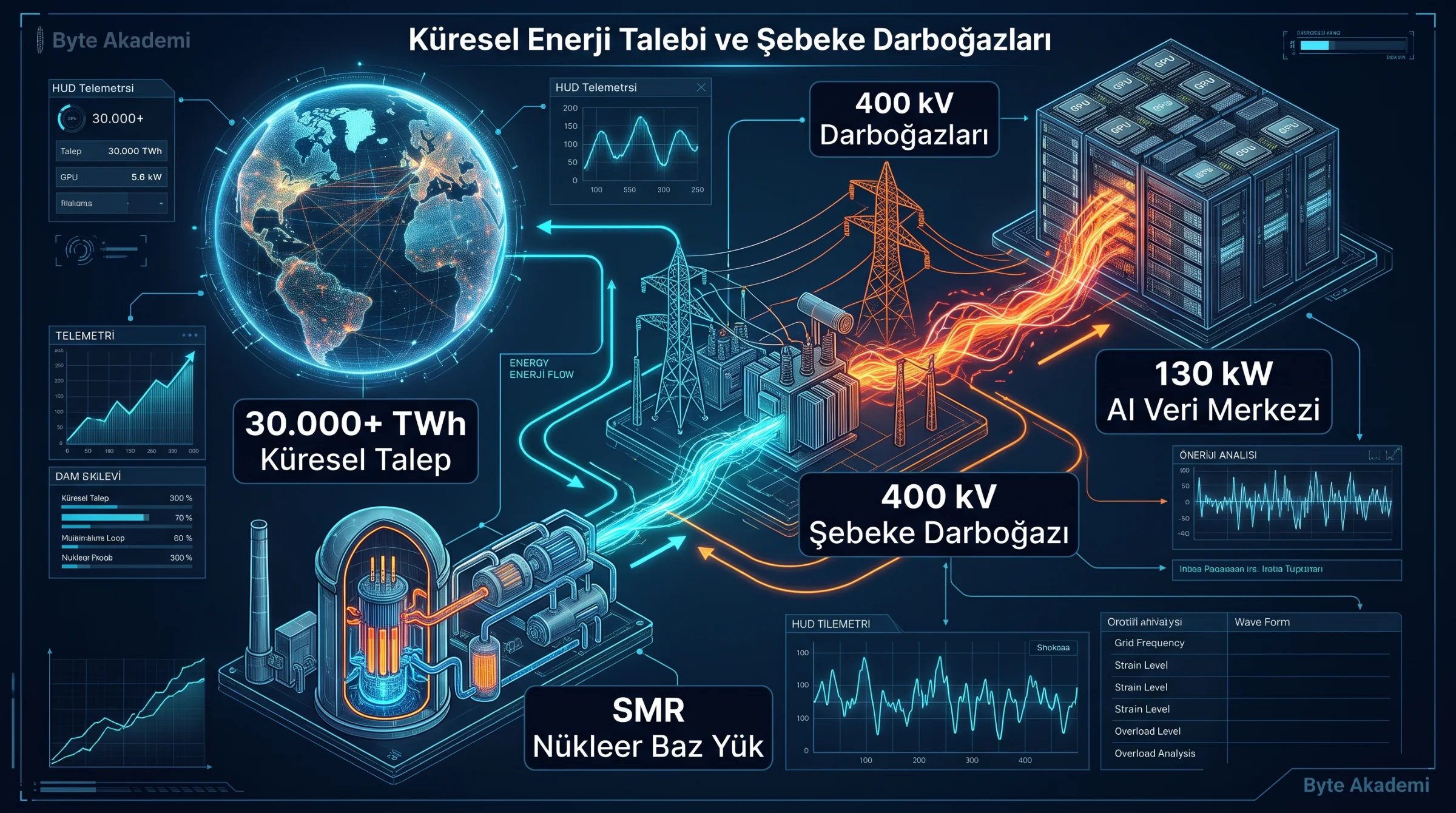
Over the past two decades, solid-state lighting, variable-frequency drives (VFDs), and 3-nanometer EUV silicon lithography have delivered dramatic gains in energy efficiency. Yet rather than declining, global electricity demand has surged past 30,000 Terawatt-hours (30 PWh) per year at the steepest trajectory in modern history.
In thermodynamics and resource economics, this phenomenon is governed by the Jevons Paradox: when technological progress increases the efficiency with which a resource is used (reducing the energy cost per computation or per lumen), total demand does not fall—it explodes. Four converging engineering vectors are driving today's global power crunch:
- Hyperscale AI Data Centers: A single generative AI inference query consumes roughly 2.9 Wh of electricity—nearly 10 times more than a conventional search engine query (0.3 Wh).
- Electrification of Transport and Heavy Industry: Megawatt Charging Systems (MCS) for commercial EV fleets alongside electric arc furnaces (EAF) and industrial heat pumps replacing fossil-fuel boilers.
- Thermodynamic Cooling Feedback Loops: Rising global ambient temperatures driving massive air-conditioning and data center chiller peak loads during summer stress hours.
- Green Hydrogen Electrolyzers & Sovereign Compute Clusters: Gigawatt-scale PEM/alkaline electrolyzers and high-density compute farms operating at a relentless 95%+ capacity factor.
In major data center hubs including Northern Virginia (PJM interconnection), Frankfurt, Dublin, and Singapore, deploying a new hyperscale cluster is no longer bottlenecked by GPU supply—it is constrained by 154 kV / 400 kV transmission substation queues and multi-year lead times for large power transformers (LPTs). In Ireland, where data centers now consume over 21% of national electricity, grid operator EirGrid has restricted new metro connections until nearly 2028.
The ultimate bottleneck for scaling artificial intelligence is no longer silicon lithography—it is high-voltage substation capacity, step-up transformers, and 24/7 baseload gigawatts.
2. Rack Power Density Escalation: From 10 kW Air-Cooled to 120 kW Liquid-Cooled AI Clusters
Legacy enterprise cloud server racks typically draw 5 kW to 15 kW per cabinet, easily managed by raised-floor Computer Room Air Conditioning (CRAC) units. By contrast, tightly coupled AI training racks (such as Nvidia Blackwell GB200 NVL72 architectures) pack 72 GPUs into a single footprint, pushing thermal design power (TDP) to 100 kW – 130 kW per rack.
At this flux density, total grid draw is dictated by the facility's Power Usage Effectiveness (PUE):
// DATA CENTER POWER USAGE EFFECTIVENESS (PUE) & GRID DEMAND
PUE = P_total_facility / P_IT_equipment

P_total_facility = P_IT_equipment + P_cooling_chillers + P_UPS_conversion + P_PDUs

// ENGINEERING BENCHMARK (100 MW IT Load Hyperscale AI Campus):
// At PUE = 1.40 (Conventional Air/Chiller Cooling):
// Total Substation Draw = 100 MW * 1.40 = 140 MW (40 MW lost to cooling & distribution!)
// Annual Energy = 140 MW * 8,760 hrs = 1,226,400 MWh/yr (Equivalent to ~400,000 European homes)
3. Power Systems Engineering Challenges: Inertia Loss and Millisecond Load Ramps
Beyond raw Terawatt-hours, the dynamic electrical signature of modern loads threatens high-voltage grid stability in three critical ways:
- Sub-Second AI Load Transients (di/dt Power Spikes): When tens of thousands of GPUs synchronize for a distributed tensor matrix multiplication step and then pause for network communication, facility load can swing by 50 MW to 150 MW within milliseconds. Conventional gas turbines cannot ramp fast enough to track these sub-second steps, inducing dangerous frequency excursions (50 Hz / 60 Hz RoCoF - Rate of Change of Frequency).
- EV Coincidence Factor & Distribution Transformer Saturation: Unmanaged evening EV charging collapses residential diversity factors. Simultaneous 11 kW – 22 kW Level-2 loads saturate local medium-to-low-voltage (MV/LV) pole and pad-mounted transformers, accelerating insulation breakdown.
- Harmonic Distortion (THD) & Loss of Synchronous Inertia: Data center rectifiers, EV chargers, and solar/wind inverters interface with the grid via power electronics (IGBTs and SiC MOSFETs). Unlike heavy rotating steam or hydro turbines, inverter-based loads and generators provide zero mechanical rotational inertia ($H$) while injecting harmonic currents into the transmission network.
  [2020 - 2035 Global Incremental Electricity Demand Drivers (TWh/yr)]

  Added Demand (TWh / Year)
  4000 |                                                      ▄▄▄ [AI & Data Centers: +1200 TWh]
  3000 |                                           ▄▄▄       ████ [Electric Vehicles (EV): +1100 TWh]
  2000 |                                ▄▄▄       ████       ████ [HVAC & Heat Pumps: +900 TWh]
  1000 |                     ▄▄▄       ████       ████       ████ [Industry & H2 Electrolyzers: +800 TWh]
     0 |____________________████_______████_______████_______████_____________________
            Year 2020       2024       2026       2030       2035 (Projection)
4. Technical Comparison of Global Load Drivers and Grid Impact
| Demand Sector | Unit Power Scale | Load Profile & Coincidence | Primary Power Grid Engineering Challenge | Est. 2030 Global Share |
|---|---|---|---|---|
| Hyperscale AI Data Centers | 100 MW – 1,000 MW (1 GW) / Campus | 95%+ Flat Baseload + Millisecond Step Transients | HV Substation Queues, RoCoF Instability & Harmonics | 4.5% – 6.0% of Global Power |
| EV Charging Infrastructure | 11 kW (AC) – 350 kW (DC) – 1 MW (MCS) | High Evening Peak Coincidence | MV/LV Transformer Overload & Feeder Voltage Drop | 4.0% – 5.0% of Global Power |
| Space Cooling & Heat Pumps | 3 kW (Residential) – 5 MW (District Chiller) | 90% Coincident During Extreme Weather Waves | Summer/Winter Peak Capacity Deficit & Reactive Power (VAR) | 12.0% – 15.0% of Global Power |
| Green H2 & Electric Arc Furnaces | 50 MW – 500 MW / Facility | Continuous or Cyclic Heavy Industrial Draw | Voltage Flicker & Short-Circuit Ratio (SCR) Requirements | 3.0% – 4.5% of Global Power |
5. Engineering the Solution: Small Modular Reactors (SMRs), 800 VDC & Grid-Forming BESS
While utility-scale solar and wind remain vital for decarbonization, their intermittency cannot independently sustain a 1-Gigawatt AI training cluster requiring 99.999% ("five nines") uptime. Global grid architects and hyperscalers are converging on three structural solutions:
- Co-Located Nuclear Baseload (SMRs): Deploying 300 MWe Small Modular Reactors directly behind the meter at data center campuses, providing carbon-free, high-inertia synchronous power without straining public transmission corridors.
- 800 VDC Rack Distribution & Direct-to-Chip Liquid Cooling: Eliminating multiple AC-DC-AC conversion stages inside the data hall and adopting two-phase cold-plate or immersion cooling to slash facility PUE down to 1.06 – 1.08.
- Grid-Forming Battery Storage (BESS) Buffers: Installing utility-scale LFP battery banks equipped with grid-forming inverters to smooth out millisecond GPU power spikes and inject synthetic inertia into weak transmission grids.