1. Methodology Comparison: Wet Slurry Coating vs. Tesla's Solvent-Free Dry Cathode Architecture
In modern electric vehicle (EV) engineering, a vehicle's driving range, fast-charging curve, warranty longevity, and total manufacturing cost are governed by its structural battery pack architecture. Pioneered across the Tesla Cybertruck, Model Y, and next-generation EV platforms, the 4680 cylindrical lithium-ion cell replaces thirty years of conventional wet-slurry coating with a revolutionary Solvent-Free Dry Electrode Coating process at Gigafactory Texas and Gigafactory Berlin.
In traditional wet electrode manufacturing, active cathode powders (high-nickel NMC811 or NMC955), conductive carbon black, and PVDF polymeric binders are dissolved in NMP (N-Methyl-2-pyrrolidone)—a toxic, expensive organic solvent. This wet slurry is coated onto aluminum collector foils and conveyed through 150-meter-long thermal drying ovens to evaporate and recover the solvent. However, solvent evaporation introduces two severe electrochemical flaws:
- Capillary Binder Migration: As NMP vapor rises toward the drying front, capillary forces drag insulating PVDF binder and fine carbon particles to the top surface of the electrode. This starves the bottom aluminum-foil interface of binder, increasing internal DC resistance (DCIR) and causing thick electrodes to crack or delaminate.
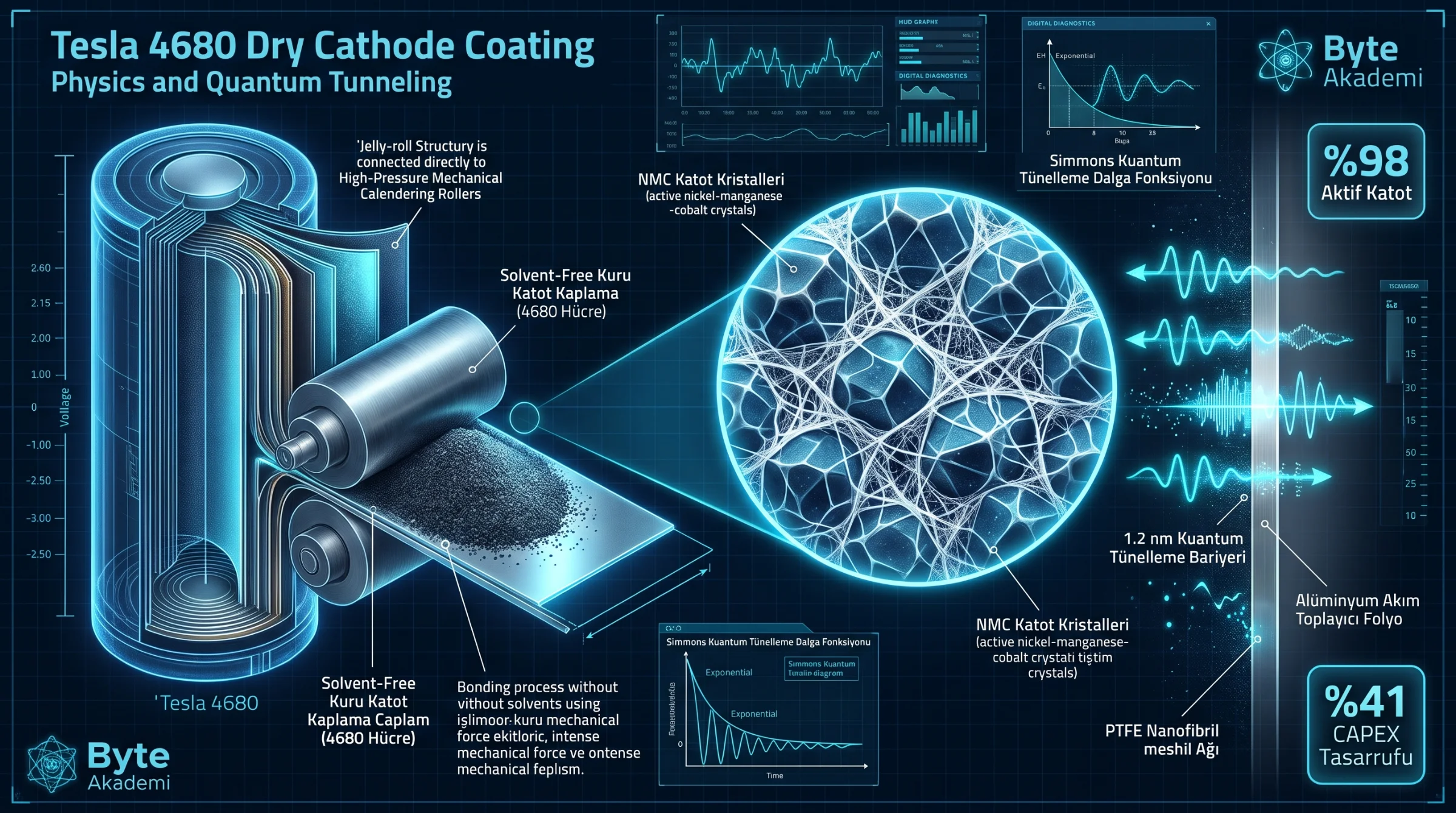
- Dry Coating & PTFE Shear Fibrillation: Tesla's Gen-2 dry cathode process eliminates liquid solvents entirely. Active cathode crystals, porous conductive carbon, and just 1% to 2% by weight of dry PTFE (Polytetrafluoroethylene) powder undergo high-shear jet milling. Under intense mechanical shear stress, PTFE polymer chains fibrillate—stretching into a sub-micron 3D "spider-web" matrix that mechanically traps active cathode particles without dissolving. Heated high-pressure calendering rolls then compress this powder directly into a free-standing film laminated onto the aluminum current collector in just three roller passes.
Inside a dry-coated 4680 cathode, electrons bypass insulating PTFE nanofibrils by leaping across 1.2-nanometer percolation gaps via quantum mechanical tunneling.
2. Quantum Dynamics: Electron Tunneling Across the Cathode-Foil Interface
While lithium-ion diffusion governs energy capacity (kWh), the instantaneous power delivery required for sub-3-second EV acceleration and 250 kW – 350 kW DC Supercharging is dictated by sub-nanometer electron transport physics across the cathode matrix.
Lithium-Nickel-Manganese-Cobalt-Oxide (NMC) crystals are poor electronic conductors, and the PTFE nanofibrils binding them together are wide-bandgap (~8 eV) dielectric insulators. According to classical physics, an insulating PTFE web wrapping conductive particles should block current flow. Instead, high-rate conduction in dry electrodes is governed by Quantum Mechanical Tunneling:
- 3D Percolation Threshold & Nanometric Gaps: High-pressure calendering consolidates the dry cathode film to densities exceeding 3.5 g/cm3 with a 97% – 98% active material fraction. Because there is no evaporating solvent to disturb the porous carbon backbone, conductive carbon nodes are locked within 0.8 to 1.8 nanometers (nm) of one another.
- Simmons Quantum Tunneling Conduction: When the insulating PTFE/oxide barrier thickness ($d$) between adjacent carbon-coated NMC particles is compressed below 2 nanometers, the electron's quantum wave function ($\psi$) does not decay to zero inside the dielectric barrier. Electrons traverse the insulating polymer gap via direct quantum tunneling.
- Eliminating Interfacial Schottky Barriers: In wet-coated cathodes, solvent evaporation voids at the aluminum foil interface widen the gap past 4 – 5 nm, causing tunneling current to collapse exponentially. In Tesla's dry lamination process, thermal-compression bonding forces the dry film into intimate atomic contact with the primer-coated aluminum foil, locking the tunneling barrier below 1.5 nm and minimizing polarization during extreme fast charging.
// SIMMONS QUANTUM TUNNELING CURRENT DENSITY IN DRY CATHODE NETWORKS
J_tunnel = (e^2 / (2 * pi * h * d^2)) * (Phi_B * exp(-A * d * sqrt(Phi_B)))

// EXPONENTIAL DEPENDENCE OF TUNNELING CONDUCTANCE ON GAP DISTANCE (d):
G_quantum(d) = G_0 * exp( - (2 * d / h_bar) * sqrt(2 * m_e * Phi_B) )

J_tunnel : Quantum Tunneling Current Density (A/cm²)
d        : Inter-particle PTFE Dielectric Barrier Width (0.8 nm - 1.8 nm)
Phi_B    : Effective Potential Barrier Height of PTFE/Interface (eV)
m_e      : Effective Electron Mass (9.11 x 10^-31 kg)
h_bar    : Reduced Planck Constant (1.054 x 10^-34 J.s)

// ENGINEERING RESULT: Compressing gap distance 'd' from 3.0 nm down to 1.2 nm
// via 3-pass calendering increases quantum tunneling conductivity by ~10,000x!
[Wet Slurry Coating vs. Tesla 4680 Dry Coating: Quantum Electron Percolation]
WET SLURRY COATING (NMP Solvent) TESLA 4680 DRY COATING (PTFE Fibrils)
+-----------------------------------+ +-----------------------------------+
| Top Surface: Migrated PVDF Layer | | Uniform 98% Active NMC811/955 Mass|
| (High Interfacial Resistance) | | [o]--(~1.2nm Tunneling)--[o] |
| [o] (Broken) [o] | | | (3D PTFE Spider-Web) | |
| \ d > 5 nm (No Tunneling)| | [o]--(~1.2nm Tunneling)--[o] |
|=================[Voids]===========| |===================================|
| Aluminum Current Collector | | Aluminum Foil (Ohmic Contact) |
+-----------------------------------+ +-----------------------------------+3. Manufacturing Efficiency & Electrochemical Performance Comparison
| Engineering & Production Metric | Conventional Wet Slurry Process (NMP) | Tesla 4680 Dry Cathode Process (DBE) |
|---|---|---|
| Solvent & Drying Infrastructure | Toxic NMP Solvent + 150m Thermal Ovens | 0% Solvent (Direct Dry Powder Lamination) |
| Binder Load & Active Material Fraction | 3% – 5% PVDF Binder (94%–95% Active Mass) | 1% – 2% Fibrillated PTFE (97%–98% Active Mass) |
| Calendering Compression Passes | 10+ Roller Passes / Multi-Stage Drying | 3 Roller Compression Passes (3x Throughput) |
| Quantum Tunneling Gap (d) | Non-Uniform (2.5 nm – 8.0 nm / Binder Segregation) | Uniform & Locked (0.8 nm – 1.8 nm Percolation) |
| Gravimetric Energy Density & Cycle Life | ~240 – 250 Wh/kg | 260 Wh/kg (340 Wh/kg Roadmap) / 90% at 2,000 Cycles |
| Equipment CAPEX & Factory Footprint | 100% Baseline Cost & Massive Utility Load | 41% Lower Equipment CAPEX & Up to 50% Process Savings |
4. Q&A: Key Engineering Questions on Tesla's 4680 Dry Battery Technology
Q1: How does dry electrode technology impact real-world EV battery longevity and fast charging?
A: Because dry coating eliminates binder migration and locks conductive carbon into a uniform quantum-tunneling network, thick 4680 cathodes exhibit significantly lower polarization at high discharge and charge rates. Testing demonstrates 90% capacity retention after 2,000 full charge-discharge cycles (equivalent to ~600,000 miles of EV driving), drastically enhancing long-term EV resale value and battery warranty reliability.
Q2: Why did scaling dry cathode production take nearly eight years to perfect?
A: Unlike softer graphite anodes, lithium-metal-oxide (NMC) cathode powders are ceramic-hard and abrasive. Under intense calendering pressure, early rollers suffered severe mechanical deflection, metal contamination, and film cracking. By re-engineering the dry mixing sequence and utilizing tailored molecular-weight PTFE powders under high-shear jet milling, production lines achieved the critical 92%+ manufacturing yield threshold.
Q3: Why is dry coating the mandatory bridge to next-generation All-Solid-State Batteries (ASSBs)?
A: Sulfide-based solid-state electrolytes (such as argyrodite) react violently with polar liquid solvents used in wet slurry processing, degrading ionic conductivity and releasing toxic gas. Tesla's solvent-free dry film lamination is the exact manufacturing architecture required to mass-produce future solid-state EV battery packs.