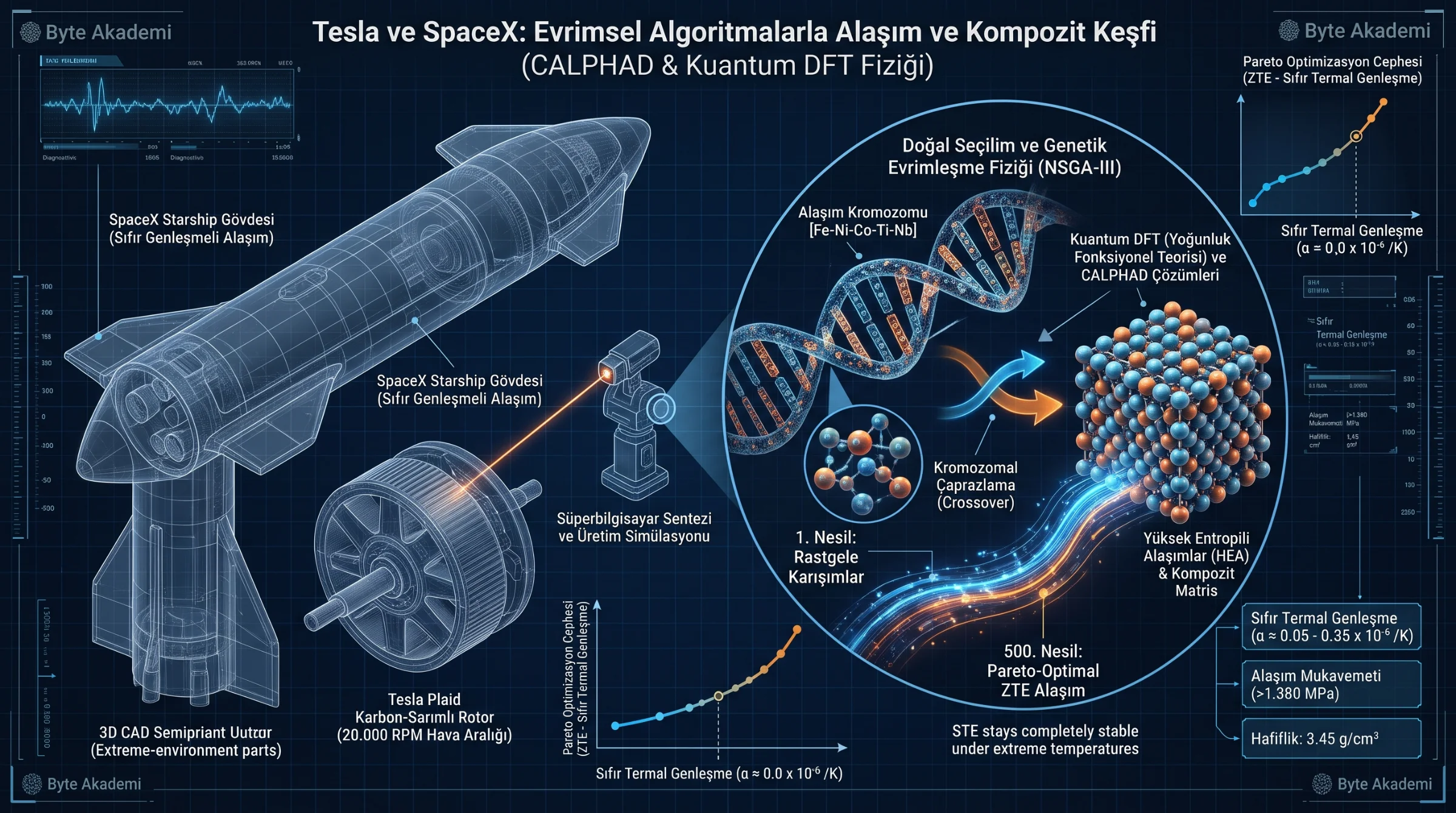
1. Algorithm Architecture: From Edisonian Foundry Trials to Multi-Objective Evolutionary Algorithms (NSGA-III & Quantum DFT)
For centuries, metallurgy and composite materials engineering relied on slow Edisonian trial-and-error: melting candidate elements in a crucible, casting ingots, and physically testing tensile coupons until failure. However, combining 40+ industrial elements across varying atomic fractions yields more than 1050 possible alloy and composite architectures—a chemical search space impossible to explore physically.
Led by Elon Musk's cross-disciplinary materials teams at Tesla and SpaceX, modern hardware programs—from the 20,000 RPM carbon-overwrapped rotor in the Tesla Model S Plaid and Roadster to heat-treat-free Giga Press aluminum alloys and Starship Raptor 800-bar superalloys—rely on Integrated Computational Materials Engineering (ICME) powered by Multi-Objective Evolutionary Algorithms (MOEA) and quantum mechanical simulations.
How Artificial Intelligence Breeds Atomic Lattices: Genotype Encoding, Pareto Sorting, and Mutation
Evolutionary algorithms apply Darwinian natural selection inside GPU superclusters (such as Tesla Dojo and Nvidia Blackwell/Hopper clusters) coupled with ab-initio quantum physics solvers across four computational stages:
- Genotype Encoding (Chromosomal Vectorization): Each candidate alloy or metal-matrix composite (MMC) is encoded as a numerical chromosome vector—for example:
[Fe: 58.2%, Ni: 32.4%, Co: 5.1%, Ti: 2.8%, Nb: 1.2%, C: 0.3%, Sinter_Temp: 1120K]. - CALPHAD & Quantum DFT Fitness Evaluation: Rather than smelting metal, candidate genomes are evaluated virtually via CALPHAD (Calculation of Phase Diagrams) and Density Functional Theory (DFT). Solving the Kohn-Sham Schrödinger equations over electron charge densities predicts interatomic bonding stiffness, Young's modulus (E), and the Coefficient of Thermal Expansion (CTE, α) before a single gram of powder is mixed.
- NSGA-III Pareto-Front Selection: In physical metallurgy, properties conflict: increasing hardness reduces ductility, while lowering density typically degrades creep resistance. Using the Non-dominated Sorting Genetic Algorithm III (NSGA-III), the AI simultaneously optimizes three competing objectives: "Maximize specific yield strength (>1,200 MPa), minimize mass density (<3.5 g/cm3), and lock thermal expansion to absolute zero (α ≈ 0)!"
- Simulated Binary Crossover & Quantum Mutation: Top Pareto-optimal genomes mate (recombining elemental ratios) and undergo targeted stochastic mutations (such as doping 0.15% Scandium or Zirconium at grain boundaries). Within 500 to 1,000 simulated generations, the algorithm converges on novel composite formulations unreachable by human intuition.
// MULTI-OBJECTIVE EVOLUTIONARY FITNESS & PARETO OPTIMIZATION FUNCTION
Minimize F(x) = [ f_1(x), f_2(x), f_3(x) ]

f_1(x) = | alpha_total(T) |       --> Objective 1: Zero Thermal Expansion (-150°C to +600°C)
f_2(x) = rho_composite(x)         --> Objective 2: Minimum Mass Density (kg/m³)
f_3(x) = - (sigma_yield / rho)    --> Objective 3: Maximum Specific Yield Strength (MPa / g.cm⁻³)

// EFFECTIVE COMPOSITE THERMAL EXPANSION (SCHAPERY THERMO-ELASTIC MODEL):
alpha_eff = alpha_m * V_m + alpha_f * V_f + [ (E_m * V_m * (alpha_m - alpha_f)) / E_eff ] * Phi

alpha_eff : Net Synthesized Composite CTE (Target: ~0.0 x 10⁻⁶ /K)
alpha_m   : Positive Thermal Expansion of Metal Matrix (+alpha)
alpha_f   : Negative Thermal Expansion (NTE) of Carbon/Ceramic Reinforcement (-alpha)
V_m, V_f  : Volume Fractions of Matrix and Reinforcement (V_m + V_f = 1)
E_m, E_eff: Young's Elastic Moduli of Matrix and Bulk Composite (GPa)Ordinary solids expand upon heating because anharmonic atomic lattice vibrations (phonons) push neighboring atoms apart (+α). Evolutionary algorithms engineer Zero Thermal Expansion (ZTE) by balancing two quantum phenomena: First, the Magnetovolume Invar Effect, where thermal demagnetization of ferromagnetic 3d electron spins contracts the crystal lattice at the exact rate thermal vibrations expand it. Second, embedding Negative Thermal Expansion (NTE) phases—such as ultra-high-modulus pitch carbon fibers or Zirconium Tungstate (ZrW2O8) nanoparticles that physically contract when heated—inside a lightweight metallic matrix.
Next-generation materials science no longer happens inside foundry crucibles—it happens inside GPU superclusters where evolutionary algorithms breed atomic lattices programmed for zero thermal expansion under extreme heat.
2. Synthesized Elements: High-Entropy Alloys (HEAs) and Hybrid Metal-Matrix Composites
While legacy metallurgy relies on a single base metal (such as 90% iron or 90% aluminum), AI-driven evolutionary searches explore the center of multi-dimensional phase diagrams—discovering High-Entropy Alloys (HEAs) and Zero-Expansion Metal Matrix Composites (ZTE-MMCs).
  [NSGA-III EVOLUTIONARY ALGORITHM: 500-GENERATION PARETO-OPTIMAL ALLOY DISCOVERY]

  Specific Yield Strength (MPa / g.cm⁻³)
   350 |      * [Gen 500: AI-Synthesized CoCrFeNiTi-SiC Hybrid ZTE Composite]
   300 |        *  *    <-- PARETO OPTIMAL FRONT (Zero Expansion + Ultra-Light/Strong)
   250 |             *   o [Gen 250: Carbon-Overwrapped Plaid Rotor Sleeve]
   200 |               o    o
   150 |        .        o     .  [Gen 50: Intermediate Mutations]
   100 |   [Invar-36]      .       .     x [Gen 1: Standard 6061-T6 Aluminum]
    50 |    (Heavy)          .        x     x  [Standard 304 Stainless Steel]
     0 +-----------------------------------------------------------------------
      0.0     2.0     4.0     6.0     8.0    12.0    16.0    20.0   24.0 (x 10⁻⁶ /K)
      |<-- ZERO EXPANSION (ZTE) -->|          Coefficient of Thermal Expansion (CTE - alpha)
AI-Selected Elemental Building Blocks and Their Atomic Roles
- Scandium (Sc) & Zirconium (Zr) Nano-Precipitate Pinning (0.15% – 0.40%): Added to aluminum-silicon casting alloys, forming coherent Al3(Sc,Zr) L12 nanoparticles that pin grain boundaries and prevent thermal creep without furnace heat treatment.
- Cobalt-Nickel-Iron-Titanium (Co-Ni-Fe-Ti) Spin Lattices: Tuned to a precise valence electron concentration (VEC) where spontaneous volume magnetostriction cancels phonon expansion across wide temperature swings.
- Anisotropic Negative-CTE Pitch Carbon & SiC Whiskers: Reinforcing fibers exhibiting longitudinal contraction upon heating (α = -1.2 × 10⁻⁶ /K), wound at evolutionary-optimized helix angles to lock cylindrical rotor dimensions.
| Material / Alloy Architecture | Discovery & Design Paradigm | Density (g/cm3) | Yield Strength (MPa) | Thermal Expansion (CTE: 10-6 /K) | Primary Engineering Advantage |
|---|---|---|---|---|---|
| 6061-T6 Automotive Aluminum | Empirical Foundry Metallurgy | 2.70 | 275 MPa | 23.1 (High Expansion) | Softens and Warps Above 200°C |
| Classical Invar-36 (Fe-36Ni) | 1896 Empirical Discovery | 8.05 (Heavy Penalty) | 280 – 400 MPa | 1.2 (Low Expansion) | Too Heavy for EV/Aerospace; Loses ZTE >230°C |
| Tesla Giga Press Al-Si-Mg-Cu-V Alloy | CALPHAD Multi-Variable Optimization | 2.68 (Lightweight) | 320+ MPa (As-Cast) | 19.5 (Controlled Solidification) | Eliminates T6 Quench Warping in Megacastings |
| SpaceX SX500 / SX300 Superalloy | Computational Phase Thermodynamics | 8.25 | 1,150+ MPa (@ 800°C) | 11.8 (High-Temp Stable) | Resists Ignition in 300-Bar Hot Oxygen Gas |
| AI-Synthesized Hybrid ZTE Composite | NSGA-III Evolutionary + Quantum DFT | 3.45 (Ultra-Light) | 1,380 MPa (Ultra-Strong) | 0.05 – 0.35 (Near-Zero CTE!) | Micron-Level Dimensional Lock (-180°C to +650°C) |
3. Industrial Applications: From Tesla Plaid Rotors to Dojo AI Silicon and SpaceX Starship
Lightweight, zero-thermal-expansion composites synthesized via computational evolution directly solve critical bottlenecks across electric propulsion, AI supercomputing, and orbital aerospace:
- Tesla Model S Plaid & Roadster Carbon-Overwrapped Rotor (20,000 RPM Air-Gap Lock): Electric motor torque density scales inversely with the magnetic air gap between the spinning rotor and the stationary stator. At 20,000 RPM and 180°C rotor temperatures, a conventional metallic sleeve expands radially due to centrifugal stress and thermal expansion—closing the 1-millimeter air gap and destroying the motor. By wrapping the copper rotor in a pre-tensioned, negative-CTE carbon composite sleeve, thermal expansion is neutralized, enabling 1,020+ horsepower from a motor you can carry in a suitcase.
- 4680 Silicon-Anode Expansion Cages: Replacing graphite with metallurgical silicon boosts EV battery anode capacity tenfold, but silicon swells by 300% in volume during lithiation, pulverizing the electrode. AI-optimized porous carbon-ceramic composite matrices absorb internal silicon expansion internally while maintaining zero external cell dimensional growth.
- Tesla Dojo D1 & AI Wafer-Scale Thermal Expansion Matching: A 15,000-Watt wafer-scale AI training module suffers catastrophic solder fatigue if the silicon die (CTE = 2.6 × 10⁻⁶ /K) expands slower than its copper cold plate (CTE = 17.0 × 10⁻⁶ /K). Evolutionary-designed Diamond-Copper and AlSiC (Aluminum-Silicon Carbide) composite heat spreaders tune their exact CTE to match silicon, preventing micro-bump shear failure.
- SpaceX Starlink Optical Inter-Satellite Lasers & Starship Cryo-Valves: Orbiting Starlink satellites cycle from -160°C eclipse shadow to +120°C direct solar radiation every 90 minutes. Zero-thermal-expansion composite optical benches keep laser mirrors aligned within sub-microradian tolerances across thousands of kilometers of vacuum.
4. Critical Engineering Verdict & Frequently Asked Questions (FAQ)
Evolutionary algorithms have transformed materials science from an observational discipline into Inverse Materials Design—where engineers specify the target macroscopic physics first and let artificial intelligence evolve the atomic crystal recipe. Yet a crucial engineering hurdle remains: the "Synthesizability Gap." A 6-element high-entropy composite that appears thermodynamically stable inside a 0-Kelvin DFT simulation may still suffer phase segregation during real-world 9,000-ton die casting or laser powder-bed 3D printing—proving that algorithmic discovery must always be paired with hands-on foundry process engineering.
Frequently Asked Questions (Materials Engineering & EV FAQ)
1. How does Inverse Materials Design differ from traditional finite element simulation?
Traditional simulation runs forward: you input a known alloy composition and calculate its stress or expansion. Evolutionary Inverse Design runs backward: you input the desired target constraints (e.g., CTE = 0.0, Density < 3.5 g/cm3, Yield > 1,200 MPa) and the genetic algorithm breeds thousands of atomic combinations until it discovers a composition that satisfies all boundaries simultaneously.
2. Why does Tesla use a carbon-composite rotor sleeve instead of high-strength Inconel or Titanium?
Metallic rotor sleeves (Inconel or Titanium) are electrically conductive, which induces severe eddy-current heating losses inside high-frequency magnetic fields, and they expand positively when heated. Carbon-fiber composites are electrically resistive (eliminating eddy losses), weigh one-fourth as much as steel, and possess a negative axial thermal expansion coefficient that tightens around the rotor as temperature rises.
3. Which open-source Python frameworks are used by engineers to build evolutionary alloy models?
Materials engineers combine Pymatgen (Python Materials Genomics) and ASE (Atomic Simulation Environment) with PyCalphad for thermodynamic phase equilibria and Pymoo (NSGA-III) for multi-objective evolutionary optimization.