As an electrical and electronics engineer studying high-power semiconductor designs, you keep running into one unchanging law of nature: "Compute capacity depends not on the limits of silicon, but on the heat flux that can be removed per unit area." For years, data center servers running in the 400W–700W TDP (Thermal Design Power) band could be cooled, if only just, with huge air ducts and high-RPM fan arrays. But with NVIDIA’s Blackwell B200 architecture, the silicon industry has finally hit the physical limit of air: the inevitable Thermal Wall.
A heat load climbing to 1,000W to 1,200W in a single GPU package has turned conventional air cooling from a choice into a physical impossibility. The industry now has to accept Direct-to-Chip Liquid Cooling (DLC) not as an optional luxury but as a mandatory engineering standard. Starting from TSMC's CoWoS-L packaging architecture, let's use thermodynamic equations to see why air has failed and what bill this sends to the grid infrastructure of data centers, following a Source → Analysis → Conclusion discipline.
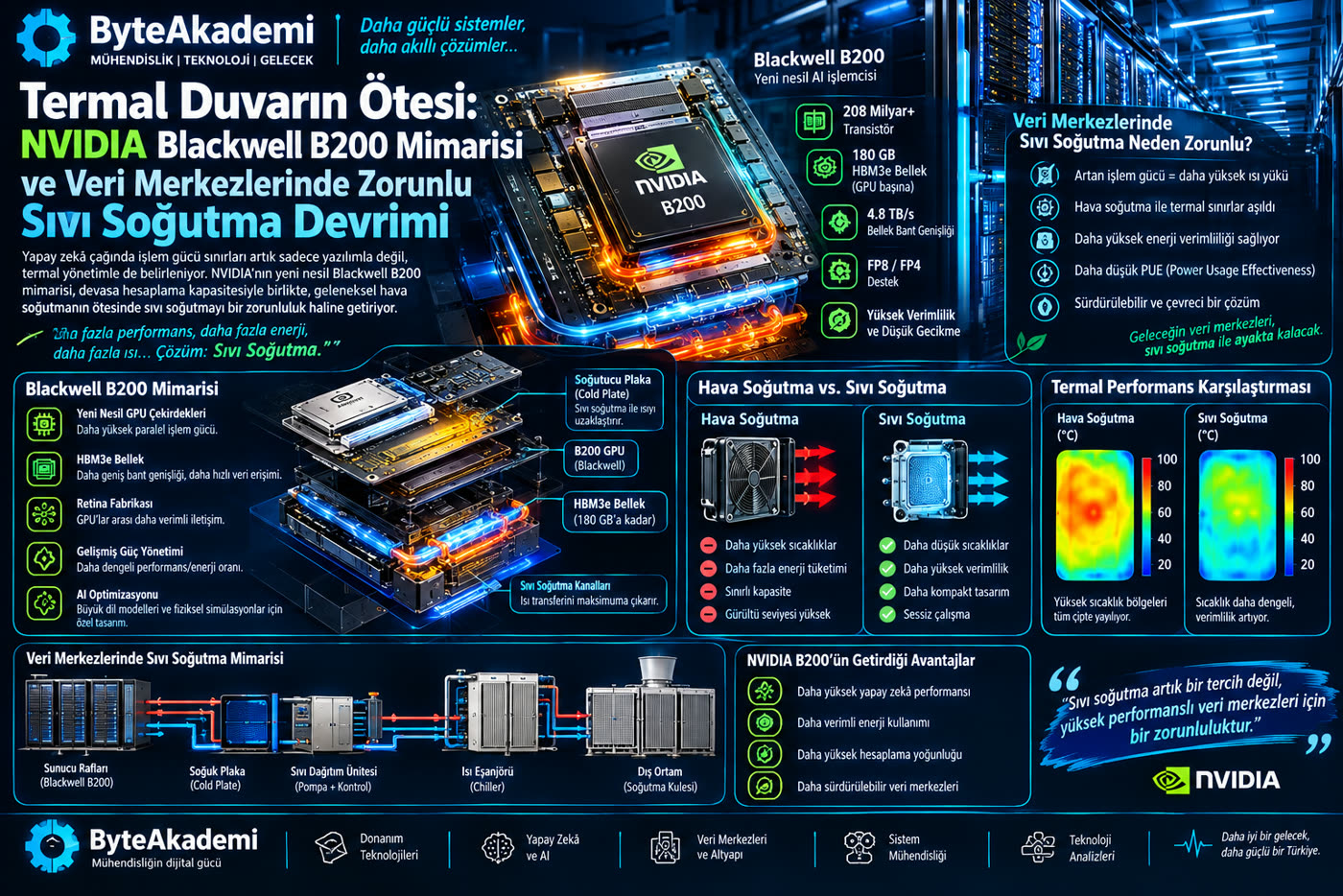
Blackwell B200 generates 1200W of heat across a massive dual-die, 208-billion-transistor silicon area, permanently breaking through the limit of air cooling.
1. Source and Silicon Architecture: The End of the Reticle Limit and CoWoS-L
In photolithography tools, the maximum area that can be exposed in a single shot is limited by lithography rules to roughly 858 mm² (Reticle Limit). To push the transistor count to 208 billion with Blackwell B200, NVIDIA had to abandon single-piece monolithic die manufacturing:
- TSMC 4NP Process: Two separate full-reticle-size dies, built with a custom-optimised 4-nanometer-class EUV lithography process, are joined on a single substrate.
- 10 TB/s NVLink-C2C Interface: The two dies are connected using TSMC CoWoS-L (Chip-on-Wafer-on-Substrate with Local Silicon Interconnect) advanced packaging. This link delivers 10 terabytes per second of bidirectional bandwidth with no added latency, so at the software layer the two dies behave like a single monolithic chip.
- 192 GB HBM3e Memory Stack: Eight 24 GB HBM3e stacks arranged around the chip reach 8 TB/s of memory bandwidth, while creating an enormous cluster of thermal density at the edges of the processor package.
2. Thermodynamic Analysis: The Physical Failure of Air and Heat Flux
The issue is not only the total power consumed (1,200 watts); the real problem is how small the area generating that power is. On the B200's silicon surface, heat flux exceeds the 100 W/cm² threshold. That density rivals the surface heat flux of a typical nuclear reactor fuel rod.
Let's look at the fundamental heat transfer equation:
Here Q is the heat energy transferred, ṁ is the mass flow rate, Cp is the specific heat of the fluid and ΔT is the temperature difference. Put the thermophysical properties of the two cooling media side by side and the picture becomes clear:
- Air: Density ≈ 1.2 kg/m³, Specific Heat (Cp) ≈ 1.005 kJ/kg·K. Volumetric Heat Capacity: ~1.2 kJ/m³·K
- Water (Liquid Coolant): Density ≈ 1,000 kg/m³, Specific Heat (Cp) ≈ 4.184 kJ/kg·K. Volumetric Heat Capacity: ~4,184 kJ/m³·K
Water's volumetric heat-carrying capacity is a full 3,486 times that of air. To pull 1200 watts of heat out of a piece of silicon the size of the B200 with air, you would have to push a massive airflow through the server cabinet at jet-engine noise levels. That would make the electrical energy consumed by the fans exceed the energy consumed by the processor, and the thermal resistance (Rth) would shoot the silicon above its 85°C ceiling.
Blackwell B200 Cooling Architectures Analysis Matrix
| Engineering Criterion | Forced Air Cooling (Air Cooled) | Direct Liquid Cooling (Direct-to-Chip DLC) |
|---|---|---|
| Maximum Heat Removal Capacity | ~700W - 800W (Critical ceiling) | > 1,500W - 2,000W (Wide thermal margin) |
| Rack Power Density | 35 kW - 40 kW / Cabinet | 120 kW - 140 kW / Cabinet (NVL72 Rack) |
| Data Center PUE | 1.40 - 1.60 (High cooling waste) | 1.10 - 1.18 (High energy savings) |
| Coolant Supply Temperature (FWS) | 18°C - 22°C Conditioned Cold Air | 35°C - 45°C Warm Water (Compressor-Free Solution) |
3. Conclusion and the System-Level Bill: The PUE Revolution in Data Centers
As we saw in our earlier iPhone 18 Pro Max vapor chamber analysis, closed-loop phase change rescues the silicon in mobile devices; in mega data centers, the solution is to pump liquid straight into the server through pipes.
As an electrical engineer, let me spell out the bill at the bottom of the table: Blackwell B200's NVL72 cabinet system, housing 72 GPUs, draws 120 kilowatts on its own. If you tried to cool this cabinet with air, you would need an extra 50 kW of chiller capacity per cabinet. With direct liquid cooling, coolant temperatures of up to 45°C can be tolerated (ASHRAE W45 class). This makes it possible to take energy-hungry compressor-based refrigerant chillers out of the loop and use free-cooling towers instead.
Final Engineering Verdict: Although liquid cooling raises the initial investment (CapEx) by 30% because of piping, manifolds and leak detection sensors, it pays for itself in 18 months on the operating side (OpEx) by bringing the data center's Power Usage Effectiveness (PUE) down from 1.55 to 1.15. Blackwell B200 is not a graphics card; it is an industrial transformer that the laws of thermodynamics are using to force a rewrite of data center architecture.
- NVIDIA Corporation: "NVIDIA Blackwell Architecture Technical Brief & GB200 NVL72 System Architecture" (2024).
- TSMC: "CoWoS (Chip-on-Wafer-on-Substrate) Advanced Packaging Technology Roadmap", IEEE ECTC Technical Proceedings.
- ASHRAE TC 9.9: "Thermal Guidelines for Data Processing Environments - Liquid Cooling Classes (W17 to W45)" Standard.
- Open Compute Project (OCP): "Direct to Chip Water Cooling Interoperability and Manifold Standards".
As the power consumption of AI models climbs from kilowatts to megawatts, do you think we will see liquid-cooled campuses wired directly to nuclear power plants? Join our thermal engineering table with your comments!