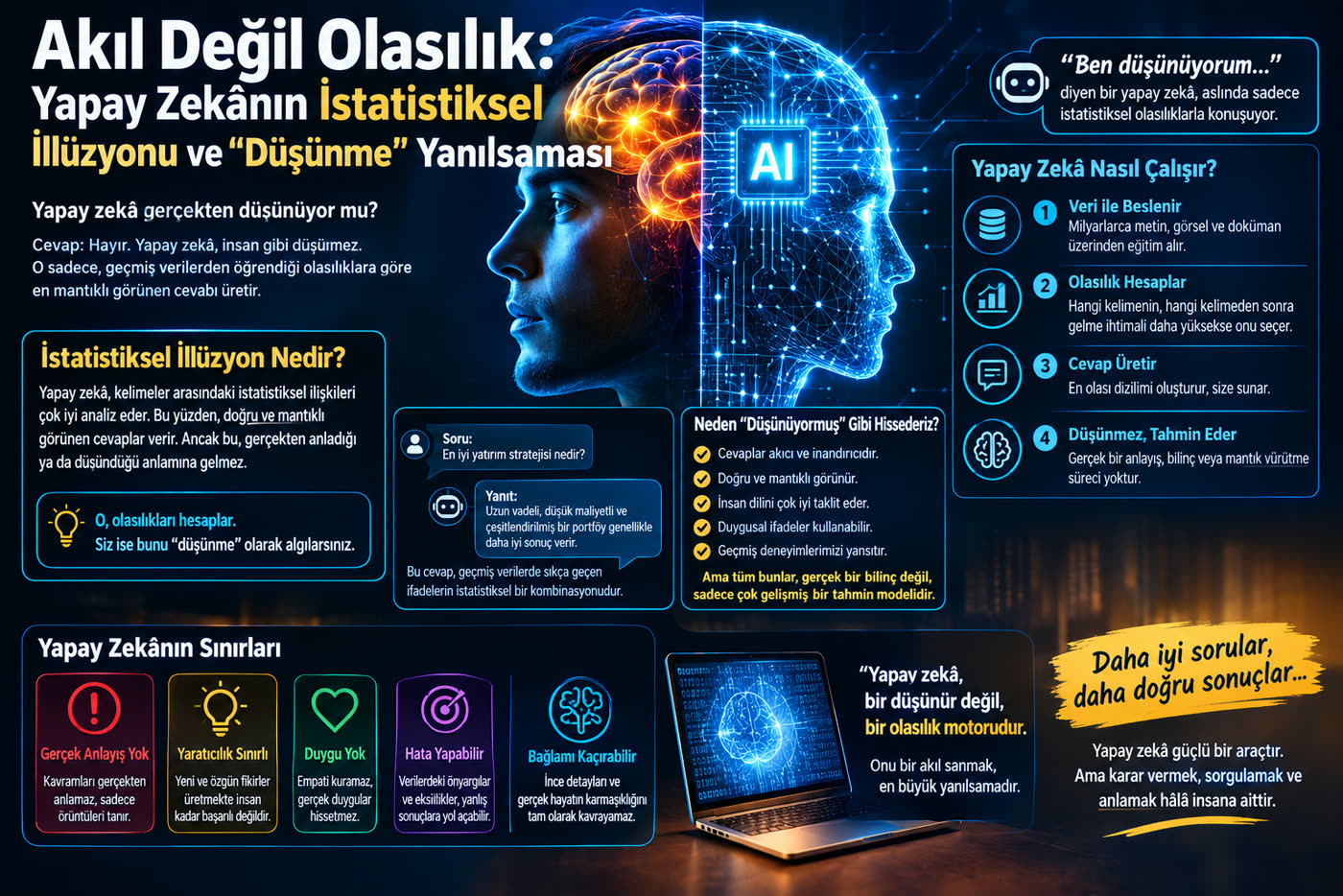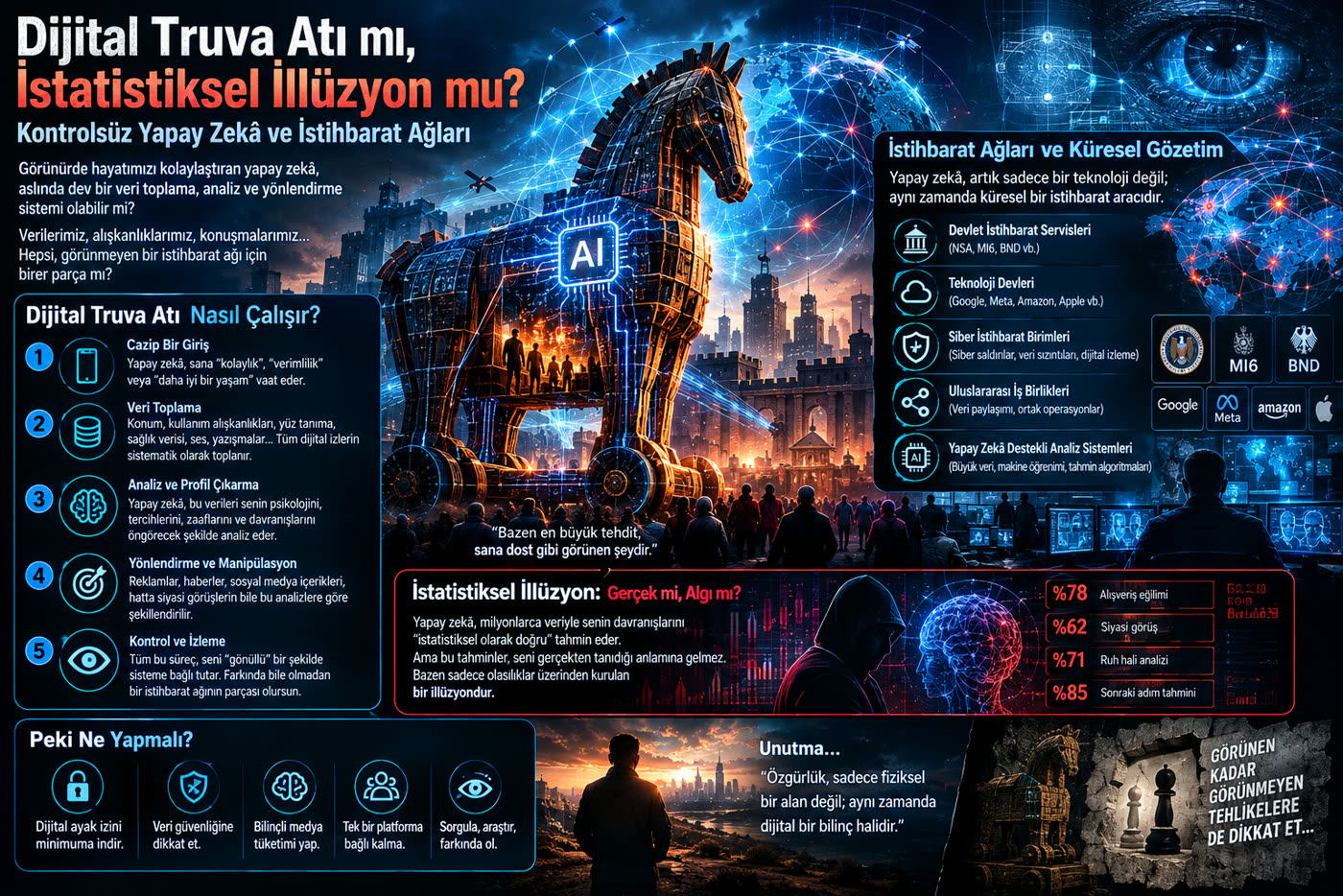
Whenever AI comes up in movies, two extreme scenarios always spring to mind: either the witty, loyal robot TARS from Interstellar, or the cold Skynet of the Terminator universe that codes humanity as a threat. Today, when we sit at the keyboard and chat with an AI model, the answers we get are so human and so seamless that it's easy to feel a thinking consciousness really exists behind the screen.
So is a "spark of thought" really flashing behind the curtain, or are Silicon Valley's brightest engineers pulling off the most spectacular magic trick in history? Let's dive into the neural networks of large language models (LLMs) and work out the mechanics of this digital illusion.
The projection of words in a mathematical universe: algorithms that produce meaning from numbers.
The Smart Parrot Theory: Does It Only Know the Next Word?
To define AI in its simplest form, we could call it a probability monster. When you type a message, the model doesn't actually "understand" how you feel or the philosophical depth of your question. All it does is calculate, across trillions of parameters and enormous datasets, what the next word should mathematically be.
For example, when you write "Better late than...", the model looks at the weights in its memory and determines that the next word is "never" with 99.8% probability. But the revolution that sets today's models apart from an ordinary autocomplete tool lies in an architecture introduced in 2017: the Transformer and the Attention Mechanism.
"When an AI reads a text, it doesn't just look at the words; it calculates the invisible links between every word in a sentence and every other word."
From Words to Coordinates: A High-Dimensional Space of Meaning
How does a computer store the concept of "cat" or "love"? The answer: embedding vectors. For an AI, every word is a single point in a vast mathematical space made up of thousands of dimensions.
In this space, words with similar meanings are neighbors. For the model, the following equation is pure mathematical fact: Vector("King") - Vector("Man") + Vector("Woman") = Vector("Queen"). The model doesn't empathize like a human, but by solving the distances between concepts with geometry, it becomes able to reason as consistently as a person.
- Tokenization: Breaking sentences down into sub-word pieces or numeric blocks (tokens).
- Self-Attention: The model working out from context which subject at the start of a sentence a pronoun at the end refers to.
- RLHF (Reinforcement Learning from Human Feedback): The human touch that keeps the model from talking nonsense and helps it give ethical, useful answers.
So Where Does All This Run? The Hardware Reality
Conventional processors fall short when billions of parameters have to perform these massive matrix calculations simultaneously. To train these models, tens of thousands of advanced graphics cards and dedicated AI chips consume electricity day and night for weeks.
If you'd like to understand how these enormous algorithms are fed by architectures at the atomic scale, take a look at our earlier review, Next-Generation Chip Architectures and the Hardware Revolution, to see how the limits of physics are being pushed.
Conclusion: Consciousness, or a Giant Mirror?
For now, AI doesn't get hungry, tired or afraid, nor does it suffer existential pain. It is a giant mirror of all the written culture, philosophy, code and emotion that humanity has poured onto the internet. However smart it seems to the person in front of it, that is because the human intelligence fed into it is just as rich.
Perhaps they don't yet have a consciousness that makes its own decisions, as in the series Westworld; but even the mathematical predictive power we have today is more than enough to set off the greatest technological leap in human history.
Do you think a system that only calculates probabilities could one day truly learn to "feel" or to have "free will"? Or will it all remain nothing more than numbers? Let's discuss in the comments!