In spy films we often see hackers break into a mobile phone within seconds, empty every bank account or copy facial recognition data. In everyday life, the malware and phishing attacks our mobile devices are exposed to keep feeding this fear.
Yet at the heart of modern smartphones lies a hidden, physically isolated world where even the operating system has no say. Why can't your fingerprint, passwords and cryptographic keys be stolen even if the operating system (the Android kernel) is completely compromised? We examine, through an engineering lens, this line of defence that has shifted from software to hardware over the course of the evolution of the Android operating system.
Physical isolation: hardware armour against the storms of the software world.
Why Isn't a Software Shield Enough? What Happens When the Kernel Is Broken?
In conventional computer architecture, firewalls and antivirus software essentially run at the operating system kernel level (Ring 0). But when an attacker finds a zero-day vulnerability in the kernel and escalates privileges (Root/Jailbreak), they can theoretically access all unencrypted data in memory (RAM).
To eliminate this risk, engineers found the solution not in the software layer but directly in silicon design: the Hardware Root of Trust.
"Even the most secure operating system can contain software bugs; but fooling a crypto core locked inside a physically separate data bus would defy the laws of nature."
Two Different Worlds: ARM TrustZone and the TEE
The ARM processors powering billions of smartphones today create two parallel universes on a single silicon die:
- Normal World (Rich Execution Environment - REE): The general space where the Android interface, games and every app you download run.
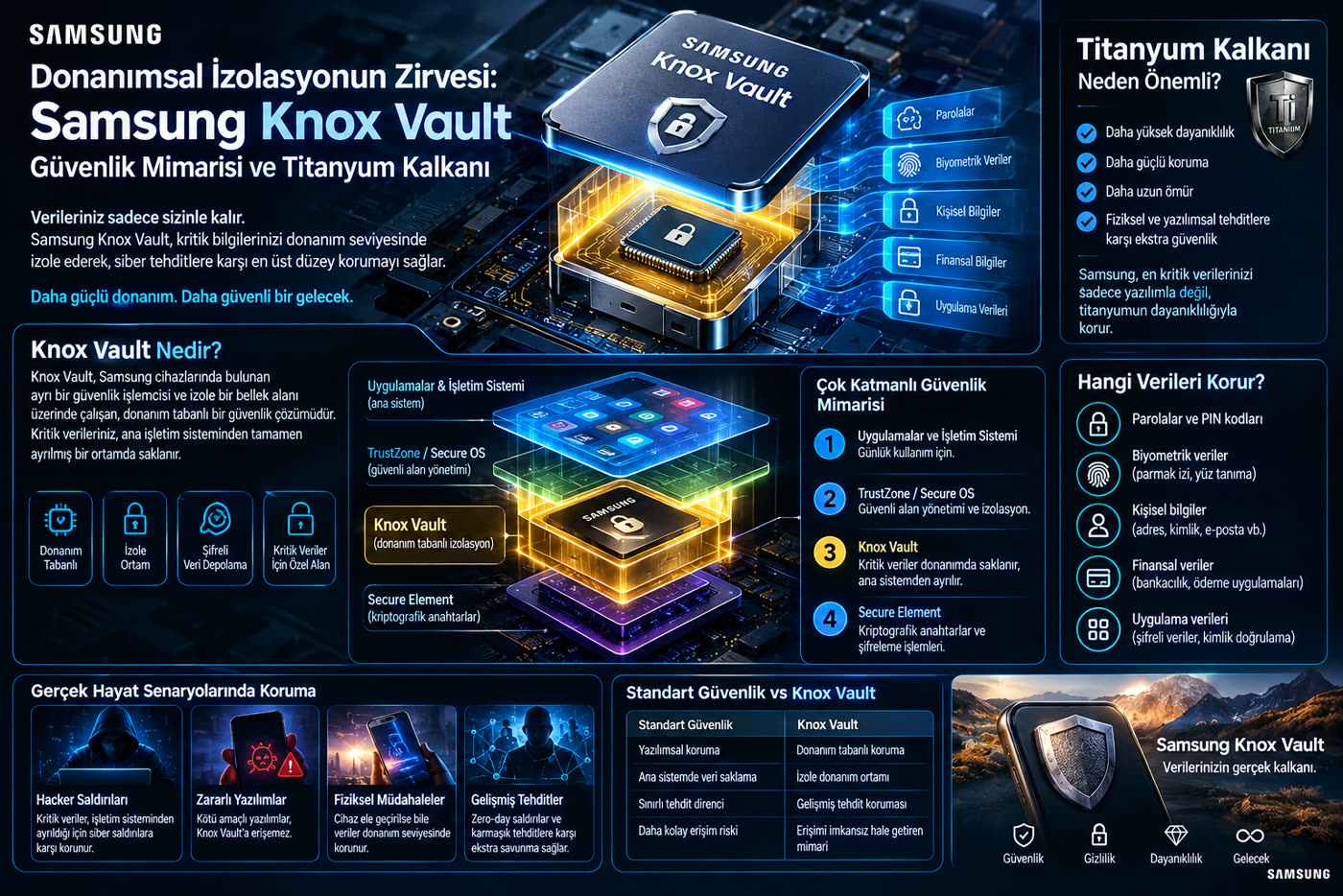
- Secure World (Trusted Execution Environment - TEE): A physically isolated sandbox with its own independent micro operating system (Trusty OS).
When you touch the in-display fingerprint sensor, the raw fingerprint data is never passed to the Android side. The hardware switch (at the AXI bus level) moves to the Secure World; the data is verified there, and only a single-bit confirmation signal in the form of "Authentication Successful: Yes/No" is returned to Android.
- eFuses (Electronic Fuses): Microscopic lines that physically blow, irreversibly, when the device's bootloader lock is broken.
- Dedicated Security Chip (Titan M2 / Knox Vault): An independent microcontroller running on a PCB path completely separate from the main SoC (processor), resistant to side-channel power analysis.
- PUF (Physically Unclonable Function): An impossible-to-copy digital chip fingerprint that arises from microscopic silicon imperfections during the chip's manufacture.
Defending Against Physical Attacks: Side-Channel Analysis
Advanced hardware hackers don't only look for software vulnerabilities; they try to crack keys by measuring, with oscilloscopes, the current fluctuations the chip draws while encrypting (DPA - Differential Power Analysis).
When next-generation chip architectures are designed, artificial noise generators and clock frequency scramblers are added to these cryptographic blocks. So even if the circuit is eavesdropped on from outside, all an attacker gets is meaningless electrical noise.
Conclusion: The Greatest Fortress Is the Silicon Itself
Although a new type of malware emerges in the mobile world every day, what actually keeps the banking and identity security of our devices standing is not antivirus apps but these microscopic hardware vaults on the mainboard.
The security standards of the future, meanwhile, are preparing for a much tougher test: in a world where quantum computers threaten today's RSA and ECC encryption algorithms, post-quantum cryptographic chips are already at our door.
Do you think hardware security chips can make our devices completely untouchable, or could new AI-powered attack vectors break through these hardware barriers too? Let's discuss in the comments!