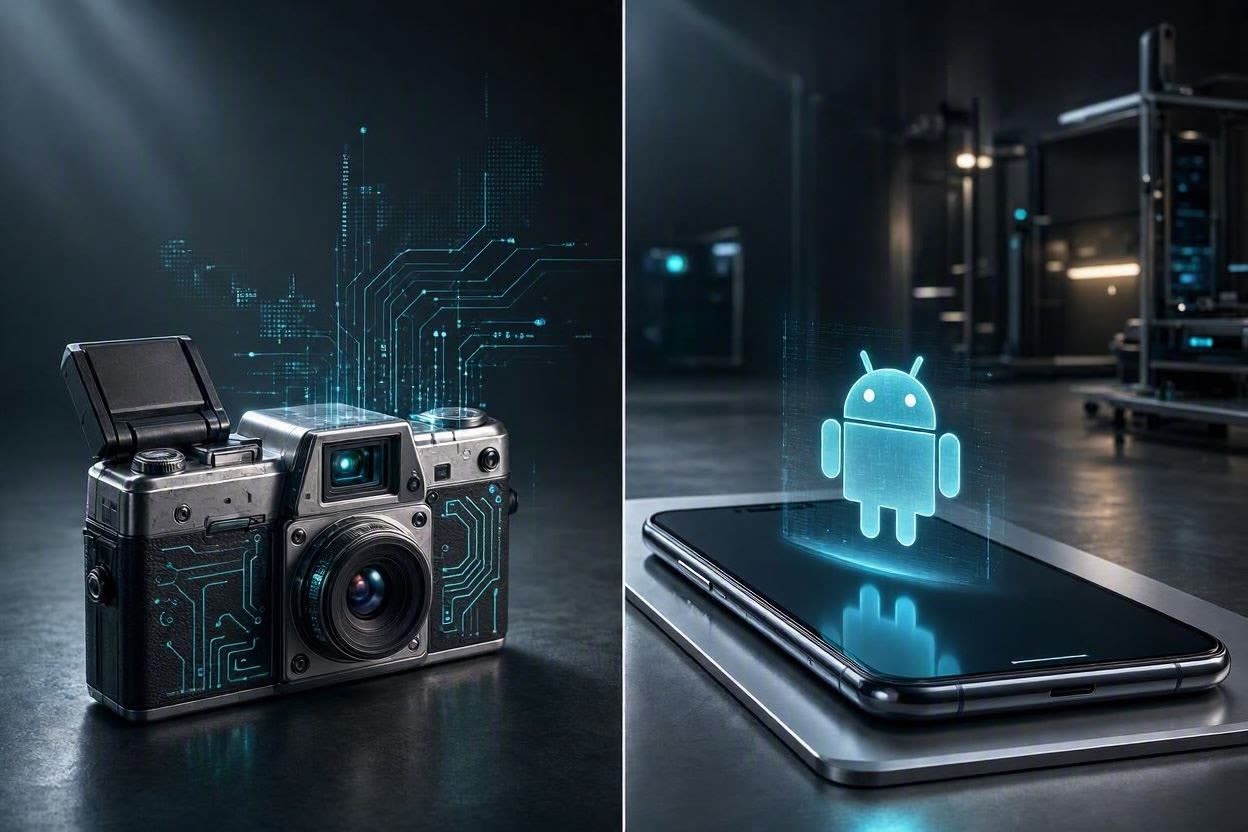
What would the mobile world look like today without Android, the system we carry in our pockets and that runs on more than 3 billion devices worldwide? Most people assume Android is a project Google engineers coded from scratch for smartphones behind closed doors. In reality, the birth of Android is the story of a startup on the brink of bankruptcy, a huge deal that was turned down, and an operating system originally designed for cameras.
Here is one of Silicon Valley's greatest mysteries: what was Android actually built for, and what kind of chess match was played behind the scenes?
The story and history of Android's evolution from cameras to smartphones.
Not a Smartphone, but a "Smart Camera" Idea
When Andy Rubin, Rich Miner, Nick Sears and Chris White founded Android Inc. in California toward the end of 2003, they had a single goal in mind: to make digital cameras smart.
Digital cameras were spreading rapidly in those years, but transferring photos to a computer with cables and slow card readers was a real ordeal. Rubin's original vision was to build a camera operating system that connected to wireless networks, backed up photos directly to a cloud-like server (the "Android Datacenter") and was location-aware.
Market analysis, however, revealed a harsh truth: the digital camera market was quickly reaching saturation, while mobile phones were starting to include camera sensors, however basic. In 2004, Rubin and his team made a radical decision to adapt the entire core architecture to mobile phones. The main goal was to break the dominance of Symbian and Windows Mobile.
The Giant That Turned Down $20 Million: Laughter at Samsung's Table
By early 2005, the startup was about to run out of money completely. Struggling even to pay the office rent, Andy Rubin traveled to Seoul, to the headquarters of tech giant Samsung, to sell the project or secure investment.
Standing before 20 senior Samsung executives, Rubin described their Linux-based, open-source system that would power the mobile devices of the future. The reaction at the end of the meeting was the kind that goes down in tech history: the executives in the room burst out laughing and asked Rubin:
"You and your team of eight are going to build this giant? We have thousands of engineers working in this field alone."
Rubin returned from Seoul to San Francisco empty-handed, unable to save the project. But fate would weave its web just two weeks later.
Larry Page and Google's Secret Move
Over at Google, a very different alarm was ringing. Larry Page and Sergey Brin were seriously worried about Microsoft gaining strength in mobile and restricting users' internet searches. A search engine monopoly forming in the future of mobile was an existential threat to Google.
The first contact between Rubin and Google began as an investment meeting, but Larry Page recognized the potential immediately. In July 2005, Google quietly acquired Android Inc. for roughly $50 million. The acquisition echoed through tech circles for a long time. Most analysts assumed Google would build "Google Phone" hardware; the real plan, however, was not hardware but an ecosystem distributed free of charge to the entire industry.
The Prototype That Steve Jobs Upended: From BlackBerry Look-Alike to Touchscreen
Inside Google, the Android team initially worked on a device code-named "Sooner." Like the BlackBerry, the popular standard of the time, it had a physical QWERTY keyboard and a small, non-touch screen.
On January 9, 2007, everything was turned upside down. Steve Jobs took the stage and unveiled the first iPhone. Android engineer Chris DeSalvo describes the moment like this:
"I pulled the car over and watched Jobs's keynote. At that moment I realized: we have to throw the Sooner project away. The phone we had designed was stuck in the 1990s."
Google shelved the Sooner project immediately, adapted the entire architecture for full touchscreen optimization and multi-touch protocols, and entered a secret partnership with HTC. The result: the first commercial Android device, the HTC Dream (T-Mobile G1), released in 2008.
- 2003: Android Inc. is founded (goal: a smart camera operating system)
- 2004: After market analysis, the course shifts to smartphones
- 2005: Samsung rejects the offer; Google acquires the project for $50 million
- 2007: The iPhone is unveiled; the keyboard prototype is abandoned for a full touchscreen
- 2008: The HTC Dream, the first commercial Android device, officially launches
The Philosophy Behind the Code: Why Open Source?
The real secret behind Android leading iOS in market share today is that its architecture was released as open source under the AOSP (Android Open Source Project).
Google flatly rejected the model of making money by selling the operating system. It gave the software to every phone maker (Samsung, HTC, LG, Xiaomi and others) for free. In return, it set a single condition: services such as Google Search, Maps and YouTube had to come preinstalled on the device by default. This move, which channels mobile internet traffic straight to Google's servers, is one of the most cleverly designed business models in history.
Where Are We Today?
What began as a small garage project built on Andy Rubin's dream of connecting a digital camera to the internet now runs a vast range of hardware, from cars to smartwatches and from televisions to spacecraft. The small core team of eight that Samsung laughed off in 2005 became the architects of the platform that shapes more than 70% of today's mobile operating system market.
In the tech world, success lies not only in writing flawless code but in the flexibility to transform your vision instantly as market conditions change. Android's very existence is the most concrete proof of that flexibility, born from scrapped prototypes and rejected offers.
How do you think the mobile market would look today if Samsung had bought Android that day? Share your thoughts and experiences in the comments below!