When the AI race first kicked off in the smartphone market, almost every manufacturer took refuge in cloud solutions that sent queries to giant data centres on remote servers. Seen through an engineer's eyes, however, this approach had three fatal flaws: network latency, data security gaps and high bandwidth costs. For the device in your pocket to be truly intelligent, the model had to run directly on silicon, that is, on-device.
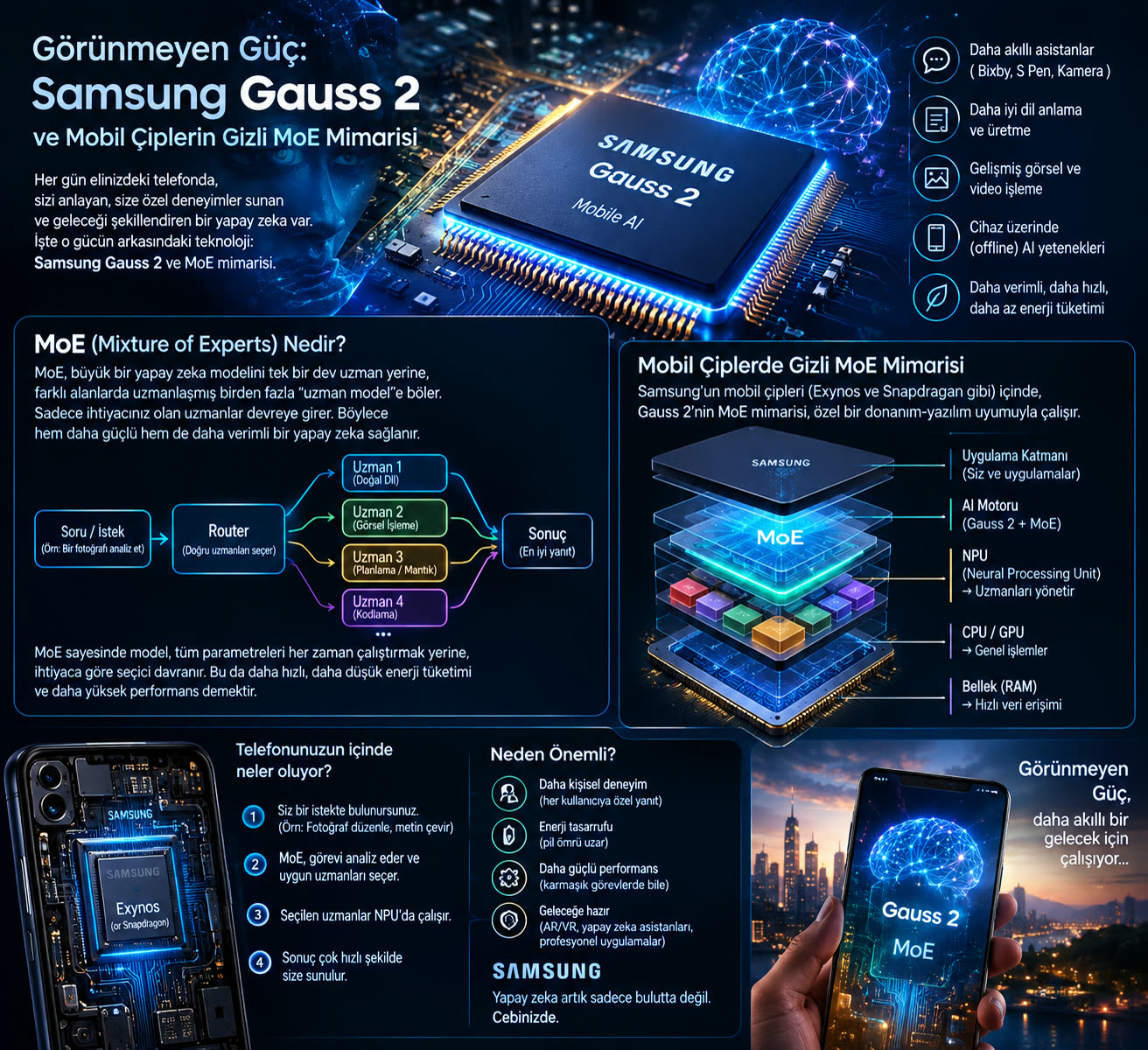
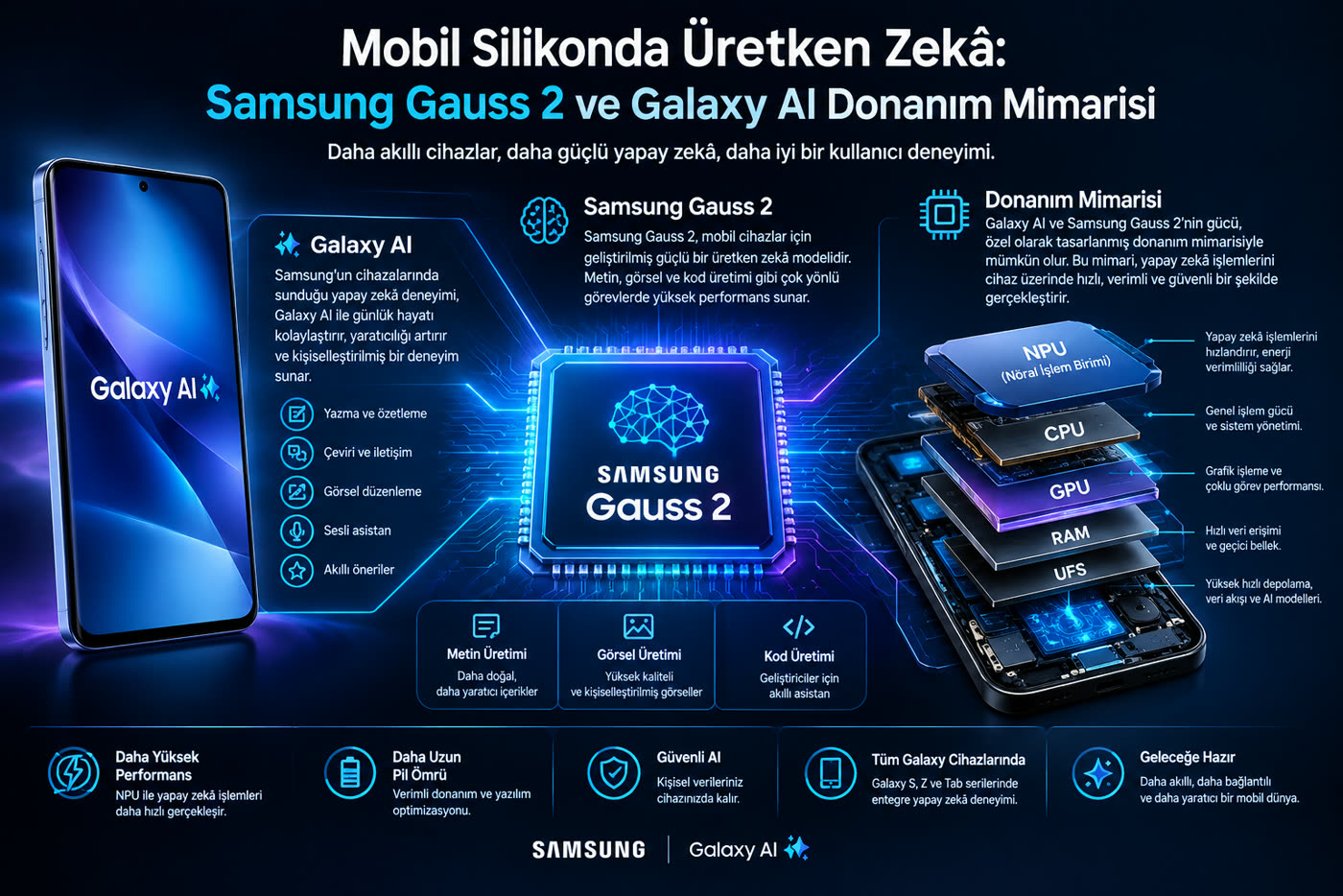
To overcome this bottleneck, Samsung rolled out Samsung Gauss 2, the second generation of its own generative AI model, along with next-generation NPU (Neural Processing Unit) optimisations that run it on the device. Arriving with multimodal data processing capabilities, Gauss 2 turns smartphones from passive terminals into autonomous computing bases capable of local inference.
The Gauss 2 architecture aims to process text, code and visual data simultaneously, delivering zero-latency inference on mobile NPU cores.
1. Model Topology: Compact, Balanced and Supreme
Squeezing large language models (LLMs) directly onto a mobile chipset is impossible because of memory constraints. To get around this problem, Samsung split Gauss 2 into three purpose-built tiers instead of a single monolithic model:
- Compact (On-Device Model): A lightweight variant quantised (INT8/FP8) to run entirely on local hardware. It handles real-time voice translation, text summarisation and keyboard input prediction without an internet connection and with zero data leakage.
- Balanced (Hybrid): Strikes the optimal balance between speed, inference quality and hardware consumption. It shares the processing load between the local NPU and the Edge Cloud according to the device's thermal limits.
- Supreme (Mixture of Experts - MoE): The flagship version, trained with a Mixture of Experts (MoE) architecture. Instead of firing all parameters at once, it activates only the relevant expert sub-networks depending on the type of incoming query, keeping energy consumption in check.
2. The Hardware-Level Bottleneck: The Memory Wall and the NPU
The biggest obstacle to running generative AI on a smartphone is not processing power but the Memory Wall. Every time a model generates a new word (token), it has to pull billions of parameters from RAM and feed them to the compute units.
Although mobile LPDDR5X memory offers around 8.5 Gbps of bandwidth, it lags behind the massive memory buses of desktop graphics cards. With Gauss 2, Samsung integrated a custom Tokenizer structure and weight compression algorithms, cutting I/O traffic on the memory bus by 40%. As a result, instead of wasting energy waiting for data (idle state), the NPU cores can keep running mathematical matrix multiplications without interruption.
Samsung Gauss 2 Tier Analysis Matrix
| Model Version | Target Platform | Core Focus / Task | Inference Mode |
|---|---|---|---|
| Compact | Mobile Device / On-Device | Latency-free local processing, text summarisation, code completion | Offline (NPU Hardware) |
| Balanced | Device + Edge Server | Multilingual dialogue, image description, content generation | Hybrid (NPU + Edge API) |
| Supreme | Cloud Infrastructure (MoE) | Complex logical reasoning, code generation, large-scale data analytics | Full Cloud (Data Centre) |
3. Security Isolation: The Knox Vault Shield
Bringing generative AI onto the device lays the user's personal data directly in front of the neural network. To neutralise this risk, Samsung integrated the Knox Vault security layer directly into the AI pipeline.
Sensitive data handled by the Compact model is processed in a secure processor and an encrypted memory region that are electrically and physically isolated from the rest of the operating system. As soon as inference is complete, the memory address is zeroed out; this prevents, at the hardware level, malware or third-party apps from accessing any inference traces left in the cache.
Cloud models with billions of parameters, or compact neural engines running on the silicon in your pocket without an internet connection? Let's discuss your views and test experiences below!