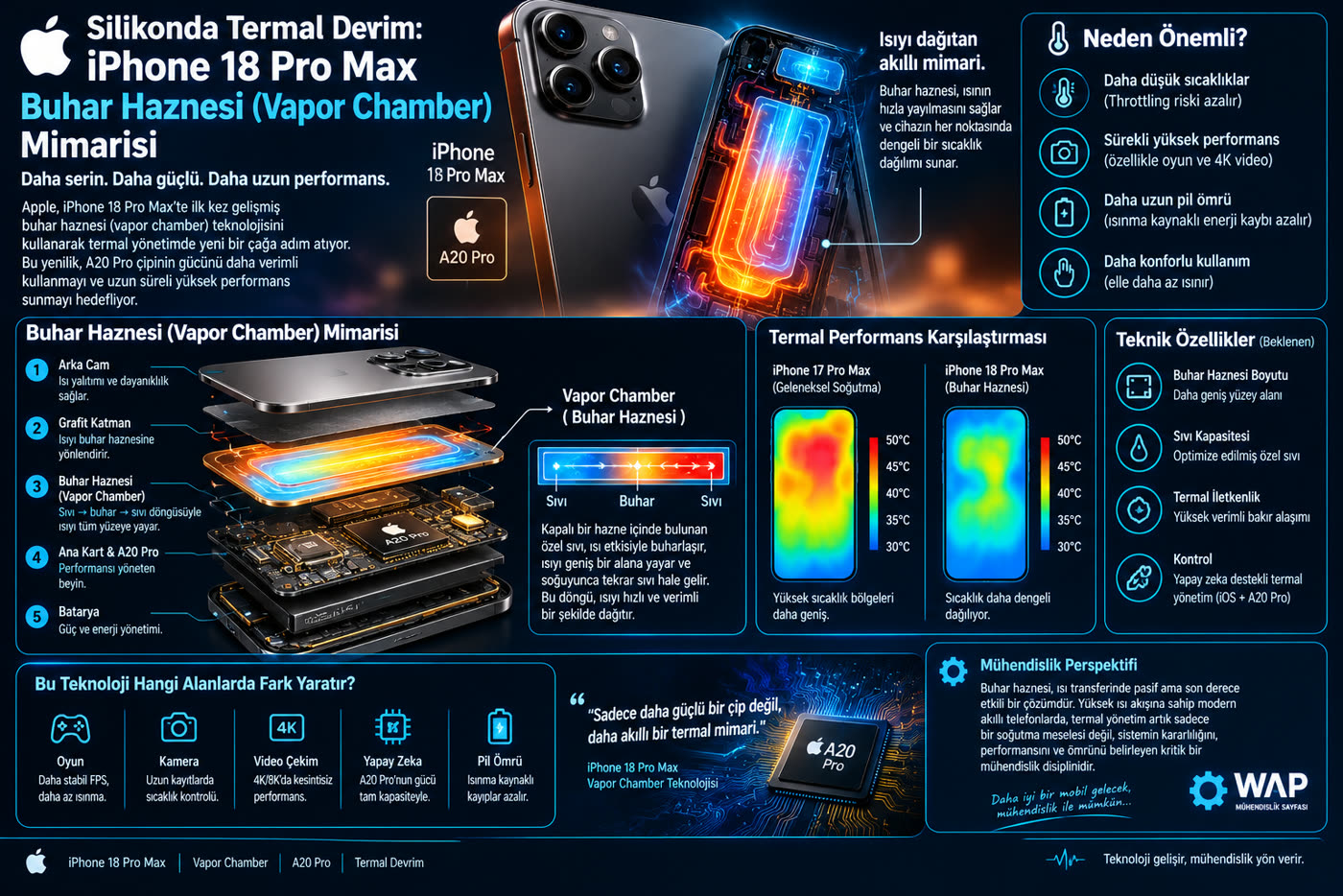
As an electrical and electronics engineer examining hardware designs, the rule I pay most attention to is this: "Performance is determined not by the chip's clock speed (GHz), but by its thermal threshold." Even as silicon process geometries in the smartphone market have shrunk to 3nm and 2nm over the years, the heat density produced per square millimetre by processor cores has come to rival a nuclear reactor core. For a long time, to keep its thin body, Apple tried to spread heat into the chassis using multi-layer graphite sheets and a titanium sub-frame. But you cannot cheat the laws of physics; under heavy AI inference and console-class graphics loads, this passive system raised the white flag.
With the iPhone 18 Pro Max, the long-awaited radical engineering break has finally happened in Cupertino. Apple has shelved the old passive graphite design entirely and moved to the most sophisticated, micro-laser-welded Vapor Chamber (VC) cooling block ever produced in smartphone architecture. Let's take a technical look at the thermodynamic anatomy of this next-generation cooling architecture and how it saves the silicon from thermal throttling.
The vapor chamber module moves heat from the SoC surface across the whole body at lightning speed, through the phase change of a liquid inside an evacuated flat plate.
1. Why Did the Old Design Hit a Wall? The Thermal Trap of Titanium
In previous generations, the switch to a titanium frame looked like a big win for lightness and mechanical strength, but it was a thermal disaster. While the thermal conductivity of pure copper is about 400 W/m·K, that of Grade 5 titanium alloy is only around 17 W/m·K. In other words, titanium is an excellent thermal insulator.
Because the high-wattage heat generated by the A-series processor could not be transferred through the graphite sheets into the titanium case, it built up at the centre of the device; within seconds the silicon would shoot up into the 45°C - 50°C range and be forced to throttle the CPU cores. To break through this thermal barrier, the new design in the iPhone 18 Pro Max builds a vacuum phase-change highway directly between the processor and the body.
2. Phase-Change Thermodynamics: How Does a Vapor Chamber Work?
A vapor chamber is a two-dimensional, ultra-thin sealed heat pipe that contains no mechanical pump or moving parts. It works through 4 flawless thermodynamic stages:
- Evaporation: When the processor surface heats up, the pure deionised liquid trapped in the micro-porous sintered wick at the base of the chamber boils at a very low temperature thanks to the low vacuum pressure, evaporating and absorbing the latent heat of vaporisation.
- Vapor Expansion: The high-pressure hot vapor zone expands rapidly along the chamber's vacuum channels towards the cooler outer edges of the device.
- Condensation: Having handed their heat to the cold surfaces, the vapor molecules instantly condense back into the liquid phase, releasing the thermal load they absorbed into the body.
- Capillary Pumping: The condensed droplets are pumped back over the processor by the capillary force created by the sintered copper wick, independently of gravity. The cycle continues as an endless loop.
Cooling Architectures Comparison Matrix
| Technical Parameter | Traditional Graphite / Titanium | Next-Generation Vapor Chamber (VC) |
|---|---|---|
| Heat Transfer Principle | Passive Solid Conduction | Two-Phase Thermodynamic Cycle |
| Equivalent Thermal Conductivity | ~300 - 500 W/m·K (X-Y Plane) | > 5,000 - 10,000 W/m·K |
| Sustained GPU Load | 40% Performance Drop After 3-5 Min | Uninterrupted 90%+ Stable Output |
| Battery Thermal Stress | Localised Heat Build-Up (Battery Ageing) | Uniform Heat Distribution and Longer Cell Life |
3. The Engineering Takeaway: What Does It Do for the User and the Hardware?
So what does this thermodynamic victory on paper change in everyday use?
First of all, when on-device AI inference on mobile devices is running, the NPU cores draw peak power continuously for minutes. Thanks to the new vapor chamber, localised hotspots on the processor are dispersed instantly, extending the life of the silicon. And because the temperature stress the battery is exposed to while charging is kept to a minimum, the battery's chemical health over its charge cycles is noticeably preserved.
Android flagships have used vapor chamber systems for a long time; how do you read Apple waiting until the iPhone 18 Pro Max to make the switch? Which do you think is more critical, design thinness or thermal stability? Join our engineering table in the comments!