When I head out to the field as an electrical and electronics engineer, or review massive public infrastructure projects, there is one detail most people overlook: the public tends to think of drinking water transmission lines as nothing more than giant steel pipes, dam embankments and mechanical valves. Yet the real invisible hero extending the life of those huge steel mains buried metres underground, the lifelines of our cities, is not mechanical or civil engineering; it is a well-designed feat of electrical engineering.
While carrying clean water to every corner of Türkiye, the State Hydraulic Works (DSİ) uses a remarkably smart method to keep its pipes from rusting and decaying: Impressed Current Cathodic Protection (ICCP). Halting the natural electrochemical corrosion of steel by feeding a controlled electric current into pipelines buried with billions of liras of public money is a brilliant piece of engineering thinking that protects the state and the national wealth, and as an engineer I give it a standing ovation. Let's take a technical look at how electricity becomes a shield for drinking water lines.
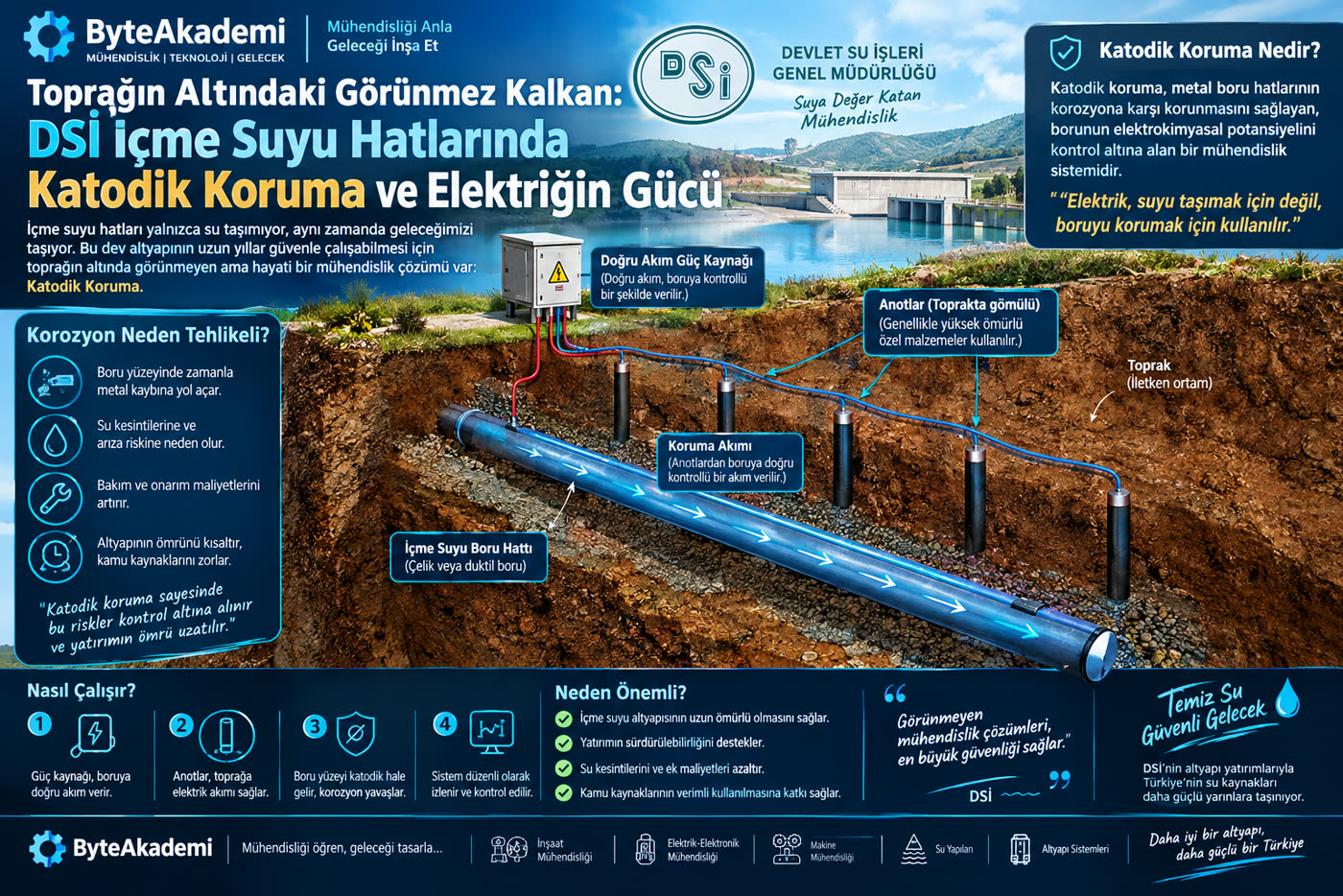
DSİ transformer-rectifier units apply a negative potential to the steel pipeline, effectively shutting down the corrosion reaction.
1. An Electrochemical War: Why Do Pipes Corrode Underground?
The moment you bury steel pipes in the ground, you have effectively built a giant galvanic cell. Moisture, dissolved salts and minerals in the soil act as an electrolyte. A potential difference (voltage) develops between points on the steel pipe that differ in chemical homogeneity:
In plain terms, this reaction means the steel pipe loses electrons, iron ions leach into the soil and the pipe corrodes. Over the years, microscopic holes (pitting) form on the pipe; tonnes of clean drinking water are lost, rusty water reaches the cities, or pipes burst under pressure. This is where DSİ reverses the chemistry: the electrons the pipe would naturally give up are supplied not from the pipe's own body but from an external electrical source.
2. How Does DSİ Build the System? (Impressed Current Cathodic Protection)
In the system DSİ applies, Cathodic Protection Rectifier Stations (T/R Units) are installed at set kilometre intervals along the line. Alternating current (AC) drawn from the grid is converted into a precisely regulated direct current (DC) through transformer and rectifier circuits:
- Making the Pipe the Cathode: The negative (-) terminal of the DC source is connected directly to the steel pipeline carrying clean water. The pipe thus becomes the cathode. Instead of losing electrons, it turns into a passive surface that is continuously fed electrons from outside.
- Anode Beds (The Sacrificial Side): The positive (+) terminal of the DC source is connected to special anode beds buried in the soil at a set distance from the pipe (high-silicon iron, mixed metal oxide - MMO electrodes).
- Closing the Circuit: Current flows from the anodes into the soil, from the soil to the pipe, and back to the rectifier through the cables. Corrosion is diverted entirely away from the pipe and onto these auxiliary anodes. The pipe does not lose a single atom.
The Difference Cathodic Protection Makes in Infrastructure: An Engineering Analysis
| Criterion | Unprotected Conventional Line | DSİ Cathodically Protected Line |
|---|---|---|
| Economic Service Life | 15 - 25 Years (Perforations begin) | 75 - 100+ Years (Permanent Infrastructure) |
| Drinking Water Losses and Leakage | Massive leakage through corrosion holes | Near-zero leakage, full pressure stability |
| Maintenance and Excavation Cost | Constant pipe bursts and road excavations | Only periodic checks of rectifiers and panels |
| Protection of National Wealth | A trillion-lira re-tender every 20 years | Decades of uninterrupted service guaranteed |
3. Applauding Smart Public Engineering, as an Engineer
We engineers are people of numbers; we look at efficiency, cost-benefit ratios and the sustainability of a system. Burying a pipeline and covering it up is the easiest part of the job. The real engineering vision lies in guaranteeing that the same pipe will still be working with the same strength 50 years later.
The cathodic protection discipline DSİ applies on its drinking water transmission lines means not throwing public money away. Saving steel lines worth hundreds of billions of liras from corrosion by spending a tiny amount of electrical energy is the most concrete proof of how engineering science turns into public benefit. If water flows uninterrupted from the taps of our cities, behind it is the signature of the DSİ engineers who win the electrochemical war underground with electricity.
Had you ever heard that drinking water pipes are protected from corrosion with electric current? Which other areas of public investment do you think should adopt protective engineering practices like this? Let's discuss below!