As an electrical and electronics engineer inspecting site panels, residential consumer units and industrial facilities, one of the deadliest misconceptions I encounter most often in the field is this: "I have circuit breakers at home; if I get a shock, the breaker will trip and save me." This is the most dangerous myth a person can believe about their electrical installation. The job of a standard Type B or C miniature circuit breaker (MCB) is not to protect people; it is to protect the cables on the circuit from overload and from fires caused by short circuits.
While the human heart goes into fatal ventricular fibrillation at a current of around 50 milliamperes (mA), a 16 Ampere breaker mistakes the 100 milliamperes flowing through your body for "an ordinary night-light load" and doesn't so much as flinch. The one and only protective shield that steps in at that critical threshold between life and death is the Residual Current Device (RCD / RCCB) quietly standing guard in your panel. Let's dissect the anatomy of this device, from Kirchhoff's current law to toroidal core physics, and from the vital boundary between 30 mA and 300 mA to its spring mechanism, using a Source → Analysis → Conclusion discipline.
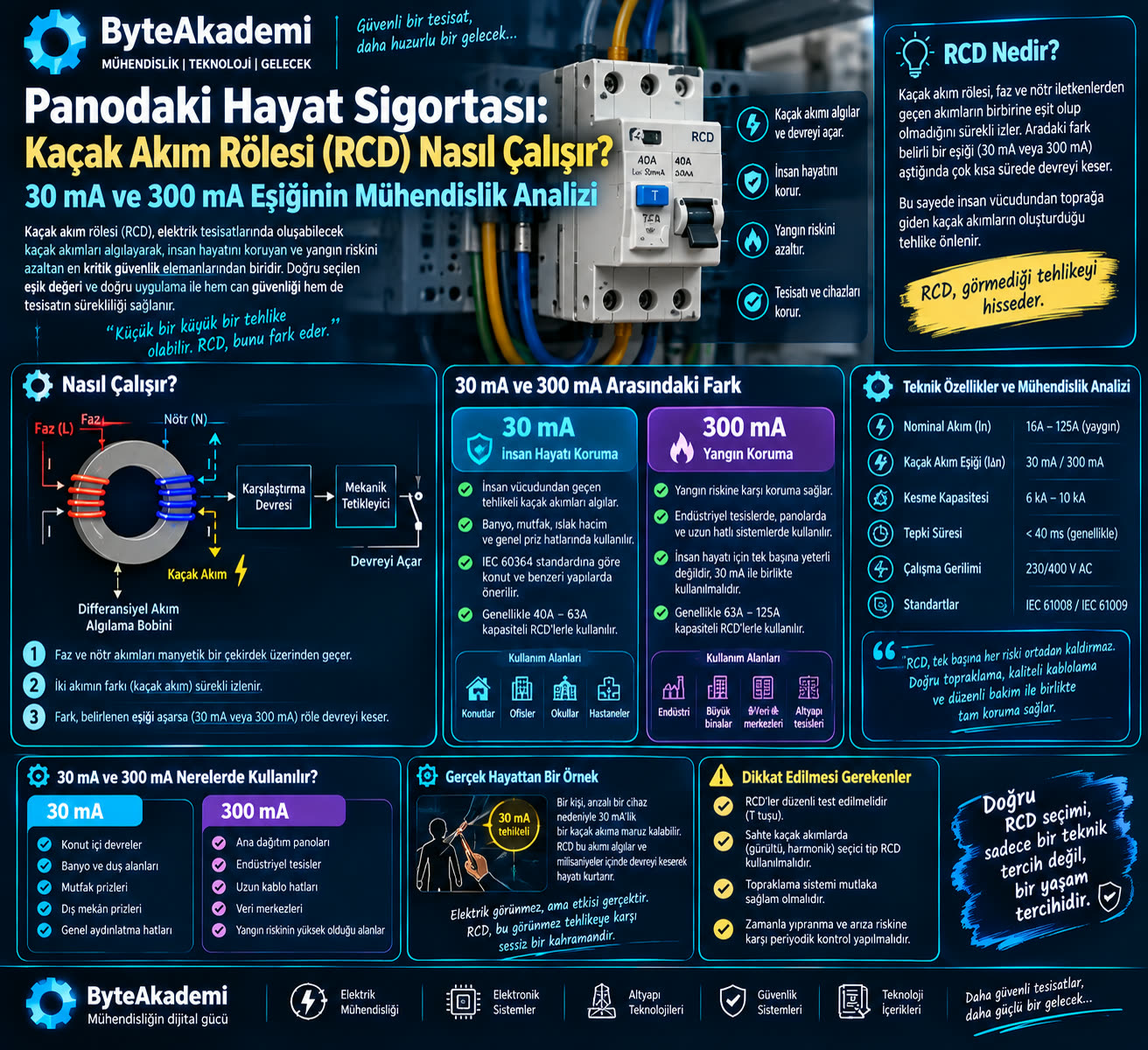
A residual current device is not just a simple switch; it is a precise differential toroidal sensor that continuously weighs the phase and neutral vectors.
1. Source and Internal Structure: The Toroidal Core and Kirchhoff's Law
According to Kirchhoff's Current Law, the foundation of electrical circuits, the sum of currents entering a closed node must equal the sum of currents leaving it. In a single-phase network, the current entering through the phase conductor ($I_F$) must return in full through the neutral conductor ($I_N$) after doing its work in the load.
At the centre of the RCD sits a circular Toroidal Current Transformer with high magnetic permeability. The phase and neutral conductors pass through this ring together so that they produce opposing magnetic fields:
- Balanced State (Normal Operation): If the current through the phase equals the current returning through the neutral ($I_F = I_N$), the magnetic fluxes they create cancel each other out completely ($\Phi_{net} = 0$). The toroidal core is magnetically asleep and the system runs uninterrupted.
- The Moment of Leakage (Imbalance): When a person touches a phase conductor or the enclosure of a device with faulty insulation, part of the current flows to earth through the earth conductor or the human body. The current returning through the neutral decreases ($I_F \neq I_N$).
- Trip Winding and Relay: The moment the magnetic balance is disturbed, a net residual flux appears in the toroidal core. This flux induces a voltage in a third sensing winding wound on the core. The induced current triggers an extremely finely calibrated electromagnetic latch (trip coil).
- Spring-Loaded Mechanical Latch: The pre-tensioned mechanical spring is released and separates the main contacts in the blink of an eye, around 30 milliseconds, cutting off the current.
2. Physiological and Thermal Analysis: Why 30 mA, and Why 300 mA?
There are two core ratings that sell the most on the market: 30 mA and 300 mA. These are not arbitrary numbers; they are engineering thresholds calculated directly from human biology and the ignition temperatures of building materials.
An Engineering Analysis of the 30 mA and 300 mA Thresholds
| Protection Class | Trip Threshold (IΔn) | Targeted Risk | Application / Installation Point |
|---|---|---|---|
| Life Protection (Personal Protection) | 30 mA (0.03 Ampere) | Ventricular Fibrillation, Respiratory Paralysis and Death | Sub-Distribution Board (Socket, Lighting and Wet Area Circuits) |
| Fire Protection (Installation Protection) | 300 mA (0.3 Ampere) | Electric Arcing, Insulation Ignition and Installation Fire | Main Meter Panel / Upstream of the Main Incoming Switch |
According to the international standard IEC 60479-1, the effects of alternating current on the human body are divided into 4 main zones. When the current reaches the 10–20 mA band, muscle cramps set in and the person cannot let go of the conductor they are holding (the "let-go threshold"). The moment the current exceeds the 30 mA–50 mA limit and passes through the chest, the heart muscles lose their synchronisation (ventricular fibrillation) and blood pumping stops. A 30 mA RCD is designed to open the circuit within milliseconds, before the heart enters this fatal phase.
When damaged cable insulation or a loose terminal connection fails, micro-arcs begin to form towards earth. When 300 mA of leakage current flows at 230V, the localised power reaches P = V × I = 230V × 0.3A ≈ 69 Watt. This roughly 70 W of localised arc energy, about the size of a match flame, is enough to ignite surrounding wood, plastic or dust particles and start a building fire. The 300 mA main incoming RCD detects this leakage and saves the building from burning to the ground.
3. Field Engineering: The Most Common Installation Mistakes
Even if you buy the most expensive RCD from the best brand, two deadly wiring mistakes made on site turn the device into complete junk:
- Bonding (Bridging) Neutral and Earth: If neutral and earth are connected to each other at a socket or in the panel while an RCD is installed, the device either trips immediately or doesn't work at all. The neutral bar downstream of the RCD must be isolated and must never come into contact with any earth conductor.
- Mixing Up the Neutrals of Different Circuits: When a room's phase is taken from the first breaker and its neutral from the neutral terminal of another circuit, the current balance is upset and the RCD trips for no apparent reason ("nuisance tripping"). Many electricians who can't solve the fault simply remove the RCD and wire straight through; that is attempted manslaughter!
- The Test Button Routine: The "T" (Test) button on the device creates an artificial 30 mA leakage from phase to neutral through an internal resistor. To check whether the mechanical latch has seized from dust or oxidation, this button should be pressed at least once a month.
Conclusion: The Engineering Prescription
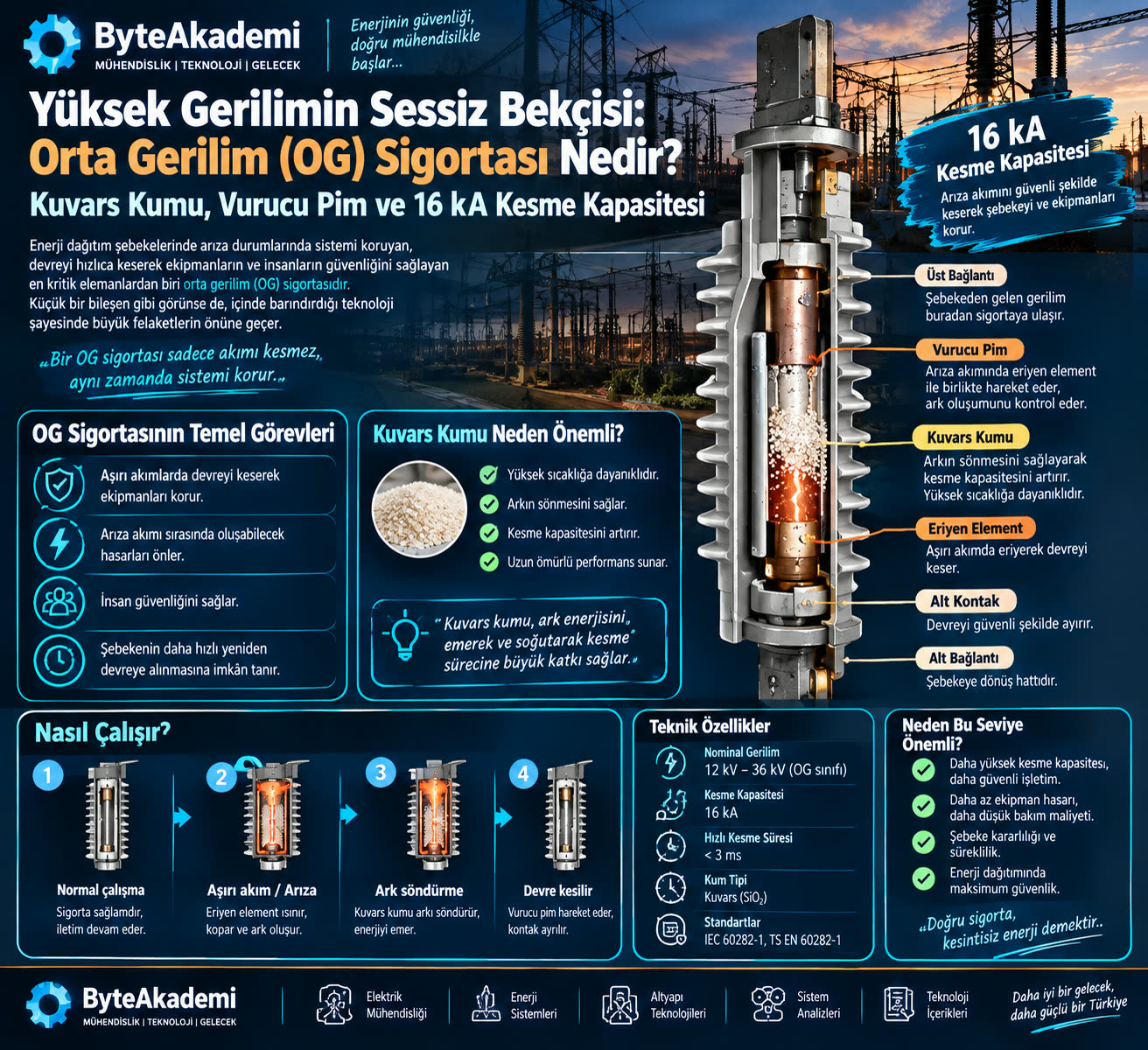
While the Medium Voltage (MV) fuses we examined in our previous technical article protect the grid's massive transformers and cables, the residual current device in our homes directly protects the physical lives of you, your family and your children.
Engineering Verdict: The one piece of equipment you must never skimp on in an electrical installation is the residual current device. In a modern, standards-compliant building, a 300 mA Selective (Type S) Fire Protection RCD in the main incoming panel and a 30 mA Life Protection RCD covering all socket and wet area circuits in the apartment sub-panels must be installed in a graded (selective) arrangement. If you ever see an electrician bridge an RCD because "it keeps tripping", know that he is not leaving a life insurance policy in that panel but a ticking time bomb.
- IEC 61008-1: "Residual current operated circuit-breakers without integral overcurrent protection for household and similar uses (RCCBs)".
- IEC 60479-1: "Effects of current on human beings and livestock - Part 1: General aspects (Threshold of ventricular fibrillation)".
- HD 60364-4-41 / TS IEC 60364: "Low-Voltage Electrical Installations - Safety and Protection Against Electric Shock Requirements".
- Elektrik İç Tesisleri Yönetmeliği (Türkiye's Regulation on Indoor Electrical Installations): Articles 44/48 - Mandatory use of residual current devices.
When did you last press the "T" button on the RCD in your home or workplace panel? Do you test whether your RCD trips? Share the interesting residual current faults you've come across in the field in the comments!