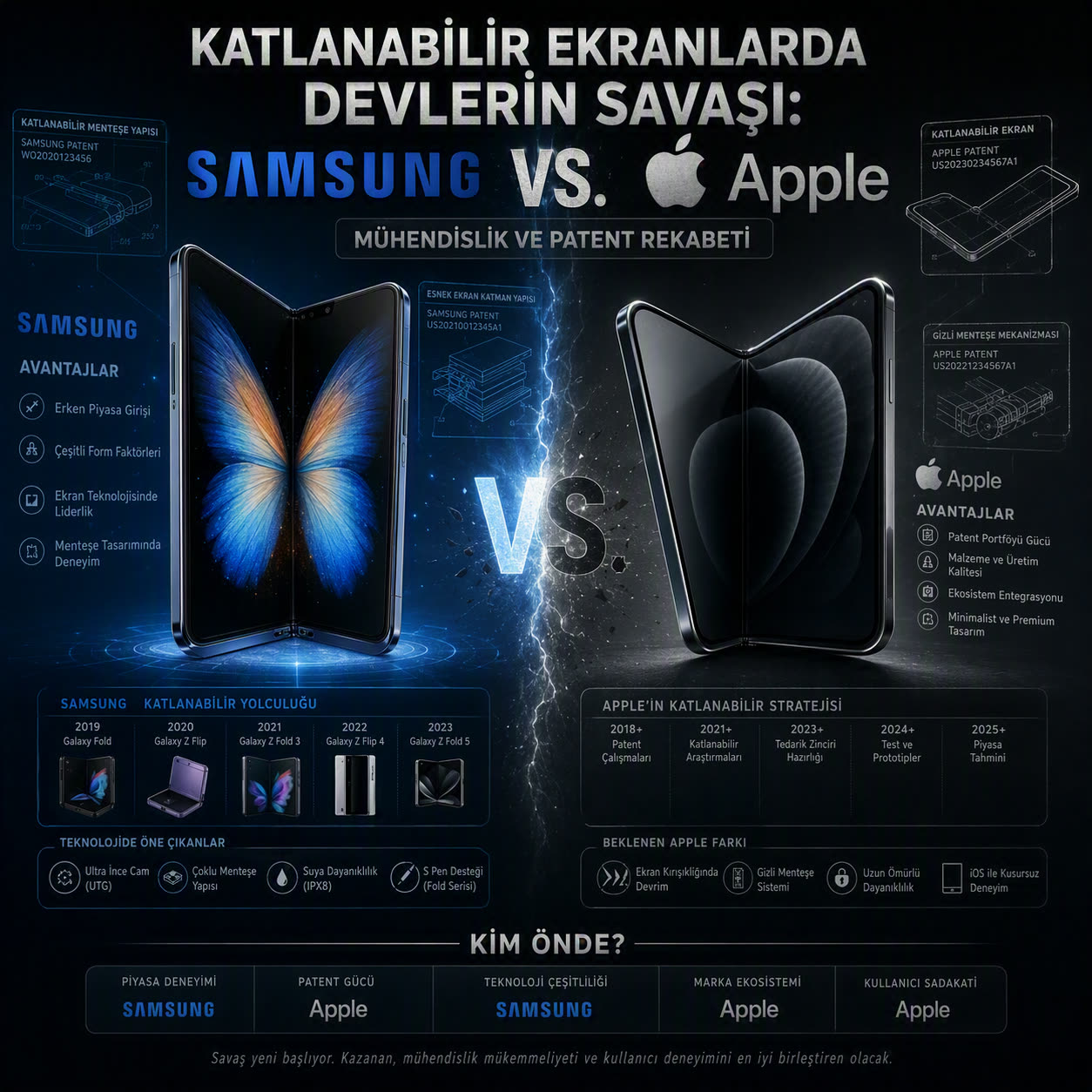
As the standard rectangular slab design in the smartphone market reaches its thermal and physical limits, the industry's two lodestars have entered a head-on materials and patent war over the foldable form factor. Samsung, which has dominated the market on its own for years with the Galaxy Z series and has tested millions of fold cycles in the field, now faces Apple, a company that has made a tradition of entering markets late and aiming to redefine the standards from scratch the moment it arrives.
This rivalry is not just about "bending a screen in half"; it is a huge mechanical and materials engineering battle that stretches from the flexibility of micron-thin ultra-thin glass (UTG) to kinematic geared hinge designs, and from under-panel cooling layers to interface ergonomics. We put the foldable display hardware, patent strategies and real-world durability dynamics of the two tech giants under the microscope.
Samsung, which has perfected waterdrop hinge kinematics, and Apple patents aiming for zero crease with liquid metal gears.
Hinge Kinematics: Waterdrop Architecture vs. Multi-Axis Liquid Metal
The most delicate component that determines the lifespan of a foldable device is the hinge. Samsung abandoned the tight-radius U-shaped folding geometry of the first-generation Fold models and moved to a waterdrop hinge structure. In this design, as the screen folds inwards, the panel curls into the body in the shape of a droplet; this increases the bending radius on the panel and minimises tensile and compressive stress.
Apple, for its part, will not accept that traditional gear mechanisms leave micro gaps behind the panel. Cupertino's latest patents rely on multi-axis rail systems made from Amorphous Alloys (Liquid Metal). When the screen folds, mechanical plates slide beneath the panel and keep the fold line under uniform tension; as a result, the classic dip (crease) you feel under your finger when the panel is opened is mechanically eliminated.
- Ultra-Thin Glass (UTG): Flexible glass layers 30 microns thick are passed through potassium ion baths for chemical strengthening, giving them resistance to fingernail scratches. Samsung Display holds a global monopoly on production yield for this glass.
- Polarizer-Free OLED Layer (Eco2 OLED): To reduce thickness, the external plastic polarizer layer is removed and colour filters are printed directly on top of the pixels. This makes the display stack thinner while reducing folding resistance by 30%.
- Optical Refraction and Crease Hiding: Apple aims to make the slope beneath the panel invisible by using a micro-prismatic refractive layer in the middle of the glass that scatters incoming ambient light.
Hardware and Strategy Comparison
Samsung's and Apple's approaches to this race represent two opposing industrial philosophies: Samsung tests its manufacturing power by iterating in the field together with its users, while Apple prefers not to ship a product until manufacturing tolerances reach watchmaking precision.
Foldable Hardware Topology Matrix
| Critical Parameter | Samsung (Galaxy Z Approach) | Apple (Duo / Fold Approach) |
|---|---|---|
| Hinge Mechanism | Waterdrop (Flex Hinge) + Sweeper brushes | Multi-axis liquid metal rail + Self-locking gear |
| Crease Tolerance | A visible micro dip is accepted | Zero crease required, optically and mechanically |
| Display Supplier | Samsung Display (In-house fabs) | Joint supply from Samsung Display & LG Display |
| Stylus (Digitizer) Layer | Split EMR layer (S-Pen support) | Active capacitive layer (Focus on not thickening the body) |
| Heat Spreading | Two-piece graphite sheet | Micro vapor channel running through the hinge |
Software and Ecosystem Fit
However powerful the hardware, the success of a foldable screen lies in the flexibility of the operating system. With the Android L foundation it co-developed with Google and the One UI Taskbar, Samsung has matured three-way split-screen and window-dragging ergonomics over the years.
Apple, meanwhile, is positioning its foldable less as a classic phone and more within a "folding iPad Mini" paradigm. A hybrid operating system that merges the iOS and iPadOS cores turns the upper half into a display and the lower half into a touch keyboard and trackpad with virtual haptic feedback when the screen is half-folded (Laptop Mode). Thanks to native Apple Intelligence integration, dragging data between the two screen areas can be done contextually, directly through the AI assistant.
The Samsung ecosystem, seasoned in the field for years and proven in hinge durability, or Apple engineering, which wants to rewrite the standards with a zero-crease goal? Let's discuss your pick in the comments.