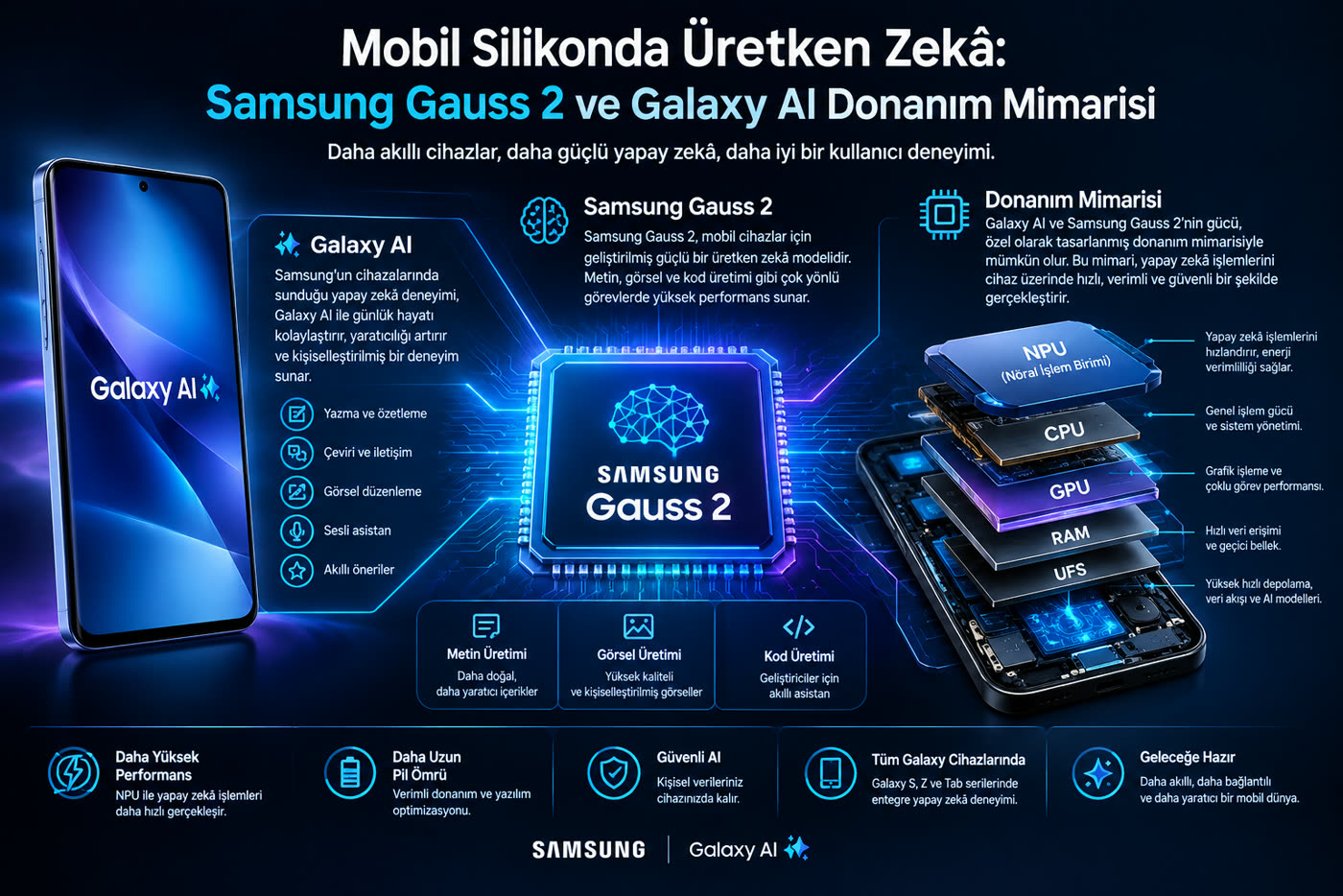
Tech newsletters gloss over Samsung Gauss 2 with superficial headlines, treating it as just another Galaxy AI update that "erases objects from photos" or "transcribes voice recordings." But the real revolution that catches a hardware and systems engineer's eye is not in the pixels on the screen; it is hidden in the mathematical architecture working behind the scenes without pushing mobile silicon past its thermal limits.
Conventional large language models could drain a smartphone's battery in minutes and lock up the processor through thermal throttling, but Gauss 2's behind-the-scenes Mixture of Experts (MoE) distributed compute structure and aggressive memory quantization break that rule at its root.
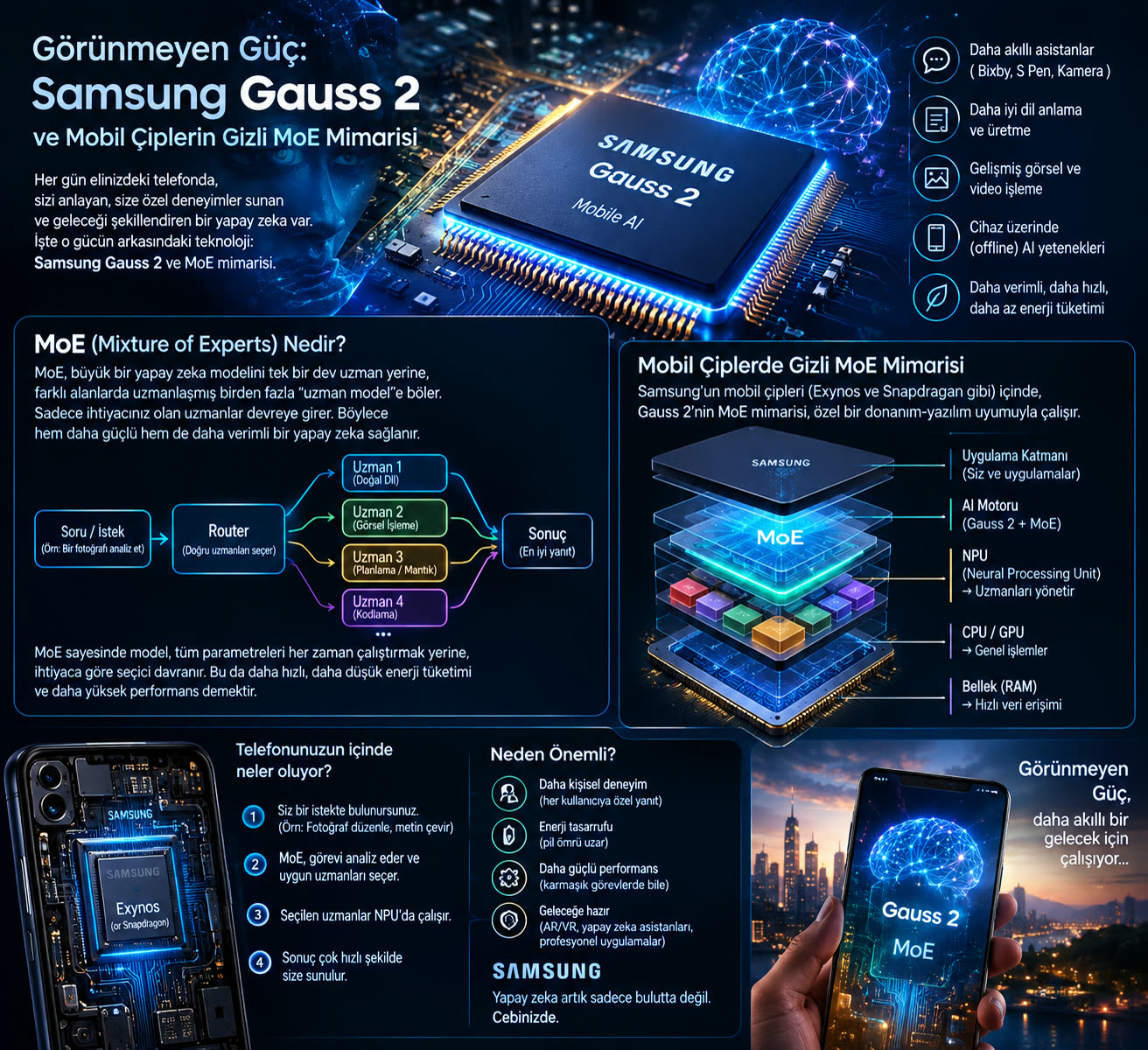
Instead of running its huge parameter set as a single block, Gauss 2 splits it into expert sub-networks to maximise inference efficiency per watt.
1. The Monolithic Era Is Over: The Sparse MoE (Mixture of Experts) Revolution
When you ask a standard generative AI model (for example an older-generation monolithic LLM) even a simple question, all of the model's weights enter the compute loop at the same time. This drains a phone's battery fast.
Gauss 2's most critical, unannounced engineering secret is its Sparse Mixture of Experts (Sparse MoE) topology. The model contains independent expert neural networks (for example, one that only handles coding, one only for grammar, or an image tensor expert). A router (gating network) analyses the incoming input and, instead of firing all of its billions of parameters, activates only the 1-2 relevant expert sub-networks needed to answer the query. The result: inference performance stays at its peak while energy consumption drops to a third.
2. Quantization That Breaks the LPDDR5X Bottleneck: INT4 and FP8
Contrary to what many people think, the real factor that determines AI speed on mobile devices is not the processor's clock speed (GHz) but memory bus bandwidth. A model trained at 16-bit precision (FP16) gets stuck on heavy bus latency as it moves gigabytes of data between RAM and the NPU for every inference.
In the Compact variant of Gauss 2 that runs on-device, Samsung engineers compressed the weights into a hybrid INT4 / FP8 mixed-precision format that brings quality loss down to almost zero.
- The model's RAM footprint was cut from around 8-10 GB to the 2.5 - 3 GB range.
- Bandwidth pressure on the LPDDR5X memory bus fell by 45%, delivering thermal stability.
- By multiplying lower-bit integer vectors many times faster in a single clock cycle, the NPU tensor cores brought Time-to-First-Token latency down to the millisecond range.
The Mobile AI Ecosystem Compared
When we line up the on-device operating dynamics of the three major mobile architectures on the market side by side by their technical parameters, the picture becomes clear:
| Technical Parameter | Samsung Gauss 2 (Compact) | Apple Intelligence | Google Gemini Nano |
|---|---|---|---|
| Architecture Type | Sparse MoE-Based | Dense Transformer | Dense / Distilled |
| Quantization Level | Mixed INT4 / FP8 | INT4 with LoRA Adapters | Mixed INT4 / INT8 |
| Hardware Isolation | Knox Vault Secure Zone | Secure Enclave Isolation | Titan M2 Chip Support |
| Multimodality | Native Text + Code + Image | Text and Image Separate | Multimodal with Nano-2 |
3. End-to-End Hardware Wiping: Inference That Leaves No Trace
Another technical detail many users are unaware of is memory security in on-device AI processing. Many open-source models can leave residual data in dynamic memory (RAM) after inference has finished.
The Gauss 2 pipeline works in coordination with the Knox security processor. The moment a voice recording or personal document is summarised, the corresponding NPU buffer is invalidated at the physical level (a zero-fill write). This way, no other app or malicious script running on your phone can reach inference traces left behind in the cache.
Do you think the winner of the future will be on-device hardware with MoE architectures that compress models aggressively, or cloud computing backed by giant data centers? Share your thoughts in the comments!