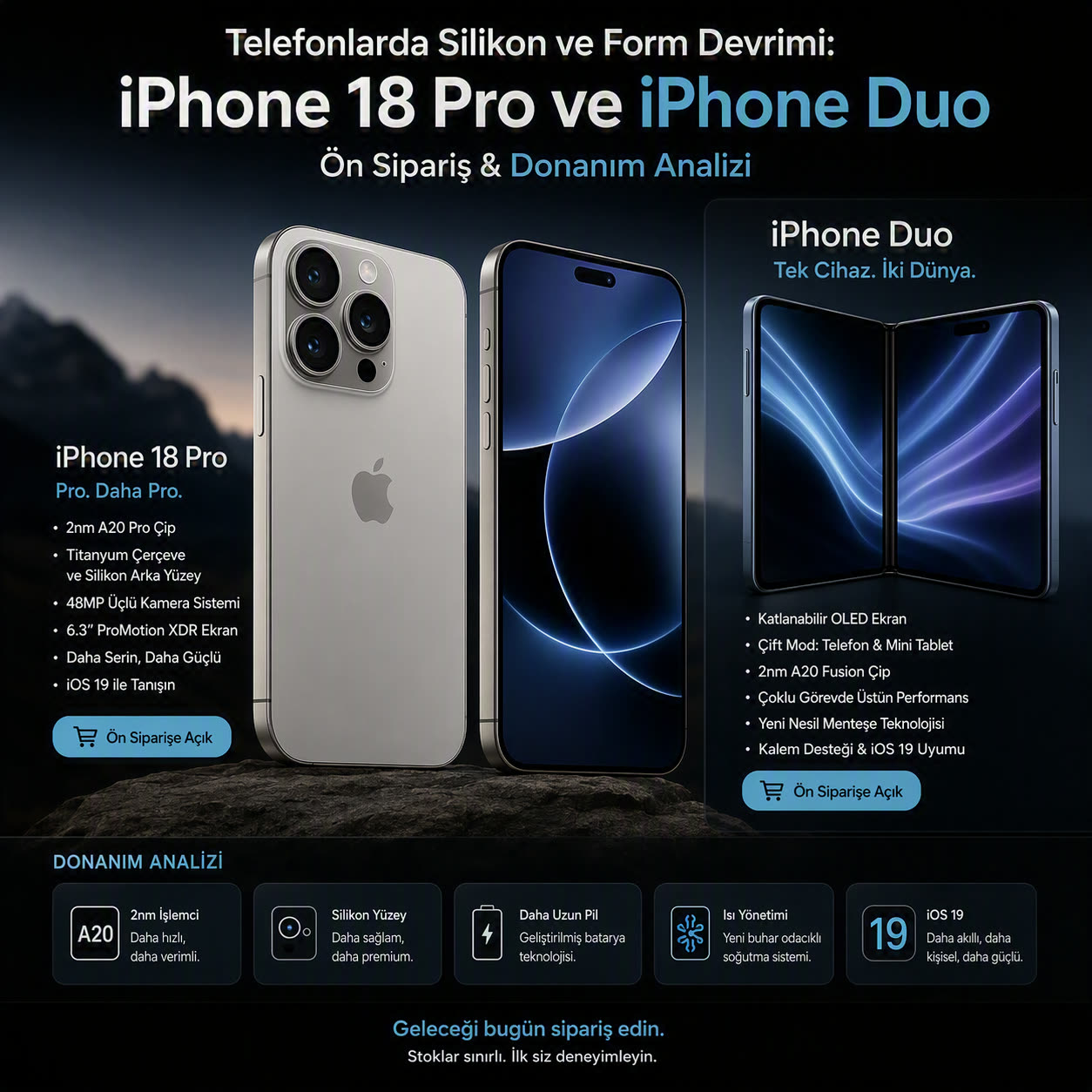
While the smartphone industry has long been stuck in a vicious cycle of "the same chassis, just a little shinier", Apple's latest move has shaken things up. The traditional flagship iPhone 18 Pro, now open for pre-order, and iPhone Duo, the brand's first hybrid device with a foldable/dual-screen concept, pit two different philosophies of consumer electronics against each other.
The first telemetry data from the pre-order pool and supply chain reports show that users are focusing not just on a new design but on the on-device AI (Edge AI) capabilities built into the device. From the 2nm process geometry to vapour chamber cooling, and from the folding mechanism to the Apple Intelligence 2.0 architecture, we put both models on the engineering bench.
The iPhone 18 Pro, crowning the classic rigid-body architecture with the 2nm A20 Pro, and the iPhone Duo with its liquid-metal-hinged multi-screen panel.
Silicon Architecture: The 2nm A20 Pro and Memory Capacity
At the heart of both devices is the A20 Pro, taped out on TSMC's 2-nanometre (N2) Gate-All-Around (GAAFET) transistor architecture. This leap in transistor density delivers up to 25% savings in power consumption while allowing higher clock speeds in multi-core performance without hitting thermal limits.
The most striking hardware shift, however, is on the memory side. So that on-device AI models can run smoothly, the base iPhone 18 Pro carries 12 GB of LPDDR5X memory, while the multitasking-focused iPhone Duo comes straight with a 16 GB Unified Memory pool. Raising memory bandwidth to 8533 MT/s minimises the memory bottleneck in neural network computations.
AI in Depth: Apple Intelligence 2.0 and the NPU
Apple's core argument this generation is "Zero Cloud Dependency". The new 16-core Neural Engine (NPU) reaches a processing capacity of 60 TOPS (Tera Operations Per Second) and can run 7-billion-parameter local language models at a generation speed of 35 tokens per second.
- Multimodal Vision: The camera interface does more than record images; it can instantly decode the wiring diagram of an electronic circuit you point it at and dynamically overlay the voltage references at the pins on the screen.
- Duo Dual-Screen Distribution: On the iPhone Duo, AI analyses the active workspace. While video or code is being edited on the top screen, the model running on the bottom screen predicts the user's next move and keeps a contextual toolset ready.
- Dedicated Security Architecture: No data goes to a server; an encrypted hardware path between the NPU and the Secure Enclave processes sensitive text summaries and voice recording transcriptions entirely on local silicon.
Design and Mechanical Comparison
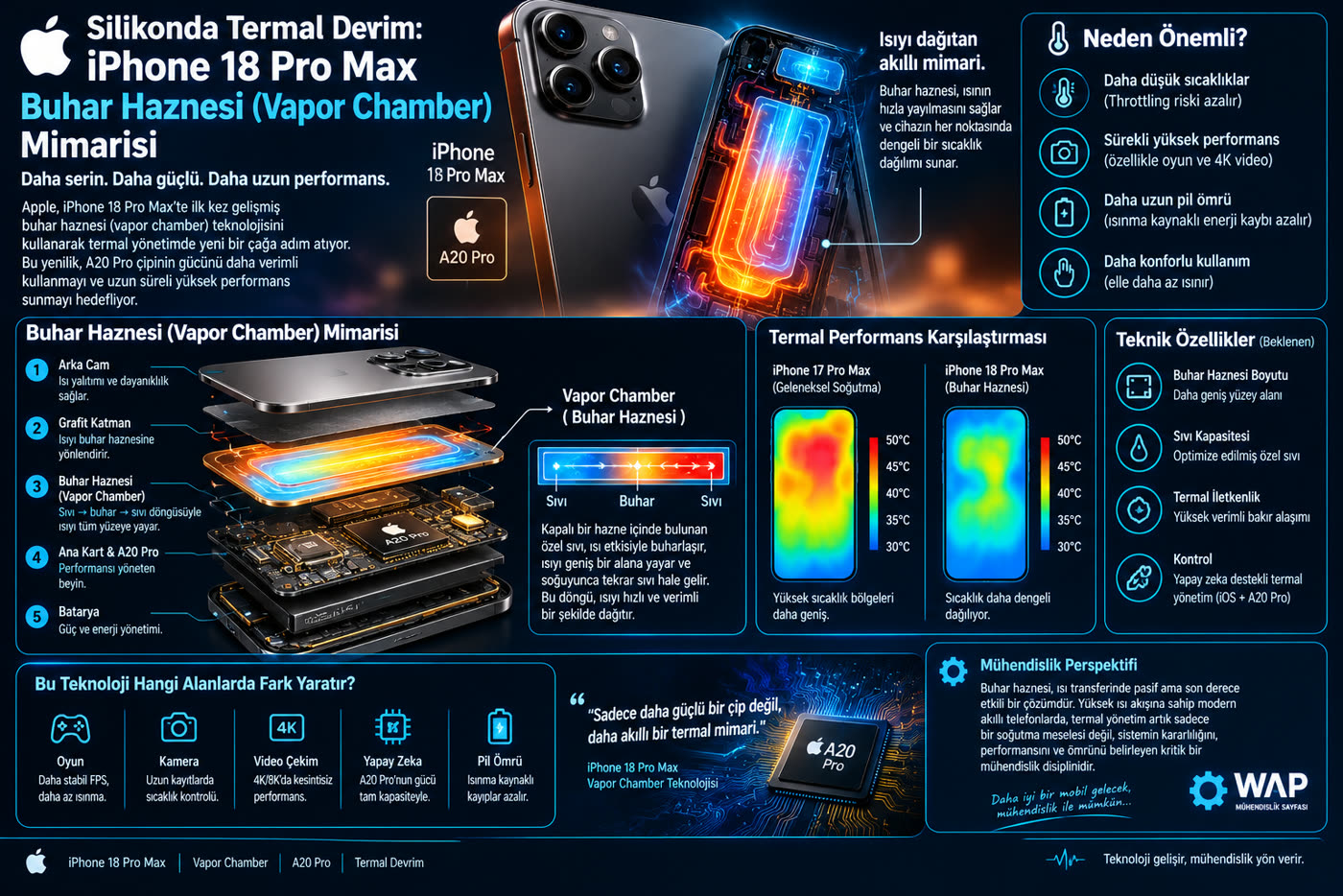
The iPhone 18 Pro keeps its Grade 5 titanium chassis while using a full-size Laser-Welded Copper Vapour Chamber in its inner body for the first time. This allows the A20 Pro chip to run at 94% stability under heavy graphics or AI loads without falling into thermal throttling.
The iPhone Duo, on the other hand, delivers the foldable form factor Apple has postponed for years with a Liquid Metal (Amorphous Alloy) Geared Hinge architecture. Its Ultra-Thin Glass (UTG) panel, which aims to eliminate the crease with an optical refraction layer, unfolds into a seamless 7.8-inch micro OLED workspace.
Technical Specifications and Hardware Matrix
| Parameter | iPhone 18 Pro | iPhone Duo |
|---|---|---|
| Processor | A20 Pro (2nm GAAFET) | A20 Pro (2nm GAAFET) |
| RAM Capacity | 12 GB LPDDR5X | 16 GB Unified Memory |
| Display Architecture | 6.3" ProMotion OLED (3000 nits) | 6.1" Outer + 7.8" Foldable UTG OLED |
| Thermal Solution | Copper Vapour Chamber | Split Graphite Layers |
| NPU Performance | 60 TOPS (16-Core) | 60 TOPS (16-Core) |
Pre-Order Analysis: What Did Consumers Like, and What Did They Criticise?
According to pre-order figures, there is a clear polarisation among buyers. In the first 48 hours of global orders, the iPhone 18 Pro held on to its traditional user base, while tech enthusiasts and professionals filled up the iPhone Duo order queues.
- The end of overheating issues thanks to the vapour chamber in the iPhone 18 Pro.
- Local AI tasks running with zero latency without an internet connection.
- The crease on the iPhone Duo made almost completely invisible.
- Top-tier background app stability with 16 GB of RAM.
- The iPhone Duo's 10.4 mm thickness when closed and its 255-gram weight.
- The omission of the periscope telephoto lens from the Duo body.
- AI features being optimised only for the A20 Pro generation.
- The steep price tag of the Duo and concerns about screen repair costs.
The iPhone 18 Pro, the thermal pinnacle of the traditional chassis, or the iPhone Duo, which offers a tablet experience with its foldable body? Share your thoughts in the comments!