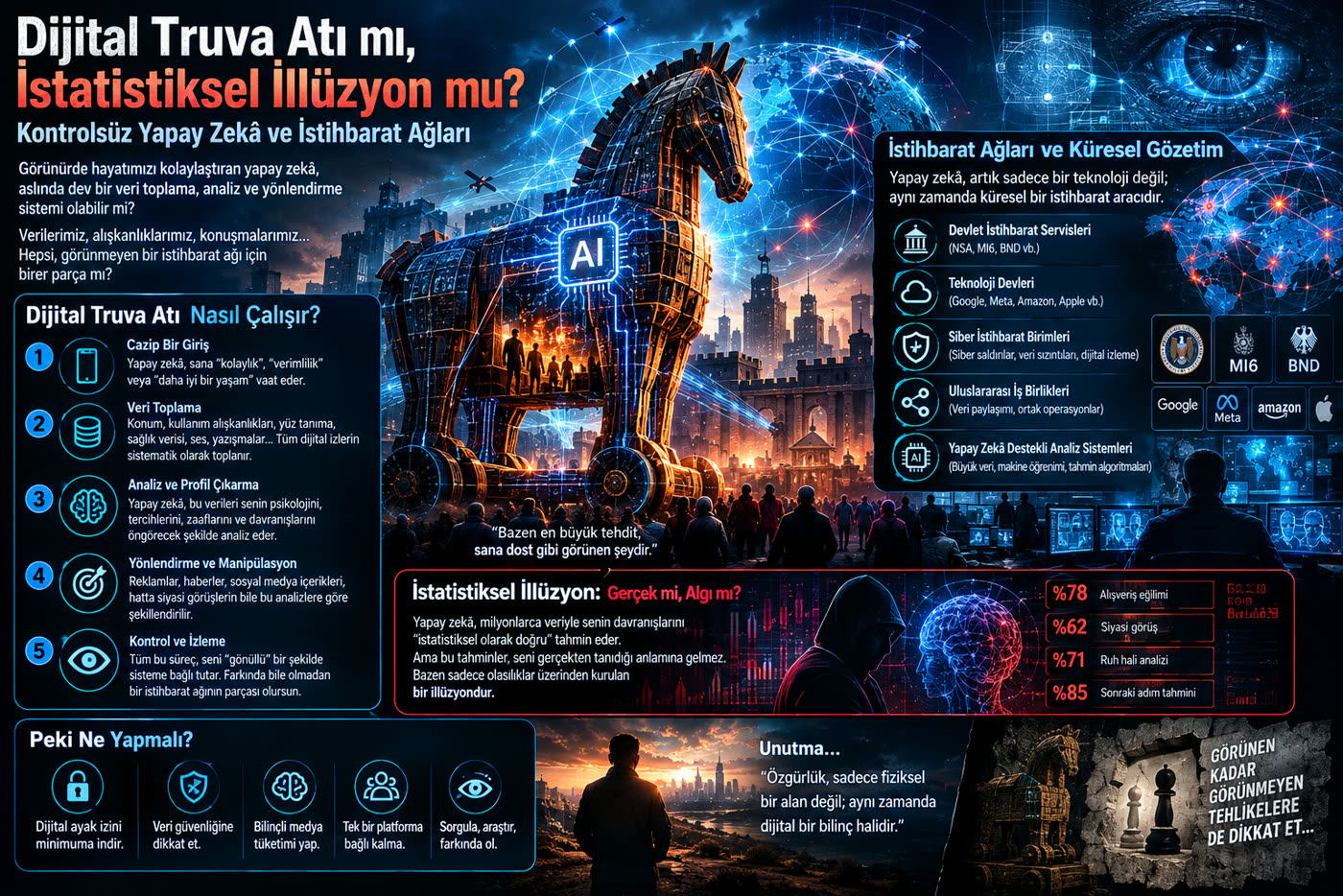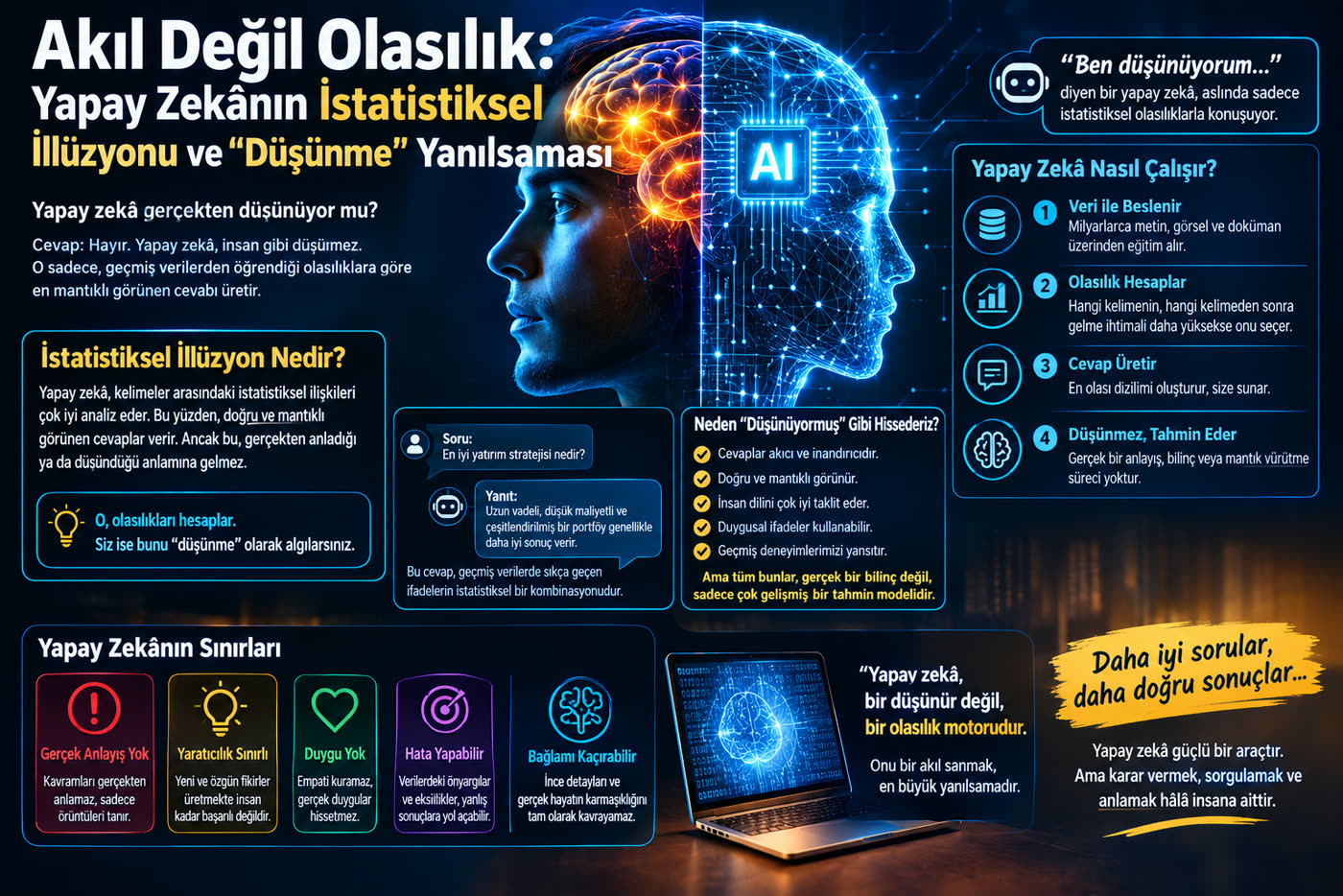
As an electrical-electronics engineer, when I look at circuit boards, microcontrollers or artificial neural networks, I don't see magic; I see mathematics, linear algebra and voltage levels. Yet today, when a large share of humanity sits in front of a screen and chats with an AI model, they assume there is a being on the other side that thinks, feels and sometimes even "has become conscious." Humans carry an ancient psychological weakness that makes us ready to treat anything that forms sensible sentences as conscious: anthropomorphism (attributing human traits to non-human things).
So what do we find when we lift the curtain and go down to the silicon chips and tensor blocks behind those shiny interfaces? I hate to disappoint you, but there is no "mind" there. What we are facing is the most flawless, most sophisticated statistical illusion in human history. Let's decode, in technical terms, why AI doesn't "think" and is simply a prediction engine with trillions of parameters.
AI models don't grasp meaning; they pick the next token with the highest statistical probability in a high-dimensional space.
1. Next-Token Prediction: Conditional Probability, Not Cognition
The mathematical principle at the heart of today's LLMs (large language models) is surprisingly simple: predicting the next word fragment (token).
When you give the model an input like "Why is the sky...", it doesn't picture the blue of the sky or internalize the physical reality of Rayleigh scattering in the atmosphere. All the model does is scan the weight matrices it learned from terabytes of text scraped from the internet and solve this conditional probability function:
To the model, the word "blue" isn't an ontological definition of a color; it is the set of coordinates in a vector space of thousands of dimensions that sits closest, by cosine similarity, to the "sky" vector. If every text you trained the model on said "The sky is green," the model would claim the sky is green with the same unshakable confidence. Because for the model there is no "true" or "false"; there is only the sequence that is "statistically the best fit".
2. "Hallucination" Isn't a Bug; It's How the System Naturally Works
When an AI cites a made-up paper or describes a historical event that never happened, users usually say, "The model made a mistake, it went crazy." Technically, this is completely wrong. The model didn't make a mistake; it carried out its task perfectly.
An AI is not an SQL engine querying a database; it is a text completion mechanism. When you ask it an academic question, it knows from statistical patterns that the answer should include a bibliography. If it has no real bibliography to hand, it weaves together a block of text that looks letter for letter like an academic citation format (Author, Year, Journal Name, DOI): grammatically flawless but entirely fictional. That's why the literature calls it a "stochastic parrot": it is no different from a parrot that imitates sounds it doesn't understand with perfect diction.
Human Reasoning vs. AI Convergence
| Feature | Human Mind (Cognitive Process) | Large Language Model (LLM) |
|---|---|---|
| Core Mechanism | Conceptual Understanding & Causality | Correlation & Probabilistic Completion |
| Perception of Reality | Sensory contact with the physical world | Digitized text tokens (zero senses) |
| Trust in Information | Doubt, verification, a filter of logic | Density distribution in the training data |
| State of Consciousness | Conscious existence (Sentience) | Pure Mathematical Illusion (Zero-Sentience) |
3. The Chinese Room: The Difference Between Syntax and Semantics
Philosopher John Searle's famous "Chinese Room" thought experiment, proposed in 1980, summed up the AI reality we face today 45 years in advance.
Put a man who doesn't know a single word of Chinese in a closed room. Give him a huge rulebook: "If the paper slipped under the door has this symbol on it, find this matching symbol in the box and push it back out." A Chinese speaker outside, seeing the flawless replies coming out of the room, will assume a genius fluent in Chinese is sitting inside. Yet the man inside doesn't know the meaning of a single symbol; he is only applying the matches in the rulebook.
The giant models running in data centers, powered by billions of kilowatt-hours of electricity burned by trillions of transistors, are exactly the man in that room. They imitate syntax perfectly but are completely devoid of semantics (meaning).
Engineering Verdict: Don't Deify the Tool
The purpose of this analysis is by no means to belittle AI. On the contrary, the fact that a statistical model can model the complexity of human language so flawlessly is one of the greatest triumphs in the history of computer science. When writing code, analyzing circuit schematics or summarizing data, these tools are unmatched productivity multipliers.
The danger lies not in the tool's power but in the user's surrender. The moment we forget that what we are facing is not a "consciousness" but a high-dimensional tensor calculator, we start mistaking hallucinations for reality and statistical predictions for unchanging truth. The most valuable engineering and mental skill of the future won't be asking AI questions; it will be preserving the genuine reasoning ability to pass its statistical answers through a filter of critical logic.
Have you ever read an AI model's answer and felt as if there were a living mind on the other side? Or what was the "hallucination" that surprised you most? Share your thoughts in the comments!