Until recently, home appliances were little more than electromechanical boxes that carried out a few fixed mechanical commands: you turned a knob, set the temperature and pressed start. But the breakthrough in consumer electronics and artificial intelligence has shaken that traditional structure to its core. Today, the refrigerator in our kitchen or the washing machine in our bathroom is no longer just a tool doing physical work; each is becoming a cognitive data station that monitors our daily routines, consumption frequency and environmental conditions.
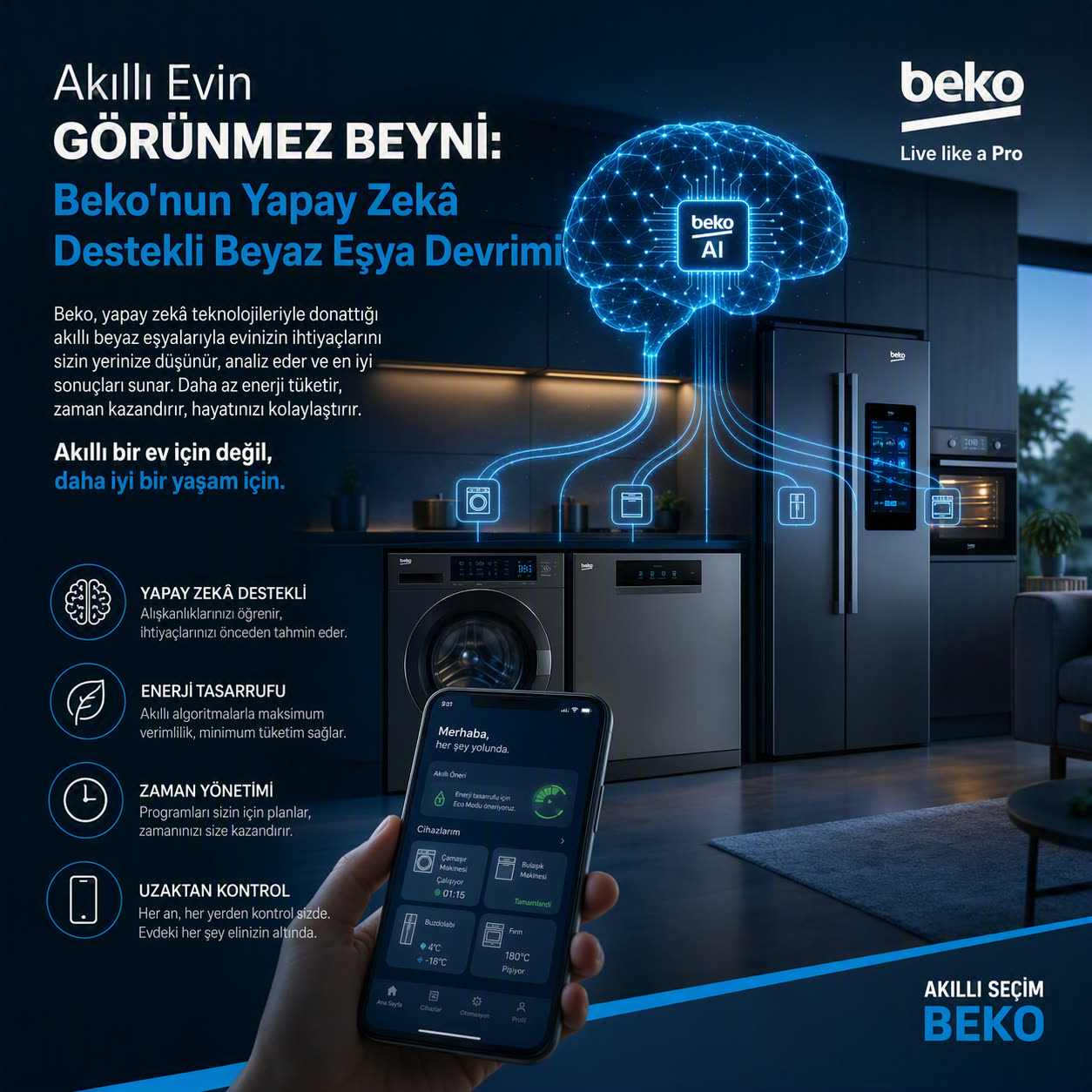
Beko, one of the biggest players in the global home appliance market, sits at the center of this transformation with the deep learning algorithms, the IoT (HomeWhiz) ecosystem and the sensor fusion technologies it has integrated into its production lines in recent years. We take an in-depth look at how these systems "learn" us step by step, how they autonomously cut energy consumption, and the engineering topology running in the background.
Modern home appliances calculate the most efficient operating path in real time using microcontrollers and sensor data, with no need for user intervention.
Sensor Fusion: How Do Appliances "Sense" Us?
For a device to learn our habits, it first has to perceive its surroundings. The architecture Beko uses in its new-generation ranges goes beyond classic timers and relies on a multi-layered sensor network:
- Optical Turbidity and Load Sensing: In dishwashers and washing machines, optical sensors that measure water clarity read the amount of particles in the water at millisecond intervals. By analyzing the soil level, the machine dynamically reprograms the water volume and wash cycle instead of following fixed, predefined programs.
- Thermal Mapping and Humidity Control: Smart humidity sensors in tumble dryers lower the drum motor speed according to the fabric type and dryness level, preventing fiber wear.
- Refrigerator Door Frequency and Temperature Control: Refrigerators model the household's wake-up, return-from-work and meal-preparation times based on how often the door is opened. They ramp up compressor speed just before the hours when the door is opened most, neutralizing internal temperature fluctuations (Delta-T); during deep-sleep hours they switch themselves into an ultra-low-power mode.
Edge AI and HomeWhiz Integration
When people hear "smart device," the first thing that comes to mind is cloud dependency. Beko's R&D investments, however, focus on an Edge AI architecture that processes data on the device's own microprocessors rather than just sending it to remote servers.
- Autonomous Dosing (AutoDose): Regression models that combine laundry weight, water hardness and soil index optimize detergent use down to the milliliter, preventing excessive chemical release.
- Predictive Maintenance: The current profile drawn by inverter BLDC motors is monitored continuously. Hardware faults such as bearing wear or pump blockage are detected from vibration and harmonic current anomalies weeks before the appliance breaks down, and the user is alerted.
- HomeWhiz IoT Bridge: All appliances in the home communicate with each other and with the mobile ecosystem. The range hood automatically adjusts its extraction power according to the type of dish cooking in the oven, with no user intervention required.
Grid Load and Energy Management (Smart Grid)
From an electrical engineering perspective, the most critical parameter for household appliances is grid load management (peak shaving). Peak hours on the power grid (the evening hours when consumption hits its maximum) are the periods with the highest cost per kilowatt-hour and the highest carbon emissions.
Beko's investments in energy efficiency allow appliances to communicate with smart grids. When you load your machine with detergent and laundry and leave it "ready," the system calculates the night-time window when the local electricity tariff is cheapest and the share of renewable energy is highest (for example, between 02:00 and 05:00) and starts the wash on its own. This protects the household budget and also balances the sudden load placed on transformer substations.
Conventional vs. AI-Powered Home Appliances
| Parameter | Conventional System | AI / Beko Architecture |
|---|---|---|
| Program Selection | Fixed manual selection by the user | Autonomous parameter setting via sensor fusion |
| Energy Consumption | Fixed-cycle, full-power consumption | Real-time optimized power with an inverter BLDC motor |
| Maintenance and Fault Detection | Generates an error code once the appliance fails | Predicts faults in advance from current fluctuations |
| User Habits | None (every cycle starts from scratch) | Profiles usage times and preferences |
Is it comfort or a loss of control when your appliances make consumption decisions on their own and model your routines? Let's discuss your views and smart appliance experiences below.