Humanity's dream of conquering the sky goes back thousands of years. But rising into the sky comes with a deadly price: gravity. With the "Aerial Screw" we examined in our previous article and the giant winged flying machines (ornithopters) he designed, Da Vinci had set his mind on lifting humans above the clouds. But what would happen if a wooden part broke during testing, or the system failed in mid-air?
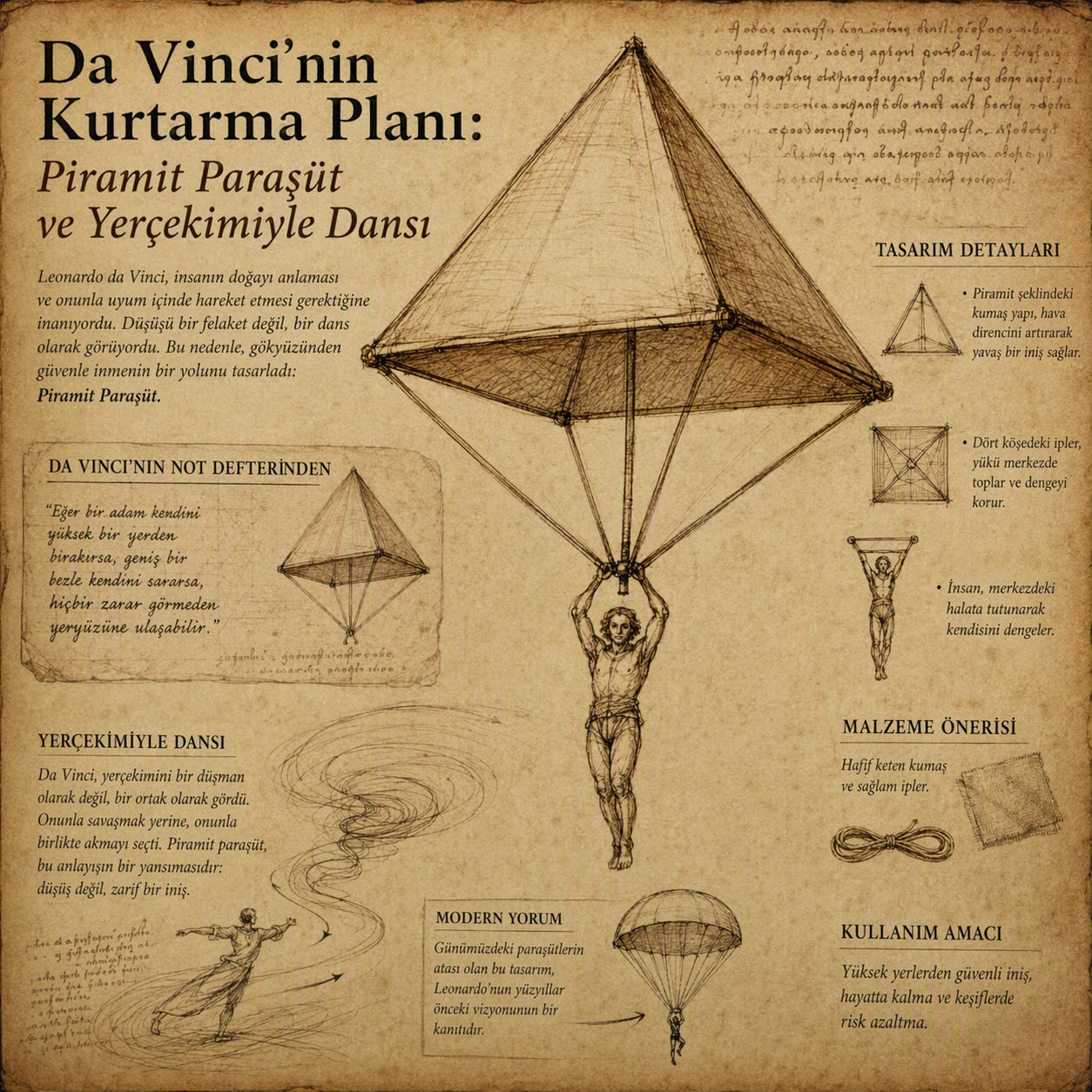
By 1485, Da Vinci had drawn history's first known systematic "emergency rescue plan" in his famous notebook, the Codex Atlanticus. A mind that had until then puzzled over how to fly had this time created a masterpiece about "falling safely": the Pyramid Parachute.
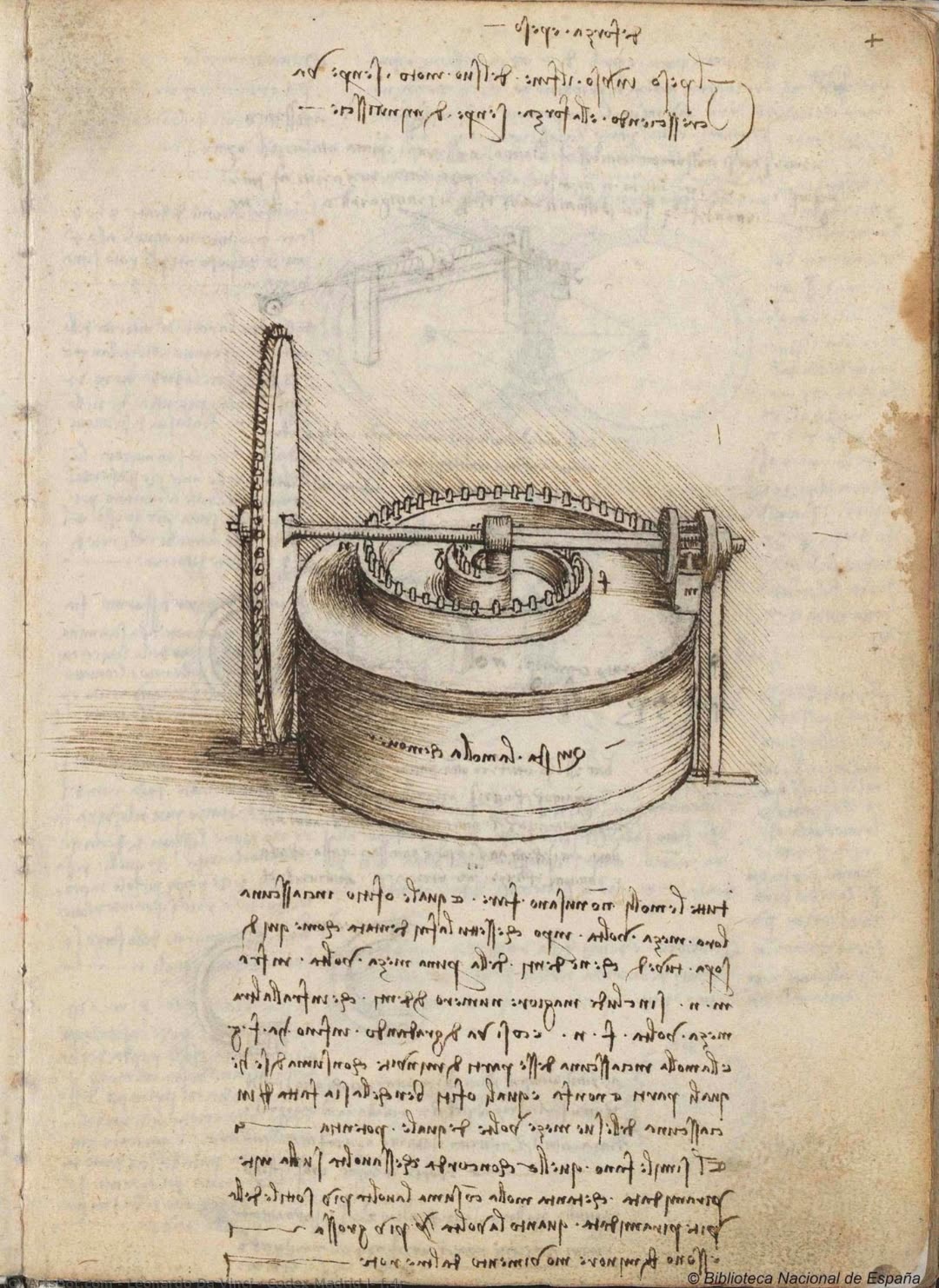
Da Vinci's original note: "If a man has a tent made of linen without any openings, each side 12 braccia (about 7 meters) long, he will be able to throw himself down from any great height without suffering any injury."
Engineering and Energy: The Physics of the Fall
To understand the basic logic of a parachute, we need to look at it from the perspective of modern energy conversion (thermodynamics and fluid mechanics). A person jumping from a high cliff has an enormous amount of potential energy (Ep = m·g·h). As they begin to fall, this potential energy is rapidly converted into kinetic energy (Ek = 1/2·m·v²), and the velocity (v) reaches deadly levels within seconds.
This is exactly where Da Vinci's parachute steps in as an "energy absorber." Thanks to its large surface area, it collides with air molecules and creates a tremendous drag force (air drag). This aerodynamic resistance converts the kinetic energy of the fall into thermal energy by heating the air molecules. As a result, the person stops accelerating and locks onto a survivable, constant terminal velocity of roughly 5-6 meters per second. In the 15th century, when the laws of gravity and air resistance had not yet been written by Newton, the fact that Da Vinci intuitively worked out this energy-dissipation math is, quite literally, astonishing.
- Structural Integrity: Modern parachutes are made from flexible, lightweight materials such as nylon and silk, and they take on a dome shape as they fill with air. Da Vinci, however, had only heavy linen. To keep the linen from leaking air, he coated it with resin.
- Wooden Frame: To keep the heavy, stiffened fabric from folding and collapsing in the air, he stretched the design over a wooden frame made of pine. Geometrically, the most robust three-dimensional structure that traps the wind most evenly was a pyramid.
- Aerodynamic Stability: Modern dome parachutes swing like a cradle (oscillation) because they spill air unevenly from the sides. Da Vinci's angular, rigid pyramid design, by contrast, provided surprisingly smooth vertical stability during the descent.
Modern Science Put It to the Test: Does It Work?
Da Vinci never got to test this parachute himself. For centuries, historians and physicists argued that this heavy pyramid, with an 85-kilogram wooden frame, could not carry a person and would flip over and crash into the ground.
Until the year 2000... British skydiver Adrian Nicholas built the parachute in complete fidelity to Da Vinci's original drawings, using no modern materials at all (only linen, resin and wood). He jumped with Da Vinci's 90-kilogram pyramid from a hot-air balloon at an altitude of 3,000 meters. The result stunned modern science: the parachute worked perfectly! Unlike modern parachutes, it lowered Nicholas safely toward the ground in a magnificent glide without the slightest jolt. (He separated from it only in the final stretch and landed with a modern reserve parachute, so that the wooden frame would not crush him on impact.)
What do you think about a man calculating energy conversion and air resistance so flawlessly 500 years ago, before the laws of physics had even been written? In the next installment of our Da Vinci series, should we examine the Armored Tank or the Robot Knight?