Modern aviation may be associated with 20th-century names such as the Wright Brothers or Igor Sikorsky, but the mathematical foundations of an aircraft capable of vertical takeoff (the helicopter) were laid a full 500 years earlier. In 1493, in an age without electric motors, carbon fiber or wind tunnels, a genius looked up at the sky and imagined that air, just like water, could be conquered by "boring through it with a screw."
Meet the ground zero of modern aeronautical engineering: Leonardo da Vinci's "Aerial Screw". In this article, we treat Da Vinci's legendary invention not merely as a historical drawing but put it through an in-depth engineering test in terms of aerodynamics, thrust and materials science.
The original Aerial Screw sketch from Da Vinci's notebooks. Using the density of air, it aimed to climb into the sky just as a screw bores into wood.
How It Works: The Logic of "Screwing" Into the Air
Da Vinci's mind worked by observing nature. He studied the Archimedes' screw, used in Ancient Greece to lift water, and reasoned: "If water can be lifted with the help of a screw, then air can be pushed downward by a screw turned fast enough, and the machine can thereby rise."
The machine consisted of a sturdy central mast rising from a wooden platform and a helical (spiral) rotor wrapped around that mast and covered with linen cloth. Thin wire and reeds were used to keep the fabric taut. The planned propulsion (engine) system relied entirely on human power: four men on the platform had to push the levers around the center while running, spinning the spiral rapidly.
- Power-to-Weight Ratio: There was no aluminum or carbon fiber in the 15th century. Built from wood and heavy linen, this machine could have weighed on the order of tons. The muscle power of four men could never generate enough thrust to free that mass from gravity.
- The Anti-Torque Problem (No Tail Rotor): According to Newton's law of action and reaction, as the main rotor turned in one direction, the platform beneath it would start spinning like a top in the opposite direction. Modern helicopters use a tail rotor to counter this torque; Da Vinci had not yet foreseen it.
- The Air Density Error: Water is incompressible and dense, which is why the Archimedes' screw works so well in water. Air, however, is a gas: it is compressible and tends to escape. A flat spiral of cloth would have flung the air sideways instead of pushing it down.
Its Legacy to Modern Aviation
The Aerial Screw was never built or flown. Yet the idea that an object can overcome its own weight by pushing air downward (Vertical Takeoff and Landing - VTOL) was written into the history of physics in golden letters. Centuries later, Da Vinci's vision inspired engineers such as Igor Sikorsky, who developed the first practical helicopters (the VS-300) in the 1930s.
The drones we use today, the Ingenuity helicopter we flew over the surface of Mars and giant military rotorcraft are all, at their core, modern motorized versions of the spiral of cloth an Italian genius sketched in his notebook 500 years ago.
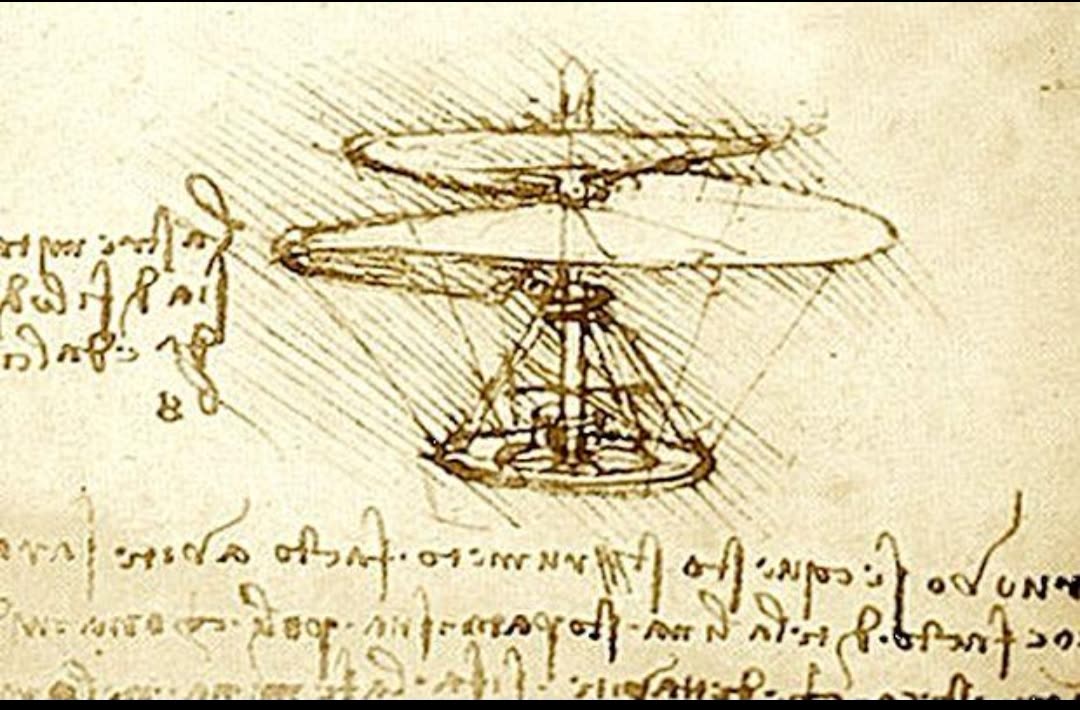
The original Aerial Screw sketch from Da Vinci's notebooks. Using the density of air, it aimed to climb into the sky just as a screw bores into wood.
We have made a fantastic start to our Da Vinci technology series. Which of his military or mechanical inventions (the Machine Gun, the Armored Tank or the Robot Knight) would you like us to put on our engineering bench next? Let us know in the comments!