1. Acoustic Isolators: The EV "Unmasking" Crisis and Constrained Layer Damping
In conventional internal combustion engine (ICE) vehicles, the continuous 60 Hz – 250 Hz mechanical rumble of piston combustion and exhaust resonance acts as an acoustic blanket, masking secondary noises. When Elon Musk and Tesla engineers eliminated the combustion powertrain across the Model S, Model 3 Highland, Model Y Juniper, and Cybertruck, they confronted a fundamental NVH (Noise, Vibration, and Harshness) paradox: without engine noise, the human ear becomes hyper-sensitive to 1,000 Hz – 5,000 Hz aerodynamic wind turbulence, tire-cavity road roar, and high-frequency SiC inverter switching whine.
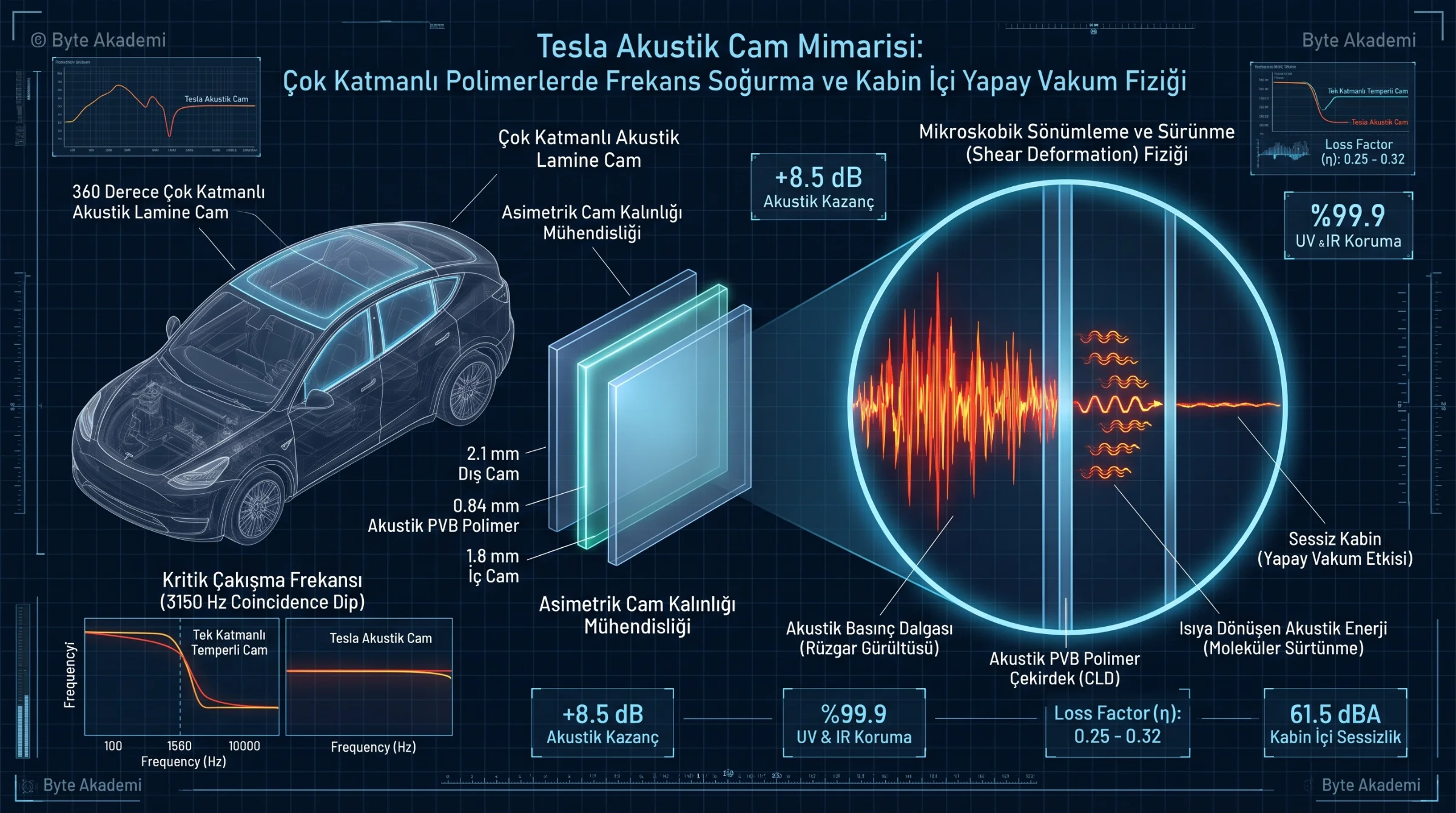
Standard automotive side windows made from monolithic tempered glass act like rigid drumheads at highway speeds, resonating with incoming pressure waves and transmitting wind noise directly into the cabin. To engineer an "artificial acoustic vacuum", Tesla transitioned to 360-degree Multi-Layer Acoustic Laminated Glass across the windshield, side doors, and panoramic roof.
This acoustic sandwich consists of an outer 2.1 mm soda-lime glass pane, a specialized 0.76 mm – 0.84 mm tri-layer Acoustic PVB (Polyvinyl Butyral) viscoelastic polymer core, and an inner 1.8 mm – 2.1 mm glass pane. When exterior sound waves flex the outer glass, the soft polymer core acts as a Constrained Layer Damper (CLD). Instead of transferring mechanical vibration to the inner glass, the long-chain polymer molecules slide past one another under shear strain, dissipating acoustic energy into imperceptible molecular friction heat.
Multi-layer acoustic glass does not merely block wind noise—its 0.84 mm viscoelastic polymer core converts incoming acoustic wave pressure into microscopic thermal energy through shear deformation.
2. Decibel Analysis: Eradicating the 3,150 Hz "Coincidence Dip"
According to the acoustic Mass Law, doubling the mass of a solid barrier increases Sound Transmission Loss (STL) by roughly 6 dB. However, doubling glass thickness on an electric vehicle severely penalizes curb weight and EPA driving range. Tesla achieves superior decibel attenuation without weight penalties by maximizing the viscoelastic Loss Factor (η) of the interlayer.
Between 2,500 Hz and 4,000 Hz, monolithic tempered glass suffers from a severe acoustic drop-off known as the Critical Coincidence Dip—where the wavelength of airborne sound matches the bending wave velocity of the glass, making the window acoustically transparent. Tesla's tri-layer acoustic PVB dampens this exact bending wave, boosting STL by 6 dB to 9 dB. Because the decibel scale is logarithmic, an 8.5 dB reduction eliminates over 85% of incoming acoustic wave energy, cutting perceived cabin wind noise nearly in half.
// 1. SOUND TRANSMISSION LOSS (STL) AT COINCIDENCE REGION:
STL (dB) = 20 * log10( f * m_s ) - 47.3 - 10 * log10( 1 / eta_total )

// 2. CRITICAL COINCIDENCE FREQUENCY (f_c):
f_c = ( c_0^2 / (2 * pi * h) ) * sqrt( 12 * rho * (1 - nu^2) / E )

// 3. ACOUSTIC ENERGY DISSIPATED AS HEAT VIA POLYMER SHEAR:
E_dissipated = pi * eta_PVB * G_prime * (gamma_0)^2

f        : Acoustic Frequency (Hz - Aero Wind Rush: 1,500 - 4,000 Hz)
m_s      : Surface Mass Density of Glazing (kg/m²)
eta_total: Composite Damping Loss Factor (Tempered: 0.002 vs Acoustic PVB: 0.28)
c_0      : Speed of Sound in Air (343 m/s)
G_prime  : Dynamic Shear Storage Modulus of PVB Core (Pa)
gamma_0  : Interlayer Shear Strain Amplitude
[Sound Transmission Loss (STL) Across the 1,000 Hz - 5,000 Hz Aero-Acoustic Band]
Sound Isolation / STL (dB)
45 | .---'---. <-- Tesla Acoustic Laminated Glass
40 | .--------' ' (Viscoelastic Tri-Layer PVB)
35 | .--------' \
30 | .--------' \ +8.5 dB Gain (85% Acoustic Energy Absorbed)
25 | .--------' .---. v
20 |-----' / \ .----.
15 | / '----------' '-- <-- Standard Tempered Auto Glass
+--------------------------------------------------------- (3,150 Hz Coincidence Dip!)
250 Hz 500 Hz 1000 Hz 2000 Hz 3150 Hz 5000 Hz (Frequency)| Acoustic & Glazing Metric | Monolithic Tempered Glass (Single 4.0 mm) | Standard Laminated Glass (Regular PVB 4.4 mm) | Tesla Acoustic Laminated Glass (Tri-Layer PVB 4.8 mm) |
|---|---|---|---|
| Cross-Section Architecture | Single Solid Tempered Pane | 2.1 mm Glass + 0.38 mm PVB + 2.1 mm Glass | 2.1 mm Glass + 0.84 mm Acoustic Core + 1.8 mm Glass |
| Composite Loss Factor (η) | 0.002 (High Ringing / Resonance) | 0.06 – 0.08 | 0.25 – 0.32 (High Viscoelastic Shear Damping) |
| 3,150 Hz Coincidence Isolation (STL) | ~26.5 dB (Severe Wind Leak) | ~32.0 dB | 38.5 – 41.0 dB (+8.5 dB Aero Noise Suppression) |
| 75 mph (120 km/h) Cabin SPL | 68.5 – 71.0 dBA | 65.5 – 67.0 dBA | 61.5 – 63.0 dBA (Recording Studio Quietness) |
| UV & Infrared (IR) Solar Rejection | 65% UV Block (High HVAC Load) | 95% UV Block | 99.9% UV + Silver-Oxide IR Coating (EV Range Saver) |
| Auto Glass Insurance & Intrusion Security | Shatters Instantly (0.5s Break-in) | Cracks but Holds | Impact-Absorbing Security Barrier (10x Intrusion Delay) |
3. Human Perception & Neurology: Why Silencing 3,000 Hz Prevents Driver Fatigue
The engineering triumph of acoustic glazing extends far beyond decibel meters into psychoacoustics and human neurobiology:
- Fletcher-Munson Equal-Loudness Contours & Ear Canal Resonance: Due to the physical geometry of the human auditory canal (~2.5 cm tube), our hearing naturally amplifies frequencies between 2,500 Hz and 4,000 Hz by 10 to 12 dB. Crucially, the exact frequency where standard tempered auto glass fails (the 3,150 Hz coincidence dip) is the exact frequency where the human auditory cortex is most sensitive!
- Amygdala Activation & Cortisol Stress Response: In evolutionary neurology, the 2,000 Hz – 4,000 Hz spectrum corresponds to distress screams and alarm signals. Prolonged exposure to high-frequency highway wind hiss triggers low-level activation of the amygdala and the HPA (Hypothalamic-Pituitary-Adrenal) axis, elevating blood cortisol levels and inducing driver exhaustion. By selectively crushing the 3,150 Hz peak, acoustic glass dramatically reduces cognitive fatigue during long-distance EV road trips.
- Synergy with Active Road Noise Cancellation (ANC): While viscoelastic glass absorbs high-frequency (1,000 Hz+) wind turbulence, low-frequency (50 Hz – 200 Hz) tire-cavity boom passes through glass. Tesla pairs its acoustic glazing with seat-mounted accelerometers and headrests microphones that fire 180-degree phase-inverted sound waves through the cabin subwoofer array—achieving full-spectrum silence.
4. Conclusion: Engineering an Artificial Vacuum on Wheels
By sandwiching a 0.84-millimeter viscoelastic polymer core between asymmetric glass panes, Tesla transforms the entire vehicle greenhouse into a continuous shear-damping absorber. Chaotic aerodynamic pressure waves striking the exterior at 75 mph are silently converted into nanowatts of heat, preserving cognitive clarity and turning the EV cabin into a rolling concert hall.