The Friction Barrier: Why Tires Alone Hit a Physical Wall
For over a century, automotive engineering has been governed by one unbreakable law of physics: even if an engine produces 2,000 horsepower or 10,000 Nm of torque, the force propelling the car forward is limited by the static friction between the rubber tire and the asphalt. On dry pavement, street-legal performance tires achieve a coefficient of friction ($\mu$) between 1.0 and 1.2, creating a physical ceiling around $1g$ ($9.81\text{ m/s}^2$) of longitudinal acceleration.
How, then, can a production car accelerate from 0 to 60 mph (0–100 km/h) in 1.1 seconds? Achieving that sprint requires nearly 2.5g of horizontal thrust—far beyond what any tire compound can transmit to the road. Tesla and SpaceX engineers solved this by bypassing the road surface altogether and applying Newton's Third Law of Motion directly to the air.
What Is the SpaceX Package? Falcon 9 Hardware in the Back Seat
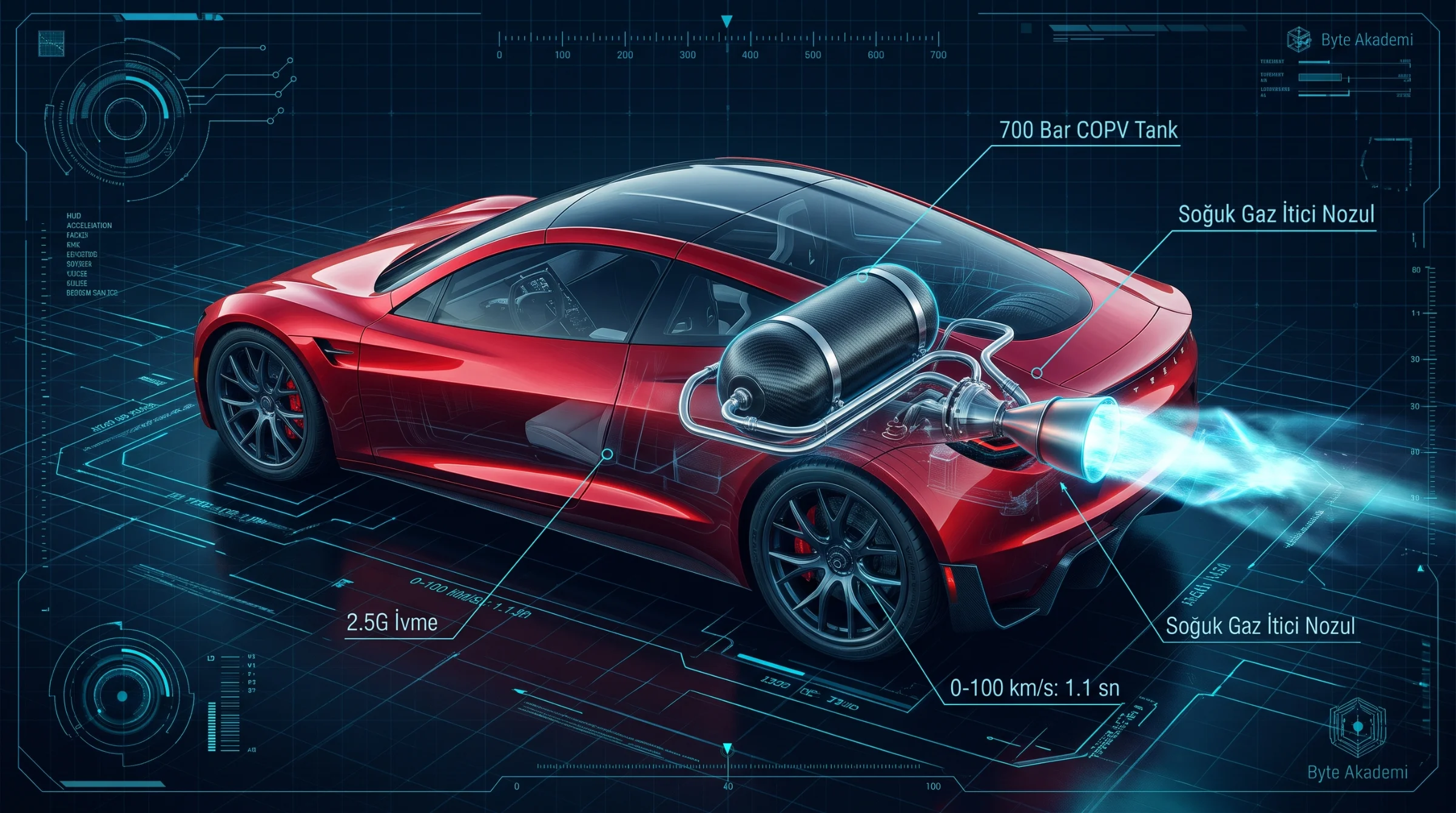
In the "SpaceX Package" configuration of the next-generation Roadster, the rear seats are completely removed. In their place sits a carbon-fiber COPV (Composite Overwrapped Pressure Vessel) derived directly from the Falcon 9 orbital rocket's attitude-control system, feeding a network of concealed Cold Gas Thrusters tucked behind the flip-down rear license plate and wheel arches.
Traditional chemical rockets combust fuel and oxidizer at 3,000°C, producing a lethal exhaust plume. To avoid incinerating traffic behind the vehicle, the Roadster uses zero combustion. Instead, ultra-high-pressure compressed air expands through a converging-diverging supersonic nozzle (De Laval Nozzle) to generate pure kinetic thrust.
Thermodynamics of 10,000 PSI (700 Bar) COPV Storage
A standard passenger tire holds roughly 32 PSI (2.2 Bar), while a scuba tank holds 3,000 PSI (200 Bar). The carbon-overwrapped COPV tank inside the SpaceX Roadster stores compressed air at an astonishing 10,000 PSI (nearly 700 Bar).
- Onboard Compression: Multi-stage high-pressure electric compressors powered by the main traction battery draw ambient air through desiccant dryers and pump it into the COPV vessel up to 700 Bar.
- De Laval Supersonic Nozzle: When launch control is triggered, high-speed electro-pneumatic valves open in milliseconds, routing 700-Bar air into a converging-diverging nozzle.
- Mach 2+ Exhaust Velocity: The gas chokes to Mach 1 at the narrow throat and accelerates past Mach 2 in the diverging bell, converting pressure potential into massive exhaust momentum.
// COLD GAS ROCKET THRUST EQUATION
F_thrust = m_dot * V_e + (P_e - P_a) * A_e

F_thrust : Net Thrust Force (Newtons)
m_dot    : Mass Flow Rate of Compressed Air (kg/s)
V_e      : Supersonic Nozzle Exit Velocity (m/s)
P_e, P_a : Nozzle Exit Pressure & Ambient Pressure (Pa)
A_e      : Nozzle Exit Cross-Sectional Area (m²)
0–100 km/h in 1.1 Seconds: Combining Two Propulsion Vectors
During a full-power launch, two independent propulsion architectures fire simultaneously:
- Electromechanical Traction (Tri-Motor Plaid Powertrain): One front and two rear carbon-sleeved electric motors push the tires to their maximum friction limit, delivering roughly 1.1g to 1.2g.
- Pneumatic Rocket Thrust: The main rear thruster generates 30,000 to 40,000 Newtons of reaction force, adding another 1.3g to 1.4g of horizontal acceleration independent of wheel grip.
Technical Comparison: Hypercar vs. SpaceX Roadster
| Engineering Parameter | Conventional Hypercar (ICE / Hybrid) | Tesla Roadster (Base) | Tesla Roadster (SpaceX Package) |
|---|---|---|---|
| Propulsion Mechanism | Tire Friction Only | 3x Electric Motors (AWD) | 3x Electric Motors + Cold Gas Thrusters |
| 0 - 100 km/h (0-60 mph) | 2.3 - 2.5 seconds | 1.9 seconds | ~1.1 seconds |
| Peak Longitudinal G-Force | ~1.15 g | ~1.44 g | ~2.50 g (Fighter Jet Catapult Level) |
| Pressure Vessel | None | None | 700 Bar (10,000 PSI) Carbon COPV |
| Cornering & Braking Aid | Mechanical Brakes + Aero | Regen + Carbon Ceramic | 10 Directional Reaction Control Nozzles |
Beyond Straight Lines: Vectoring Through Corners and Adiabatic Freezing
Up to 10 directional thrusters positioned around the chassis transform vehicle dynamics:
- Lateral Cornering Thrust: Firing outward-facing nozzles pushes the car into the apex of a turn, counteracting centrifugal force.
- Pneumatic Emergency Braking: Forward-facing nozzles fire ahead to slash stopping distances beyond tire grip limits.
- Adiabatic Expansion & Cryogenic Cooling: Expanding gas from 700 Bar to 1 Bar causes an extreme temperature drop below -100°C. Specialized moisture scrubbers and aerospace valve alloys prevent ice crystals from jamming the nozzles mid-launch.
Engineering Verdict: Carrying a 10,000 PSI pressure vessel capable of 130+ dB supersonic bursts represents the ultimate convergence of aerospace and automotive engineering—turning a street-legal electric sports car into a ground-bound spacecraft.