Ever since the dawn of the Industrial Revolution, humanity has grappled with an unrelenting dilemma: Is it possible to generate limitless base-load electricity without polluting the biosphere, accelerating climate catastrophe, or leaving behind mountains of long-lived radioactive waste? Fossil fuels choke our atmosphere, conventional nuclear fission generates hazardous spent fuel, and intermittent renewables remain hostage to weather cycles. Yet, deep inside cutting-edge physics laboratories across the globe, an ultimate energy paradigm is approaching commercial reality: Nuclear Fusion, often hailed as the quest for an "Artificial Sun".
For billions of years, our Sun and trillions of distant stars have illuminated the cosmic void using this exact thermonuclear process. Today, nuclear physicists and advanced engineers are recreating that stellar forge right here on Earth, trapping high-energy plasma inside magnetic cages. How do you suspend a 150-million-degree fire without vaporizing the reactor vessel? Why is a catastrophic core meltdown mathematically impossible? Below is a comprehensive engineering investigation into the physics, magnetics, and thermodynamic thresholds of magnetic confinement fusion.
1. Fusion vs. Fission: Plasma Physics at the Stellar Core
Existing commercial nuclear power stations operate via Nuclear Fission. Heavy, unstable atomic nuclei such as Uranium-235 or Plutonium-239 are bombarded with thermal neutrons, causing them to split into lighter fragments while discharging substantial kinetic energy. However, fission produces actinides and fission fragments that remain dangerously radioactive for thousands of years.
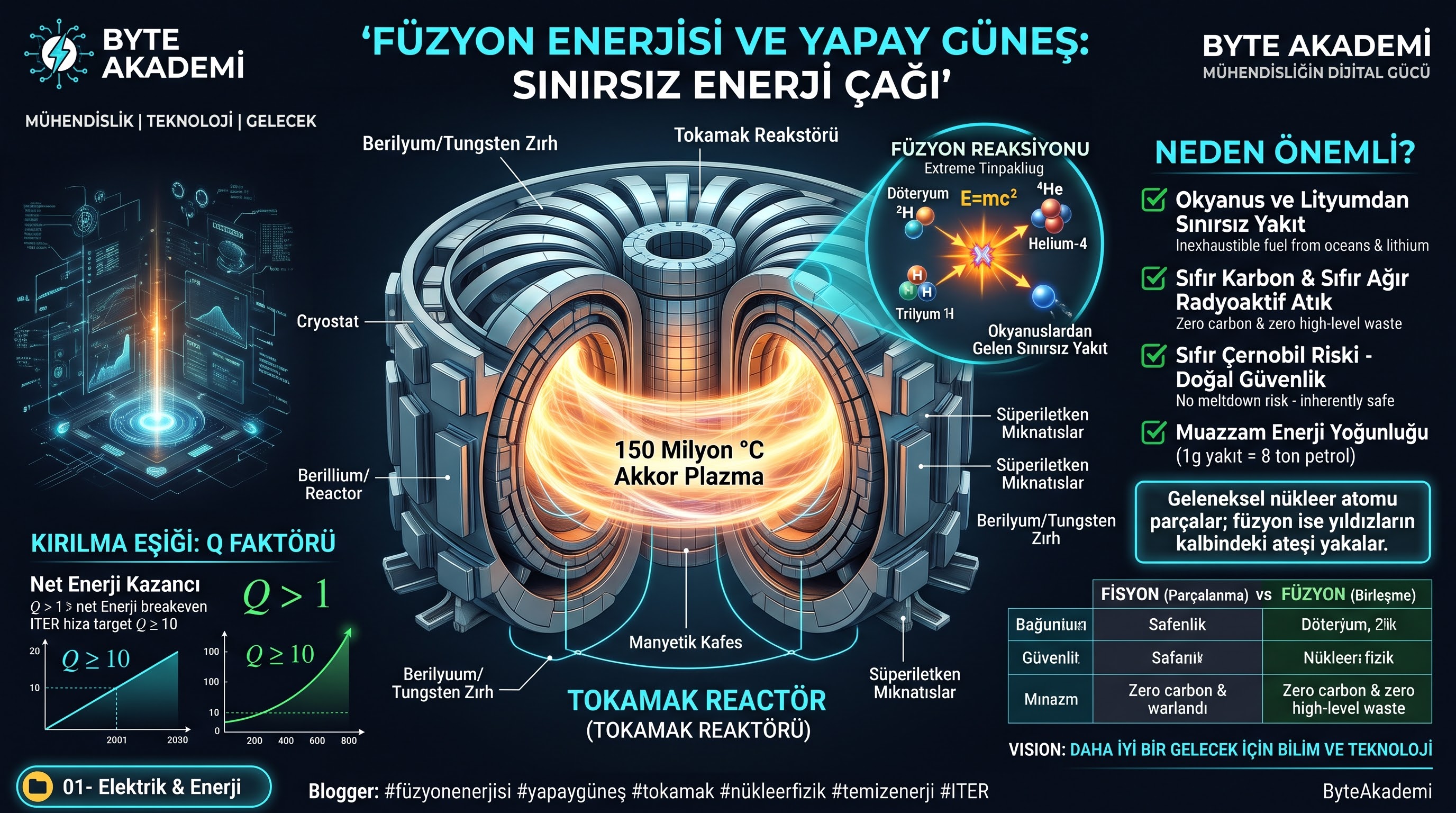
Nuclear Fusion operates on the diametrically opposed principle. Light hydrogen isotopes—Deuterium (²H) and Tritium (³H)—are subjected to extreme thermal kinetic energy and electrostatic compression until their nuclei overcome natural repulsion and fuse into Helium-4, releasing an energetic neutron:
- Overcoming the Coulomb Barrier at 150 Million °C: Positively charged protons naturally repel one another via electrostatic forces. To force them into proximity where the strong nuclear force takes over, the gaseous fuel is stripped of its electrons to form a fully ionized plasma and heated to 150 million degrees Celsius—ten times hotter than the center of the Sun.
- Extreme Energy Density: The mass deficit converted to energy via Einstein's mass-energy equivalence equation ($E=mc^2$) yields staggering power. One gram of Deuterium-Tritium fuel releases thermal energy equivalent to burning approximately 8 tons of petroleum or 11 tons of coal.
- Virtually Inexhaustible Fuel Reserves: Deuterium is readily extracted from ordinary seawater at nominal cost. The deuterium present in a bathtub of water, coupled with the lithium found in a single laptop battery, contains enough potential fusion energy to cover an individual's total electrical consumption for 30 years.
Fission splits atoms leaving radioactive waste; fusion captures the fire of stars to deliver boundless, carbon-free power.
2. Magnetic Confinement: How Tokamaks Contain Stellar Fires
No solid material in the universe can come into physical contact with a 150-million-degree medium without instantaneously melting and vaporizing. The engineering breakthrough that makes fusion possible on Earth relies on the fact that ionized plasma consists exclusively of charged particles (ions and electrons).
To confine this plasma without physical touch, engineers utilize a torus-shaped vacuum vessel known as a Tokamak. Cooled by liquid helium to near absolute zero (-269°C), superconducting magnetic coils produce magnetic flux densities surpassing 13 Tesla—nearly 280,000 times stronger than Earth's geomagnetic field. These helical magnetic field lines trap the swirling plasma particles into circular orbits inside a vacuum chamber, preventing contact with the beryllium and tungsten divertor armor tiles.
Nuclear Fission vs. Artificial Sun (Fusion) Comparison
| Engineering Parameter | Nuclear Fission (Current) | Nuclear Fusion (Artificial Sun) |
|---|---|---|
| Primary Fuel Source | Enriched Uranium / Plutonium | Seawater (Deuterium) + Lithium |
| Long-Lived Waste Hazard | High-level waste (requires 10,000+ yr storage) | Zero long-lived actinides (By-product: Helium) |
| Runaway Meltdown Risk | Present (Uncontrolled chain reaction) | Physically impossible (Inherent passive shutdown) |
| Operational Carbon Footprint | Zero direct emissions | Zero direct emissions |
| Deployment Maturity | Commercial grid operation | Advanced pilot prototypes (ITER / CFS) |
3. The Breakeven Frontier: Net Energy Gain ($Q > 1$)
For decades, the central obstacle hindering fusion energy was the energy balance equation governed by the Lawson Criterion. The external electrical power required to energize the superconducting magnets, neutral beam injectors, and microwave heating systems exceeded the thermal output generated by the fusion reactions. This performance metric is defined as the Energy Gain Factor (Q):
When $Q = 1$, the reactor reaches scientific breakeven. However, for a commercial power plant to account for thermal-to-electric conversion inefficiencies, the design must achieve high gain multipliers ($Q \ge 10$). The multinational ITER project under assembly in Saint-Paul-lez-Durance, France, is engineered to inject 50 MW of input thermal power and generate 500 MW of fusion output—demonstrating a sustained $Q \ge 10$ regime. Concurrently, private high-temperature superconducting (HTS) ventures are scaling compact magnetic fields to accelerate this timeline.
4. Why a Meltdown is Physically Impossible
Public apprehension regarding nuclear technologies typically centers on catastrophic accidents like Chernobyl or Fukushima. In fusion reactors, fundamental thermodynamic laws preclude an uncontrolled chain reaction:
Inside a Tokamak's multi-ton vacuum vessel, the active fuel mass at any given second is merely a few grams (roughly the mass of a postage stamp). In the event of an auxiliary power outage, coolant breach, or magnetic control malfunction, the fragile plasma immediately touches the interior walls, cools down within microseconds, and the thermonuclear reaction extinguishes automatically. A self-sustaining explosive excursion is fundamentally impossible under the laws of plasma physics.
5. Conclusion: Redefining Global Energy Geopolitics
When commercial nuclear fusion joins the transmission grid, energy will cease to be an extractive geological resource and transform entirely into an engineering technology. Hegemony will no longer be determined by crude oil fields, gas pipelines, or uranium reserves; rather, civilizational progress will belong to societies mastering advanced plasma confinement, supercomputing simulation, and superconducting materials science.
Engineering Verdict: Harnessing the power of an artificial sun represents humanity's most transformative technological leap since the mastery of fire. Once commercially online, fusion energy holds the power to eliminate global carbon emissions, solve industrial water desalination challenges, and fundamentally reshape modern geopolitical stability.
- ITER Organization: International Thermonuclear Experimental Reactor Technical Baseline Documentation.
- IAEA (International Atomic Energy Agency): Nuclear Fusion Fundamentals, Plasma Confinement and Tokamak Operations.
- Nature Physics: Lawson Criterion and Net Energy Gain Breakthroughs in Magnetic Confinement Fusion.
- US Department of Energy (DOE): Fusion Energy Sciences Advisory Committee Long-Range Strategic Plan.
What Is Your Outlook on Commercial Fusion?
Do you anticipate that magnetic confinement fusion will feed utility-scale megawatts into public power grids within the next decade? Share your technical thoughts and perspectives in the discussion below!