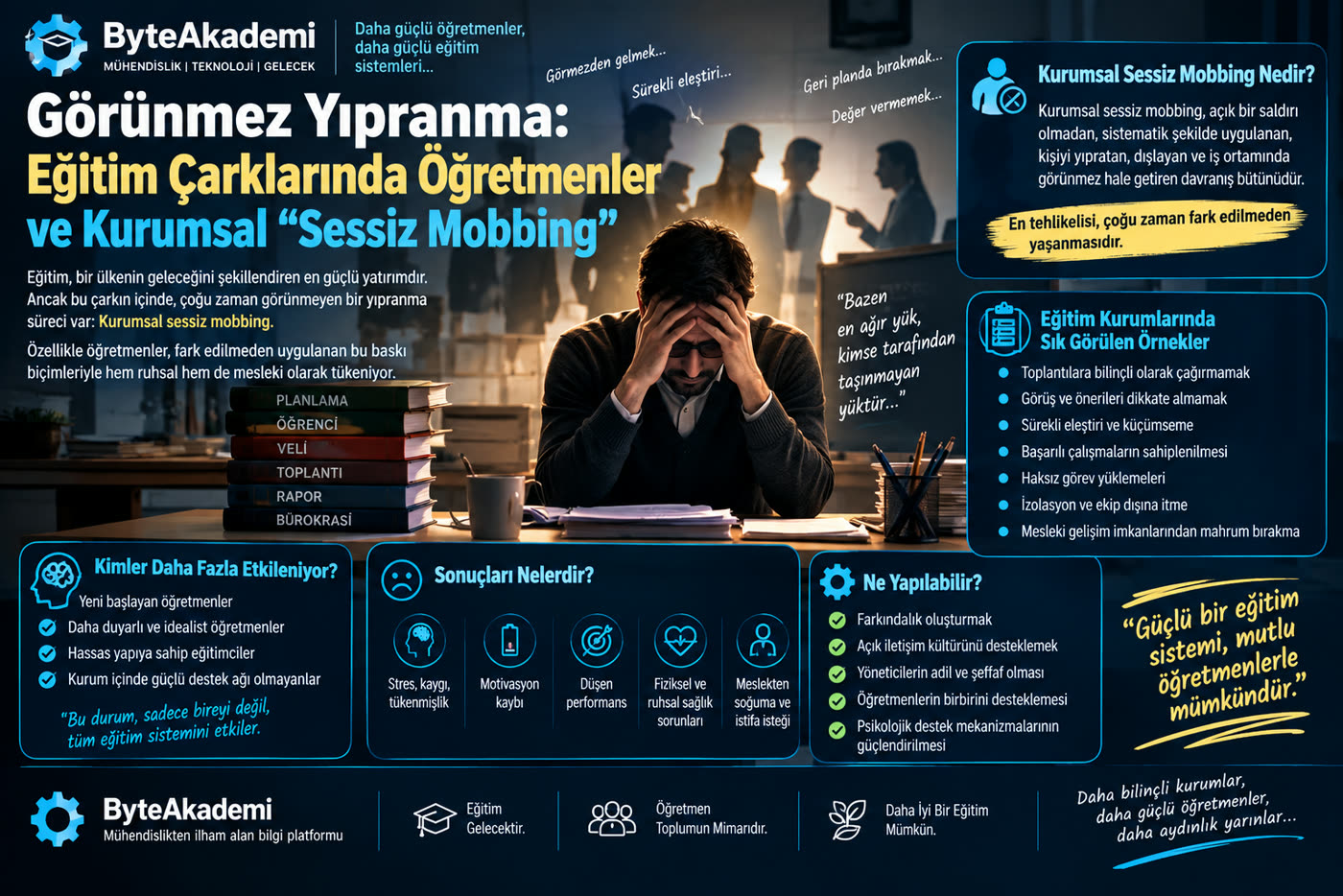
As an electrical and electronics engineer examining high-voltage lines or complex industrial drives, I know that failure does not always arrive with a big explosion. The most dangerous damage is mechanical fatigue: unnoticed, ongoing at a microscopic level inside the system, wearing the metal down over time. Looking at our education ecosystem today through a systems engineering lens, we see that the main transformative force building our future, our teachers, has been trapped in exactly this kind of insidious cycle of wear: Institutional Silent Mobbing.
Traditional mobbing shows itself through open insults, shouting and obvious injustice, and it is relatively easy to establish legally. Institutional silent mobbing, however, hides behind rules and the cover of "institutional vision." No one raises their voice; instead, the teacher's professional autonomy is pruned step by step, the scope of their duties is made vague, and the individual is pushed into systemic isolation until they are forced to give up "of their own accord."
Silent mobbing works not through open conflict but through micro-bureaucracy and emotional isolation that paralyse pedagogical will.
1. Invisible Overload: Scope Creep
In project management, the most fundamental mistake that brings a system down is called "Scope Creep." This is exactly what happens in the teaching profession: while the real job is to teach the curriculum and follow students' cognitive and moral development, teachers are constantly loaded with "small," "unobjectionable" bureaucratic burdens.
Messaging groups that send notifications non-stop outside working hours, paperwork for extracurricular activities, the obligation to produce social media content, survey quotas and administrative reporting cycles drain the teacher's real energy. These tasks are not imposed as formal orders but under the mask of "institutional belonging" or "love for the students." A teacher who objects is immediately labelled "not a team player" and drawn into a circle of psychological pressure.
2. Emotional Isolation and Gaslighting
The most destructive tactic of institutional silent mobbing is not to target the teacher's professional competence directly, but to exclude them from decision-making:
- Cutting Off the Flow of Information: Critical decisions, meetings and events within the department or the institution are deliberately passed on to the targeted teacher late or incompletely, so that the teacher is caught unprepared and appears "uninterested."
- Undermining Pedagogical Authority: At the slightest feedback from a parent or student, the administration puts the teacher in the wrong from the outset without listening to them and withdraws its hierarchical backing.
- Professional Gaslighting: The teacher is constantly made to feel that their work is inadequate, yet no concrete, measurable technical criteria are ever given as to what is actually missing.
Traditional Pressure vs. Institutional Silent Mobbing
| Dimension | Traditional (Overt) Mobbing | Institutional Silent Mobbing |
|---|---|---|
| Method | Shouting, threats, open written warnings | Ignoring, excessive paperwork, vague goals |
| Legal Proof | Easy with witnesses and concrete evidence | Hidden behind the label "routine administrative process" |
| Timing | Usually within working hours | Uninterrupted 24/7 contact through digital channels |
| End Result | Dismissal or an open lawsuit | Burnout, quiet quitting or being forced to resign |
3. The Engineering Takeaway: A System With a Burnt-Out Core Cannot Stand
In a power grid, if you leave transformers running under overload without cooling, sooner or later the entire interconnected network collapses. In the education system, the transformer is the teacher: the one and only converter that steps down the voltage of knowledge and transfers it into children's minds.
An institution that paralyses its teachers with institutional ambition, endless bureaucratic burdens and silent mobbing is a bankrupt structure, even if it has the most impressive buildings and the most expensive technology. If we want to protect the future of a society, we must stop treating our teachers as data entry clerks who fill in forms and answer messages 24/7, and make them feel respected, autonomous and safe at the front of their classrooms.
Have you witnessed this invisible form of pressure in educational institutions? What legal and institutional steps should be taken to protect teachers' professional dignity and peace at work? Let's discuss in the comments!