In an internal combustion vehicle, mechanical play across the drivetrain is frequently masked by engine combustion noise and exhaust frequencies. In a dedicated electric vehicle, however, near-total cabin silence exposes the slightest tolerance variations. The moment an electric motor unleashes instantaneous peak torque, micro-clearances between drivetrain components can generate audible clicking, vibration, and harshness.
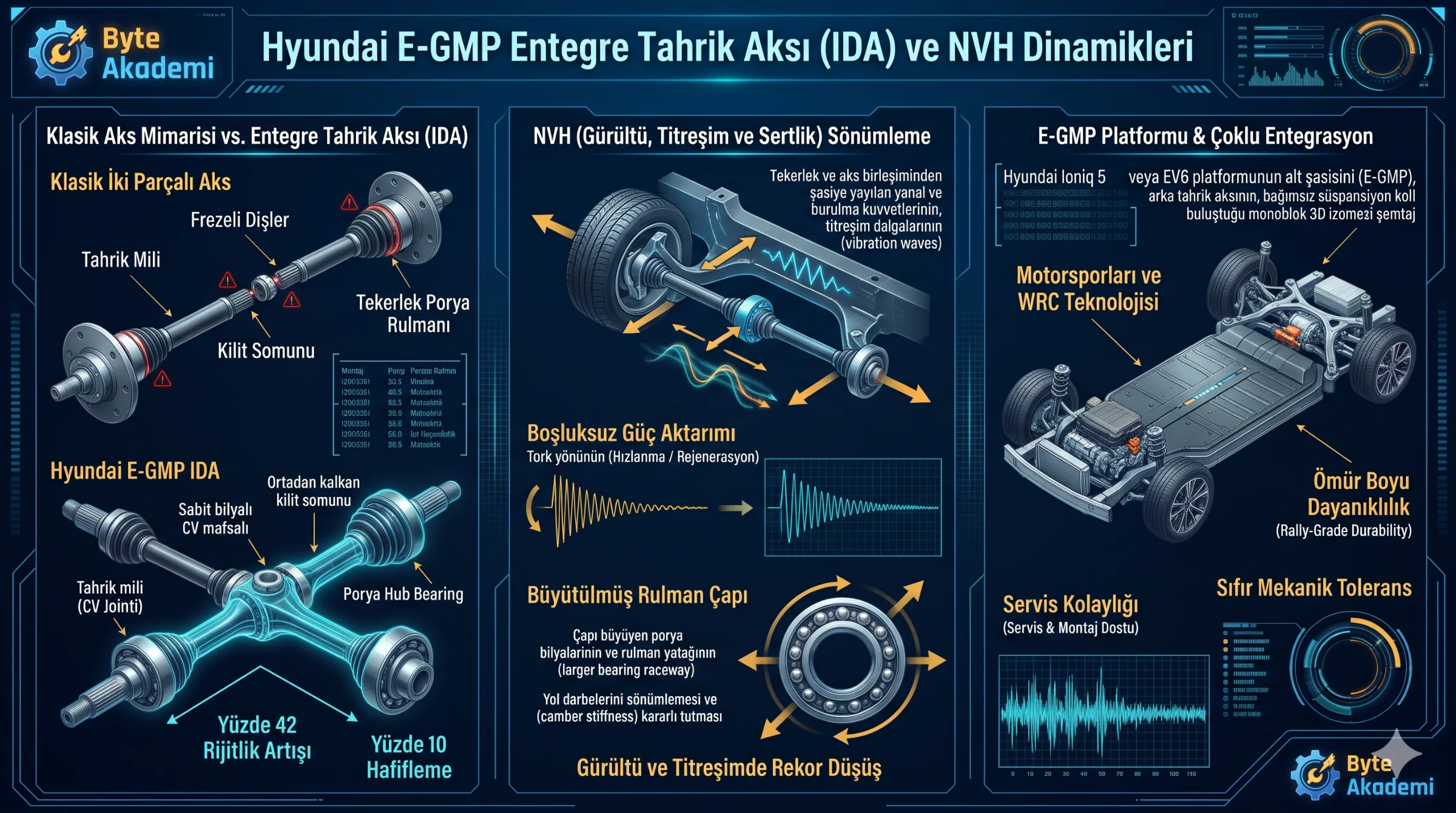
To eliminate this phenomenon across its Electric-Global Modular Platform (E-GMP), Hyundai Motor Group adopted a structural driveline design directly inspired by Formula 1 and World Rally Championship (WRC) race cars: the Integrated Drive Axle (IDA). This article examines the kinematics of uniting the drive shaft and wheel hub bearing into a single monobloc component, its 42% torsional rigidity improvement, and the physics of NVH (Noise, Vibration, and Harshness) suppression.
1. Conventional Driveline Splines vs. Integrated Drive Axle Kinematics
For decades, conventional road cars have utilized a two-piece wheel-end assembly: a splined Drive Shaft inserted through the center of an independent Wheel Hub Bearing, secured via a heavy center locknut.
Subjected to high-torque electric propulsion, this traditional two-piece architecture presents distinct mechanical limitations:
- Spline Lash and Backlash Click: Electric motors transition from zero to maximum torque within milliseconds. Under aggressive acceleration and immediate regenerative braking transitions, micro-clearances between the shaft splines and hub bore produce cyclical contact wear and audible metallic clicks.
- Rotational Inertia: The redundant steel collars, internal splines, and retention hardware add unnecessary unsprung rotational mass at the wheel center.
- The E-GMP IDA Solution: Hyundai engineers forged the drive shaft and wheel hub bearing into an unbroken single-piece assembly. The splined coupling and center nut are eliminated, with the constant-velocity (CV) joint housing integrated directly into the hub bearing raceway.
  [CONVENTIONAL TWO-PIECE AXLE vs. HYUNDAI E-GMP IDA]

  Conventional System : [Drive Shaft] ===(Splined Joint + Nut)===> [Independent Hub Bearing] --> Wheel
  E-GMP IDA Platform  : [Drive Shaft + CV Joint + Wheel Hub = SINGLE FORGED COMPONENT] --> Wheel
By eliminating interfacial connection compliance, the IDA architecture yields a 42% increase in driveline stiffness while trimming roughly 10% of rotating un-sprung mass per corner.
Instant electric torque leaves zero room for driveline backlash; integrating the drive shaft directly into the wheel hub eliminates mechanical play and transforms rally-grade engineering into whisper-quiet cabin refinement.
2. NVH (Noise, Vibration, and Harshness) Suppression Mechanics
Without the acoustic masking of an internal combustion engine, structural drivetrain vibrations between 20 Hz and 2,000 Hz transmit directly into the passenger cabin. The IDA platform targets these frequencies through three design parameters:
- Zero Driveline Lash: The monobloc interface ensures immediate bidirectional torque transfer. Transitions between wide-open throttle and aggressive regenerative braking occur with zero mechanical backlash.
- Expanded Bearing Pitch Diameter: Because the drive shaft no longer passes through a separate hollow hub bore, the pitch circle diameter of the wheel bearings is substantially increased. Larger diameter ball arrays distribute cornering and braking loads over an expanded surface area, shifting resonance frequencies away from audible cabin modes.
- Camber Rigidity Under Lateral Load: During aggressive cornering, lateral g-forces induce micro-deflections across conventional multi-piece hubs. The enhanced bending stiffness of the IDA maintains precise wheel camber alignment, reducing tire scrub drone and sharpening steering feedback.