For over a decade, Bavarian automaker BMW championed prismatic cell formats across its electrified lineup. With the advent of the "Neue Klasse" architecture, Munich engineers executed a bold structural pivot: discarding prismatic casings in favor of 46 mm diameter BMW Gen6 Cylindrical Cells. Why did one of the most meticulous automotive houses abandon prismatic packaging?
The answer extends beyond form factors into physical chemistry: a 20% leap in volumetric energy density, 30% faster DC fast charging, and the industrial scaling of Dry Electrode Coating that eliminates toxic chemical processing entirely. Let us unpack the electrochemistry and structural mechanics driving BMW's Gen6 battery transformation.
1. From Prismatic to Cylindrical: The Physics of Hoop Stress
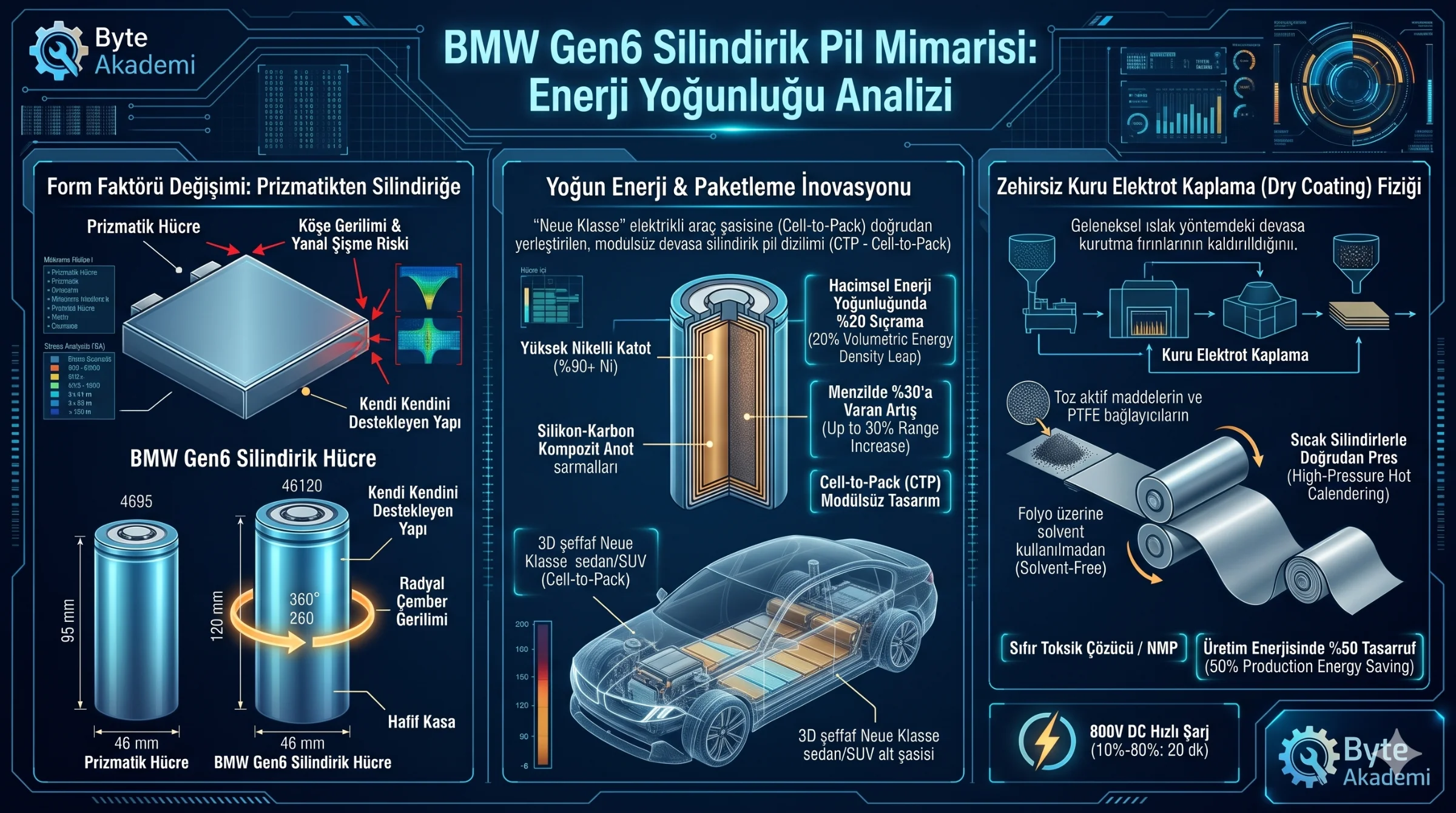
Prismatic cells package stacked planar electrode sheets inside rectangular aluminum boxes. While they maximize raw spatial packing, they present distinct mechanical challenges under cyclical dynamic loading:
- Non-Uniform Swelling and Corner Stress: During intercalation and de-intercalation, anode swelling exerts intense mechanical pressure against flat enclosure walls and corners. Heavy structural compression frames must be bolted inside the pack to mitigate mechanical deformation over thousands of charge cycles.
- Cylindrical Hoop Stress Resistance: Cylindrical geometry naturally distributes internal gas and swelling pressure uniformly across 360 degrees via tangential hoop stress. This allows BMW Gen6 cells to endure high charging C-rates without volumetric warping or external brace penalties.
- Dual Height Standards: BMW tailors cell geometry across two specific heights: 46 mm diameter by 95 mm height (4695) for low-slung performance sedans, and 46 mm by 120 mm (46120) for high-riding electric SUVs.
  [PRISMATIC STRESS CONCENTRATION vs. BMW GEN6 HOOP STRESS]

  Prismatic Enclosure  : [ High Corner Stress | Lateral Swelling Risk | Heavy External Clamping ]
  BMW Gen6 Cylindrical : ( 360-Degree Radial Uniformity | Self-Supporting | Lightweight Enclosure )
Transitioning from prismatic enclosures to cylindrical form factors neutralizes mechanical swelling stresses via uniform hoop tension while dry electrode calendering slashes factory carbon footprints in half.
2. Achieving +20% Volumetric Energy Density
Compared to fifth-generation prismatic cells, Gen6 cylindrical cells increase pack-level volumetric energy density by 20%. This jump stems from concurrent material and architectural breakthroughs:
- High-Nickel Cathodes & Silicon Anode Composites: Cathode cobalt content is sharply dialed down while nickel concentration rises above 90%. The anode incorporates silicon-carbon composites, significantly expanding lithium-ion storage sites relative to conventional graphite.
- Module-Free Cell-to-Pack (CTP) Layout: Intermediate sub-module enclosures, internal busbar bridges, and redundant structural walls are removed. Cells mount directly into the battery tray, maximizing active electrochemical volume within the chassis wheelbase.
// VOLUMETRIC METRICS & FAST CHARGE PARAMETERS

Volumetric Energy Density Gain : Delta_E_vol = +20% (Wh / Liter)
Driving Range Enhancement      : Up to +30% Total Kilometers
System Architecture            : 800V DC High-Voltage Standard
3. Dry Electrode Coating: Eliminating Toxic Solvents
Conventional lithium-ion battery manufacturing relies on wet slurry processing. Active materials are blended with NMP (N-Methyl-2-pyrrolidone) toxic solvent, spread onto metal foils, and baked in industrial drying ovens hundreds of meters long.
BMW's industrial partner network introduces solvent-free Dry Battery Electrode (DBE) manufacturing:
- Solvent-Free Binder Fibrillation: Active powders mix dry with specialized PTFE fluoropolymer binders, forming an electrostatic cohesive web without liquid chemicals.
- High-Pressure Calendering: The dry mixture passes directly through heated calendering rollers, pressing into an ultra-thin uniform film laminated straight onto current collector foils.
- 50% Manufacturing Energy Reduction: Eliminating drying ovens cuts cell factory energy demand and carbon emissions in half. Furthermore, the absence of solvent evaporation prevents microscopic capillary voids, yielding superior mechanical cohesion and electron conductivity.
Coupled with native 800V electrical architectures, Gen6 cylindrical cells trim 10% to 80% DC fast-charging intervals down to roughly 20 minutes, aided by direct bottom-plate thermal cooling loops.