When you pump fuel into an internal combustion vehicle, roughly 70 percent of that thermal energy dissipates into ambient air through cooling radiators and exhaust piping before ever reaching the drive wheels. While production electric vehicles achieve vastly superior metrics, typical EV drivetrains still forfeit 15 to 20 percent of their stored electrochemical energy to inverter switching overhead, stator copper losses, and reduction gear fluid drag.
Instead of addressing long-distance range anxiety by installing a massive 150 kWh pack that would bloat the vehicle past 2.5 tons, Mercedes-Benz asked a fundamental engineering question: "What if 95 out of every 100 Joules leaving the battery could be delivered directly to the asphalt?" The result of that pursuit is the Vision EQXX. This article examines the thermodynamics of its 95% Battery-to-Wheel (Tank-to-Wheel) efficiency, the fluid dynamics behind its world-record Cd = 0.17 aerodynamic drag coefficient, and the electrochemistry of its 117-cell solar roof adding supplementary daily kilometers.
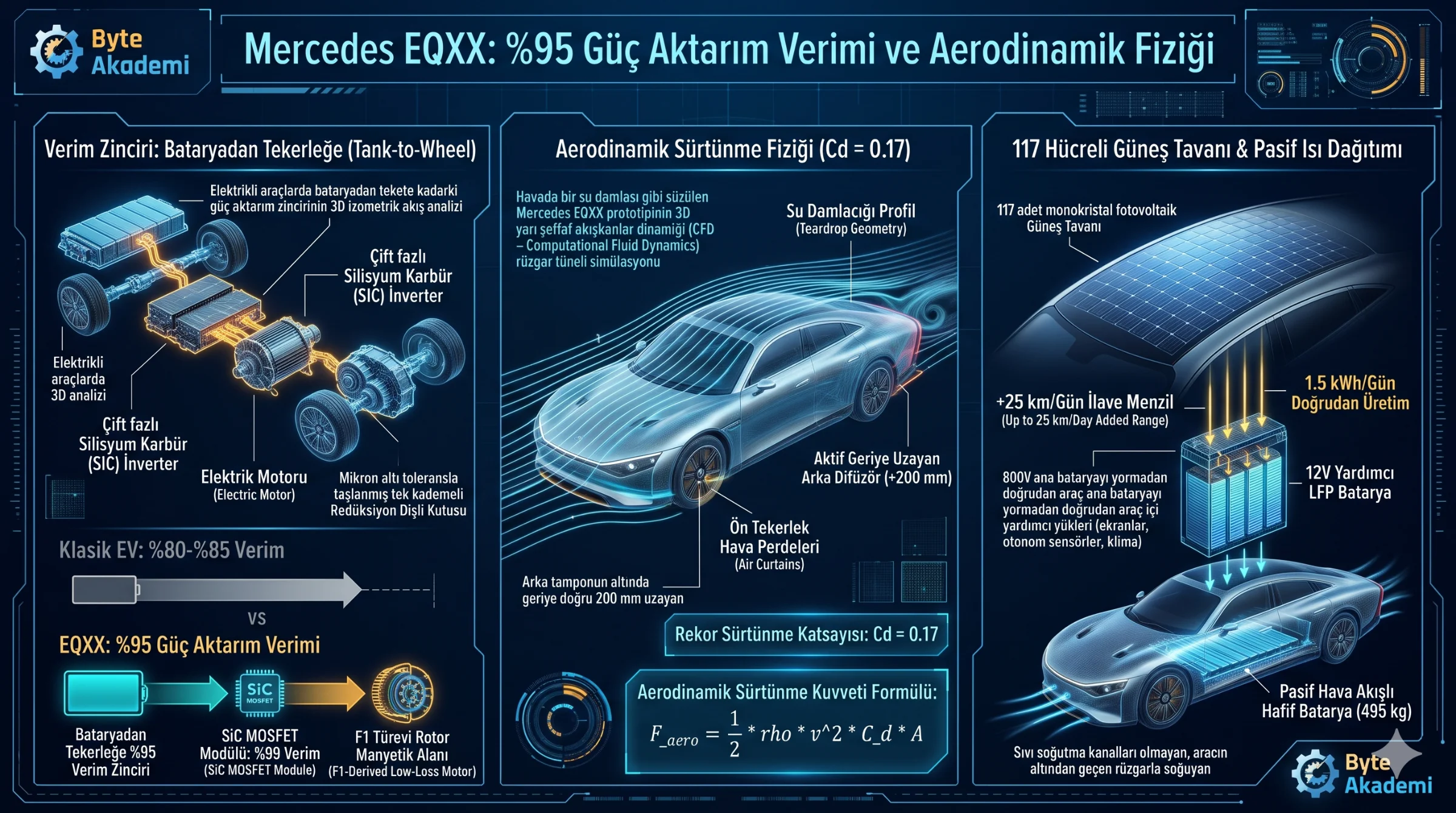
1. The 95% Battery-to-Wheel Powertrain Architecture
Energy traveling from battery terminals to mechanical wheel rotation traverses three main loss bottlenecks: Internal Cell Resistance (Rint), Traction Inverter Switching Dissipation, and Electric Motor / Reducer Mechanical Friction. Conventional EV platforms cap systemic efficiency at roughly 82 to 85 percent.
Engineers at Mercedes-AMG High Performance Powertrains (HPP) Brixworth leveraged Formula 1 race engineering to achieve a continuous 95% powertrain efficiency via three structural upgrades:
- Silicon Carbide (SiC) Inverter Switching: Replacing conventional silicon IGBT modules with wide-bandgap SiC MOSFETs reduces switching transition latency to mere nanoseconds. Conduction and switching losses fall drastically, elevating inverter electrical efficiency above 99 percent.
- F1-Derived Low-Loss Stator Laminations: The compact 180 kW radial-flux permanent magnet motor utilizes ultra-thin, grain-oriented electrical steel laminations, driving magnetic core hysteresis and eddy-current losses to near zero.
- Sub-Micron Gear Finishing & Low-Viscosity Lubrication: Tooth contact geometries on the single-speed reduction transmission undergo precision optical super-finishing. Combined with synthetic transmission fluids engineered for ultra-low shear resistance, rotational fluid churning losses are virtually eliminated.
  [DRIVELINE EFFICIENCY WATERFALL COMPARISON]

  Standard EV   : [Battery 100 J] ---> [Inverter 95%] ---> [Motor 90%] ---> [Gearbox 96%] ---> [Delivered: 82 Joules]
  Mercedes EQXX : [Battery 100 J] ---> [SiC Inverter 99%] -> [Motor 97%] -> [Gearbox 99%] ---> [Delivered: 95 Joules!]
Extending EV range is not solved by stacking heavier batteries; it is solved by preserving 95% of stored energy directly to the tires and slicing air with the physics of a teardrop.
2. Aerodynamic Drag Coefficient (Cd = 0.17): The Teardrop Profile
At highway velocities (100 km/h and above), an electric passenger vehicle expends roughly two-thirds of its total energy purely pushing through air. Aerodynamic drag force is expressed as:
F_aero = (1/2) * rho * v^2 * C_d * AWhere rho represents air density, v vehicle speed, A frontal projected area, and Cd the drag coefficient. Because aerodynamic drag scales with the square of velocity (v2), minimizing drag is paramount for long-range cruising.
While industry-leading production sedans achieve Cd values between 0.20 and 0.24, the EQXX recorded Cd = 0.17 in wind tunnel validation—lower than a spherical football (Cd ~ 0.20). Three active fluid mechanics techniques made this possible:
- Teardrop Profile & Tapered Rear Track: The greenhouse tapers smoothly toward the tail, with the rear track width engineered 50 mm narrower than the front axle. This contours laminar airflow along the flanks, preventing premature boundary-layer separation.
- Retractable Active Rear Diffuser: At speeds above 60 km/h, an electromechanical linkage extends the lower carbon diffuser 200 mm rearward. This guides underbody air upward at an optimal exit angle, neutralizing low-pressure wake turbulence behind the transom.
- Front Air Curtains & Shrouded Wheel Arches: Eliminating open radiator grilles, the front bumper routes incoming air through guided channels that form a laminar fluid barrier over the rotating front wheel faces, suppressing rotational wake scrub.
  [MERCEDES EQXX ACTIVE UNDERBODY FLUID DYNAMICS]

   (Laminar Inflow)                 (Teardrop Taper)                   (Wake-Free Egress)
  ==============> [====== EQXX CHASSIS ======] ------------------->  ========
                  [ Flat Underbody Carbon Pan ] ===> [Active Diffuser: +200 mm Extension]
                                                     (Collapses Rear Low-Pressure Wake)
3. 117-Cell Solar Roof Math & 12V Auxiliary Relieving
The EQXX integrates 117 monocrystalline photovoltaic (PV) solar cells into its lightweight roof panel. Unlike traditional automotive solar glass used merely for cabin blower venting, this array acts as a functional generation unit:
- Isolating the 12V Auxiliary LFP Battery: High-voltage charging from rooftop panels requires bulky step-up conversion. Instead, EQXX solar generation feeds directly into a dedicated 12V Lithium Iron Phosphate (LFP) auxiliary battery.
- Unloading Parasitic Driveline Draw: Onboard systems—including headlights, infotainment displays, drive-assist telemetry chips, and climate control fans—consume between 200W and 500W of continuous parasitic power. The solar roof supplies roughly 1.5 kWh of daily energy directly to these subsystems, preventing the high-voltage traction pack from expending drive energy through DC-DC buck converters.
- Adding Up to +25 km Daily Cruising Range: Against the EQXX's benchmark consumption of 8.3 kWh / 100 km, the 1.5 kWh generated by the sun translates mathematically to 18 to 25 kilometers of zero-cost driving range under optimal solar irradiance.