Approaching a corner apex at 180 km/h and deploying 1,914 horsepower and 2,360 Nm of torque simultaneously in any mechanical sports car results in immediate traction loss, uncontrolled oversteer, and a catastrophic spin. Yet the Rimac Nevera carves through apexes with razor-sharp stability, shattering production vehicle track records worldwide.
The core of this lateral capability is not a mechanical limited-slip differential (LSD) or hydraulic brake-vectoring system. Instead, the Nevera relies on four independent permanent magnet motors powered by four dedicated inverters, orchestrated at 100 Hz by the Rimac All-Wheel Torque Vectoring (R-AWTV) system. This article examines the transient control dynamics, yaw moment physics, and microsecond response times that render traditional differentials obsolete.
1. The Elimination of Mechanical Drivelines: 4 Motors & 4 Inverters
Traditional supercars channel combustion torque through a central transmission and a mechanical LSD. This architecture imposes severe physical limitations:
- Actuation Latency: Mechanical clutch packs and hydraulic differentials require 50 to 100 milliseconds to shift torque across an axle. Under extreme acceleration, tire adhesion is broken long before mechanical clutches can react.
- Brake-Based Dissipation: Modern stability control systems drag inner brake pads to induce yaw, wasting valuable electric power as useless friction heat.
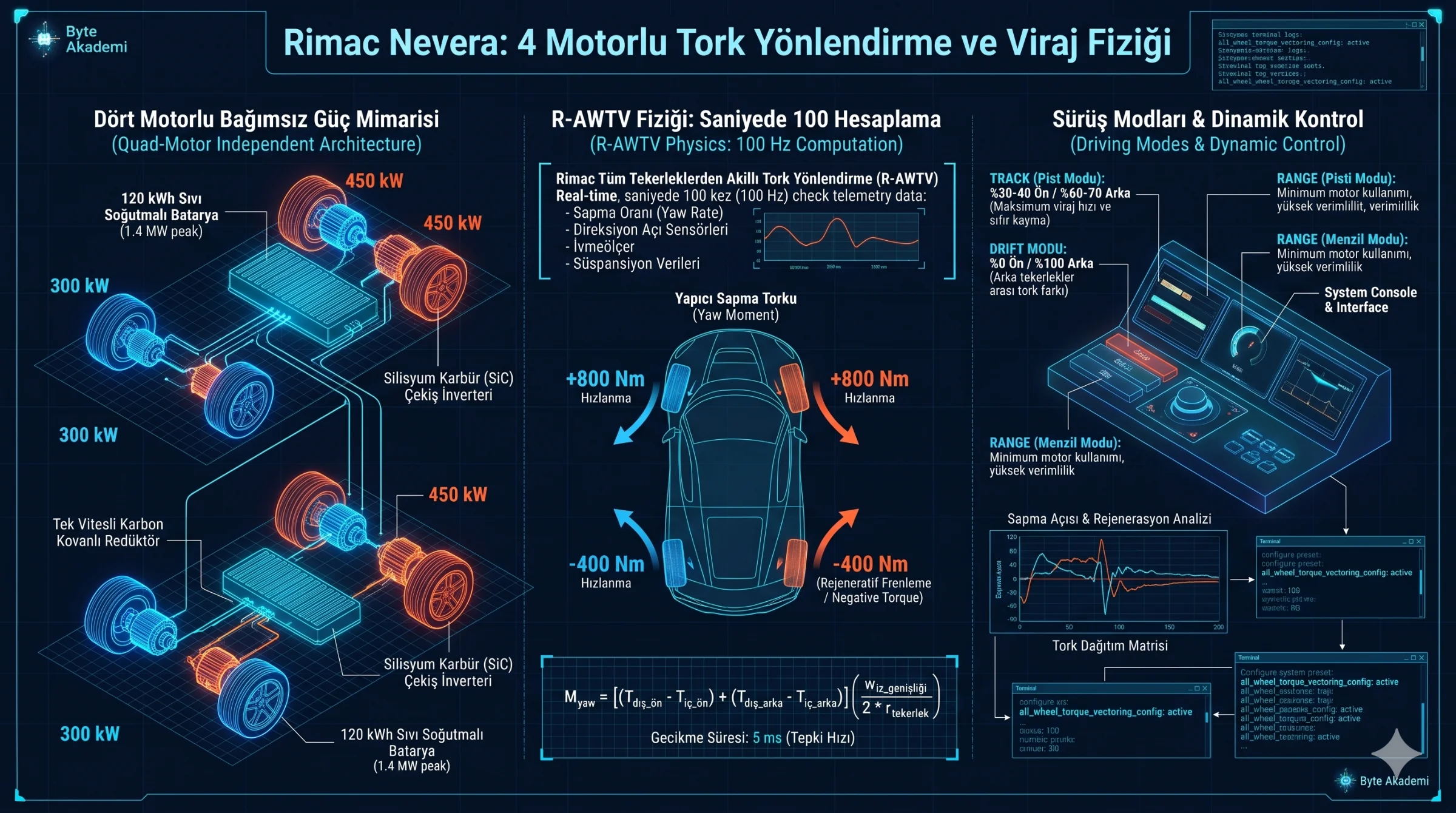
- The Nevera Quad-Motor Topology: The Nevera features zero mechanical driveshafts connecting the front and rear axles, and zero transverse differential linkages. Each wheel is coupled directly to a dedicated carbon-sleeved motor driven by an independent Silicon Carbide (SiC) inverter.
  [RIMAC NEVERA QUAD-MOTOR POWER ROUTING TOPOLOGY]

  [Front Left Motor: 300 kW]  <---(Inverter 1)---.                .---(Inverter 2)---> [Front Right Motor: 300 kW]
                                                 |  120 kWh Liquid |
                                                 |  Cooled Battery |
                                                 |   (1.4 MW Peak) |
  [Rear Left Motor: 450 kW]   <---(Inverter 3)---'                '---(Inverter 4)---> [Rear Right Motor: 450 kW]
                                          \                          /
                                           ==== [R-AWTV Brain: 100 Hz] ====
Replacing a 100-millisecond mechanical differential with 5-millisecond individual motor actuation does not just optimize cornering—it rewrites the laws of vehicle lateral dynamics through software.
2. R-AWTV Dynamics: Generating Active Yaw Moments at 100 Hz
Vehicle cornering is governed by the Yaw Rate—the angular velocity of the chassis around its vertical axis. The R-AWTV system samples steering wheel angle, lateral acceleration, wheel slip ratios, and suspension telemetry every 10 milliseconds (100 Hz):
- Positive Torque on Outer Wheels: Entering a sharp right-hand curve, the left (outer) wheels receive massive forward drive torque (+800 Nm).
- Negative Torque via Regenerative Deceleration: Simultaneously, the right (inner) motors switch to generator mode, applying negative torque (-400 Nm). Mechanical friction brakes remain completely untouched.
- Active Yaw Moment: The push-pull force couple creates an artificial rotational torque around the vehicle's center of mass, pulling the nose directly into the apex while recovering kinetic energy back into the 120 kWh pack.
// R-AWTV INSTANTANEOUS YAW MOMENT CALCULATION

M_yaw = [ ( T_outer_front - T_inner_front ) + ( T_outer_rear - T_inner_rear ) ] * ( Track_width / ( 2 * Tire_radius ) )

M_yaw         : Net Active Rotational Moment (Nm)
T_outer/inner : Positive Drive Torque vs. Negative Regenerative Braking Torque
Track_width   : Vehicle Transverse Distance Between Wheels (Meters)
Tire_radius : Dynamic Rolling Radius Under Lateral LoadWhile mechanical differentials require roughly 100 ms to respond, electric motor flux modulation takes merely 5 milliseconds. Micro-slips are countered and corrected before the driver can physically perceive chassis breakaway.