Hello there, fellow visual creator! Have you ever typed a prompt like "a sports car parked under neon lights in the rain" or "a close-up portrait of an old sailor" into an AI generator, only to get back an image that looks like a plastic wax mannequin from a 2010 video game? We have all been there! Standard diffusion models simply draw the noun you ask for—but what makes a Hollywood blockbuster frame or a million-dollar commercial product shot look authentically real isn't the object itself. It is the optical imperfections of glass camera lenses, light scattering beneath human skin pores, and micro-specular reflections across brushed metal.
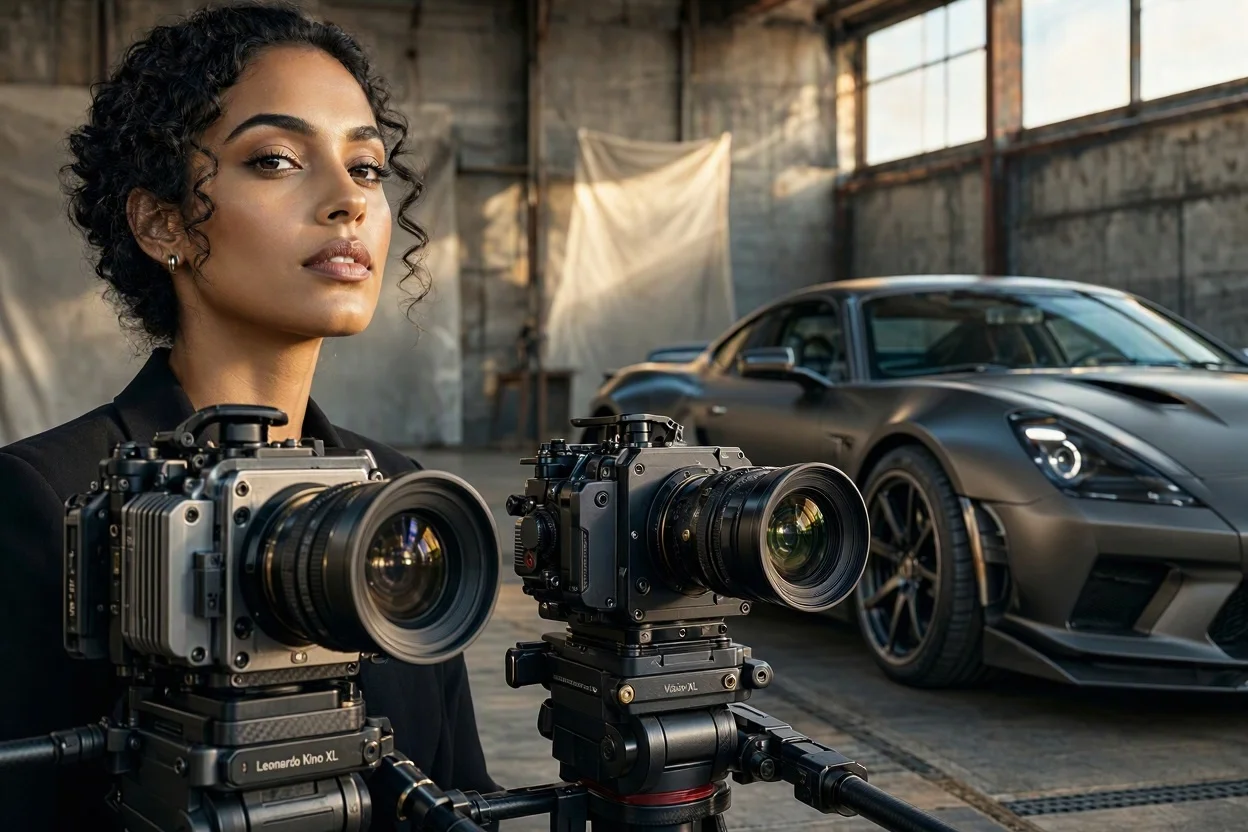
To eradicate that dreaded "plastic AI look," the engineering team at Leonardo.Ai fine-tuned the SDXL architecture into two specialized photographic powerhouses: Leonardo Kino XL and Leonardo Vision XL. Think of Kino XL as a veteran Hollywood Director of Photography (DoP) wielding an IMAX anamorphic camera, and Vision XL as a master commercial photographer shooting with an 85mm f/1.2 portrait lens and studio strobes. Grab a coffee, and let's unlock the optical physics and copy-paste camera prompts that will transform your renders forever!
1. Leonardo Kino XL: Commanding a $100,000 Anamorphic Cinema Lens with Words
"Kino" literally translates to "Cinema." What makes a frame from Dune or Blade Runner 2049 instantly recognizable compared to a smartphone photo? The secret lies in Anamorphic Optics and Film Color Grading.
While standard spherical lenses project a flat circle onto a camera sensor, Hollywood Panavision and Cooke Anamorphic lenses use cylindrical glass elements to squeeze an ultra-wide 2.39:1 widescreen field of view onto the sensor. Leonardo Kino XL is explicitly trained on anamorphic cinema datasets, automatically injecting three optical signatures into your prompts:
- Horizontal Anamorphic Lens Flares: When car headlights, streetlamps, or sunlight hit the lens, Kino XL renders signature horizontal cyan and amber light streaks across the frame rather than generic circular glare.
- Oval Bokeh Geometry: Out-of-focus background light spheres are optically stretched into vertical elliptical (oval) bokeh, creating massive spatial separation between your foreground subject and the environment.
- Kodak 35mm Dynamic Range & Film Grain: Instead of clipping highlights or crushing shadows into flat digital black, Kino XL emulates the smooth highlight roll-off, volumetric atmosphere, and organic silver-halide grain of 35mm motion picture film stock.
Because Kino XL was trained on widescreen cinema frames, forcing it into a 1:1 square box suffocates its spatial composition engine. Set your aspect ratio to 16:9 (Widescreen) or 21:9 (Ultrawide) in the left sidebar and watch your depth and framing instantly level up!
What separates an amateur AI render from a Hollywood frame or a luxury automotive ad is not the subject itself—it is Kino XL's anamorphic lens compression and Vision XL's subsurface skin scattering.
2. Leonardo Vision XL: Ending "Plastic Skin" via Subsurface Scattering (SSS) & Product PBR
While Kino XL rules widescreen storytelling, what should you choose when you need a razor-sharp close-up human portrait or a studio-lit automotive and industrial product shot? Enter the precision sniper of the lineup: Leonardo Vision XL.
The #1 reason early AI portraits looked fake is that basic models treated human skin as an opaque surface—reflecting light right off the top layer like painted plastic. Real human skin is translucent! When light strikes a face, photons penetrate the outer epidermis, bounce through microscopic blood capillaries and collagen fibers, and exit slightly adjacent with a warm reddish-amber glow. In optical physics and 3D rendering, this phenomenon is governed by Subsurface Scattering (SSS).
// OPTICAL PHYSICS & RENDERING EQUATIONS BEHIND VISION XL & KINO XL

// 1. Anamorphic Depth of Field & Circle of Confusion (CoC):
CoC = ( | S_2 - S_1 | / S_2 ) * ( f^2 / ( N * (S_1 - f) ) ) * Anamorphic_Squeeze_Factor

// 2. Vision XL Subsurface Skin Scattering (BSSRDF Function):
L_o(x_o, w_o) = Integral[ S(x_i, w_i; x_o, w_o) * L_i(x_i, w_i) * (n . w_i) ] dA dw

f         : Lens Focal Length (e.g., 85mm for Portraits, 35mm for Cinema)
N         : Aperture f-stop Number (e.g., f/1.4 melts the background into bokeh!)
S_1, S_2  : Subject Distance and Background Distance
BSSRDF    : Bidirectional Scattering-Surface Reflectance Distribution Function
Leonardo Vision XL masters both biological micro-textures—rendering individual skin pores, vellus hair (peach fuzz), and crisp studio catchlights inside the iris—and industrial Physically Based Rendering (PBR) for forged carbon fiber, brushed titanium, glass, and automotive metallic paint.
3. Decision Matrix: When to Use Kino XL vs. Vision XL
| Optical & Design Parameter | Leonardo Kino XL (Cinematic Engine) | Leonardo Vision XL (Photorealistic Engine) |
|---|---|---|
| Primary Sweet Spot | Widescreen Movie Stills, Sci-Fi, Moody Storytelling | Hyper-Realistic Portraits, Automotive & Commercial Products |
| Simulated Camera & Lens Profile | ARRI Alexa 65 + 40mm Panavision Anamorphic Lens | Sony A1 + 85mm f/1.2 GM & Hasselblad H6D 100c Medium Format |
| Lighting & Color Science | Chiaroscuro Contrast, Teal & Orange, Volumetric Fog | Three-Point Studio Softbox, Natural Daylight, True-to-Life Color |
| Micro-Texture Priority | Wet Pavement Reflections, Neon Halos, 35mm Film Grain | Epidermal Skin Pores (SSS), Iris Detail, Carbon/Metal PBR |
| Best Alchemy / PhotoReal Pairing | Cinematic, Moody, Vibrant (with PhotoReal v2 ON) | Stock Photo, Portrait Perfect, Dynamic (with PhotoReal v2 ON) |
| Optimal Aspect Ratio | 16:9 or 21:9 Widescreen | 3:2, 4:5 Vertical, or 16:9 Commercial |
4. Supercharging Both Models with the PhotoReal v2 Pipeline
To unlock the full optical fidelity of Kino XL and Vision XL, toggle the "PhotoReal v2" switch in the Leonardo studio and select either Kino XL or Vision XL as your underlying fine-tuned model:
  [KINO XL & VISION XL PHOTOREAL v2 RENDERING PIPELINE]

  +---------------------------------+      +------------------------------------+
  | 1. CAMERA & LENS PROMPT INPUT   | ===> | 2. SPECIALIZED SDXL BACKBONE       |
  |  * Optics: Anamorphic / 85mm    |      |  * [Kino XL]  -> Cinema Atmosphere |
  |  * Light : Rim Light / Octabox  |      |  * [Vision XL]-> Portrait & Product|
  +---------------------------------+      +------------------------------------+
                                                             |
                                                             v  (PhotoReal v2 + Universal Upscaler)
                                           +------------------------------------+
                                           | 3. OPTICAL & SURFACE SYNTHESIS     |
                                           |  * Subsurface Skin Scattering (SSS)|
                                           |  * Specular PBR & Anamorphic Bokeh |
                                           +------------------------------------+
5. Exclusive Copy-Paste Camera Prompts for Kino XL & Vision XL
Test these three optical-calibrated prompt recipes directly inside Leonardo.Ai to see the difference between generic prompting and camera-engineered prompting:
// RECIPE 1 — [LEONARDO KINO XL]: Widescreen Anamorphic Sci-Fi Movie Still
"A wide-angle anamorphic movie still from a sci-fi thriller, [FORMAT]
a lone engineer in a weathered dark trench coat standing inside a massive underground fusion reactor chamber, [SUBJECT/SCENE]
looking up at a glowing magnetic plasma torus ring emitting electric cyan and warm amber sparks, [ACTION/LIGHT]
shot on ARRI Alexa 65 with Panavision C-Series 40mm anamorphic lens, horizontal blue lens flares, oval bokeh, [OPTICAL LOCK]
volumetric fog, wet concrete floor reflections, Kodak Vision3 500T film grain, dramatic chiaroscuro lighting, 8k."

// RECIPE 2 — [LEONARDO VISION XL]: Hyper-Realistic Portrait with Subsurface Scattering
"An extreme close-up studio portrait of a 65-year-old Icelandic ship captain with piercing ice-blue eyes and a salt-and-pepper beard, [SUBJECT]
authentic skin texture with visible pores, fine wrinkles, and natural subsurface scattering on the cheekbones, [BIOLOGICAL TEXTURE]
tiny water droplets on his yellow waterproof fisherman jacket, [DETAIL]
shot on Sony A1 with 85mm f/1.2 GM lens, razor-thin depth of field, soft Rembrandt key lighting from a 45-degree octabox, [STUDIO OPTICS]
crisp catchlights in the iris, National Geographic award-winning photography, unretouched raw photo."

// RECIPE 3 — [LEONARDO VISION XL]: Commercial Automotive & Industrial Product Shot
"Commercial automotive studio photography of a matte-titanium electric hypercar parked on a dark wet basalt floor, [PRODUCT]
intricate forged carbon-fiber aerodynamic diffuser and glowing laser-matrix LED headlights, [INDUSTRIAL MATERIAL]
shot on Hasselblad H6D-100c medium format camera, 50mm f/4 lens, [MEDIUM FORMAT CAMERA]
overhead diffused strip-bank studio lighting tracing crisp specular highlights along the aerodynamic body lines, [STUDIO LIGHTING]
subtle low-lying dry ice mist around the Michelin performance tires, hyper-realistic PBR textures, 8k commercial ad."1. "Subsurface scattering": Instantly eliminates wax-like skin in Vision XL portraits.
2. "Specular highlights": Creates razor-sharp light reflections along metallic, glass, and automotive edges.
3. "Anamorphic lens flare & oval bokeh": Unlocks Kino XL's signature Hollywood widescreen optics.
4. "Shot on Hasselblad H6D / ARRI Alexa 65": Forces the diffusion solver to emulate $50,000 medium-format and cinema sensors rather than smartphone cameras.
6. Frequently Asked Questions (Kino XL & Vision XL Workflow)
1. When should I use Kino XL or Vision XL instead of Leonardo Phoenix?
Leonardo Phoenix is unbeatable when your prompt contains complex multi-object spatial instructions or requires exact written typography (signs, logos, labels). However, when your primary goal is organic skin texture, studio product photography, or pure anamorphic cinema grading, pairing Kino XL or Vision XL with PhotoReal v2 delivers unmatched photographic warmth.
2. What is the best Negative Prompt for Vision XL portraits and product shots?
Always include: plastic skin, airbrushed, wax figure, 3d render, cgi, doll, oversaturated, blurry, deformed iris, asymmetrical eyes, watermark, bad anatomy to keep outputs strictly photographic.