Hello there, fellow engineer and AI enthusiast! Have you ever pointed your smartphone camera at a complex electronic circuit board or a handwritten calculus equation, asked a question out loud, and wondered: "How on earth is this AI processing my live voice, the video frames from my camera, and software code inside a single brain at the exact same millisecond?" On the surface, it feels like pure magic—but beneath the hood lies one of the most profound architectural shifts in modern computer science!
For years, early "multimodal" AI systems were actually stitched-together Frankenstein pipelines (Cascaded Models). At the center sat a deaf and blind text-only Large Language Model (LLM). If you showed it a photo, an external vision captioner described the image in text; if you spoke to it, a separate Speech-to-Text (STT) transcriber converted your voice into flat words before handing it to the LLM. What got lost in translation? The sarcastic tone in your voice, a micro-spark inside a video frame, or the exact geometric angle between two lines on an engineering blueprint! When Google DeepMind engineered Google Gemini, they threw out that stitched-together approach and built a Natively Multimodal architecture from the ground up. Grab a coffee, and let's explore the mathematics of how words, pixels, and soundwaves fuse inside a single neural space!
1. Stitched-Together "Cascaded" AI vs. Natively Multimodal Architecture
What does "Natively Multimodal" actually mean in deep learning? Imagine trying to solve a mystery with three specialists who don't speak the same language: a photographer looks at a clue and writes a brief note to a writer, causing critical visual nuances to vanish through an Information Bottleneck.
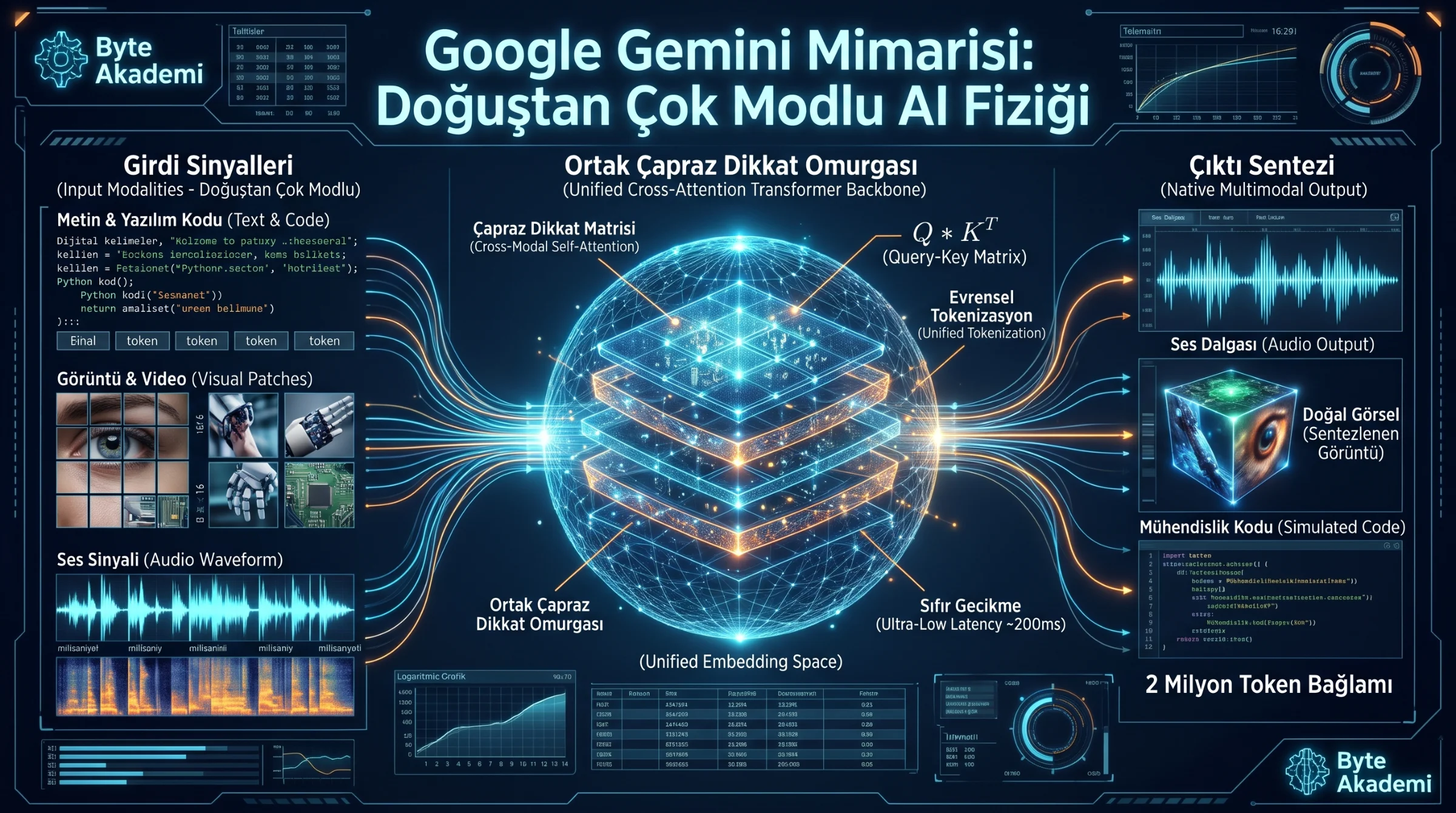
By contrast, Google Gemini was pre-trained from Day 1 across interleaved sequences of text, code, image patches, audio waveforms, and video frames inside one unified Transformer backbone. To Gemini, the written word "arc flash," the glowing cyan pixels of an electrical arc in a video, and the 16 kHz acoustic crackle of that arc are not foreign data types—they map directly to the exact same neighborhood inside a Joint Multimodal Embedding Space!
  [LEGACY "CASCADED" PIPELINE vs. GOOGLE GEMINI "NATIVELY MULTIMODAL" BACKBONE]

  A) LEGACY CASCADED AI (Stitched Adapters -> High Latency & Context Loss!):
  [Audio Wave]  ---> (External STT) ---> "Flat Text" ---+
  [Image/Video] ---> (Vision Encoder)--> "Caption"   ---+--> [TEXT-ONLY LLM] --> Output
                                                             (Vocal tone & spatial details lost!)

  B) GOOGLE GEMINI (Natively Multimodal -> Unified Neural Brain!):
  [Text & Code]  ---> Token_Text  ---+
  [Audio Stream] ---> Token_Audio ---+--> [UNIFIED CROSS-MODAL ATTENTION BACKBONE]
  [Image/Video]  ---> Token_Vis   ---+           |
v (Native Text, Audio & Visual Token Output!)If you sigh heavily and say in a sarcastic tone, "Oh great, the server crashed again," a legacy Speech-to-Text pipeline strips out your voice inflection and passes the literal words "Oh great" to the LLM. Because Gemini ingests raw acoustic tokens directly via its native Universal Speech Model (USM) layers, it hears your vocal pitch, pacing, and emotion directly!
Inside Google Gemini's unified vector space, the written word 'lightning,' the bright pixels of a lightning strike, and the audio frequency of thunder are not separate file formats—they are mathematically aligned tokens within a single neural brain.
2. Under-the-Hood Mathematics: Unified Tokenization & Cross-Modal Attention
How do you multiply a sentence, a photograph, and an audio wave inside a single linear algebra equation? Through Unified Multimodal Tokenization and Cross-Modal Self-Attention:
- Visual Patch Tokenization (ViT Grid): Gemini slices incoming images and video frames into non-overlapping pixel patches (e.g., 16x16 patches) and projects each patch into the exact same d-dimensional vector space used for text sub-words.
- Spectrogram Audio Tokenization: Continuous audio waveforms are transformed into Mel-spectrogram frames and quantized into discrete acoustic tokens (~32 tokens per second of audio).
- Joint Q-K-V Matrix Multiplication: Text tokens (Xtext), visual patch tokens (Xvis), and audio tokens (Xaud) are concatenated into one unified sequence tensor (Zjoint) and processed simultaneously through the Transformer's Query (Q), Key (K), and Value (V) attention heads!
// GOOGLE GEMINI UNIFIED MULTIMODAL CROSS-ATTENTION EQUATION

// 1. Projecting Heterogeneous Modalities into a Shared Vector Space (R^d):
Z_joint = Concat( E_text(Text), E_vis(Image_Patches), E_aud(Audio_Frames) ) + P_pos

// 2. Computing Scaled Dot-Product Attention Across All Modalities Simultaneously:
Attention(Q, K, V) = Softmax( ( Q * K^T ) / sqrt(d_k) + M_causal ) * V

// Where Queries, Keys, and Values Span Text, Pixels, and Audio Together:
Q = Z_joint * W_Q  |  K = Z_joint * W_K  |  V = Z_joint * W_V

Z_joint   : Unified Sequence Tensor of Interleaved Text, Visual, and Audio Tokens
P_pos     : 2D Spatial (Image) and Temporal (Video/Audio) Rotary Position Embeddings
Q * K^T   : Cross-Modal Similarity Matrix (Aligning a Spoken Word Directly to a Pixel!)
sqrt(d_k) : Dimension Scaling Factor Preventing Softmax Saturation
3. Architectural Benchmark: Text-Only LLMs vs. Cascaded AI vs. Google Gemini
| Engineering Metric | Text-Only LLMs | Cascaded / Stitched Multimodal AI | Google Gemini (Natively Multimodal) |
|---|---|---|---|
| Pre-Training Foundation | Text and code corpora only. | Separate models bolted together post-training. | Jointly trained from scratch on interleaved text, audio, image & video. |
| Acoustic & Voice Intelligence | Deaf (Requires external STT). | Converts speech to flat text; loses tone and pitch. | Processes native acoustic tokens; understands emotion, accents & sighs. |
| Video Spatio-Temporal Reasoning | Reads transcript text only. | Samples sparse static frames without audio sync. | Ingests thousands of synchronized video frames + audio tracks natively. |
| Real-Time Streaming Latency | Fast for text (~300 ms). | High latency (2 – 4 seconds across chained models). | Ultra-low latency (~200 – 300 ms bidirectional live streaming). |
| Engineering Diagram & CAD Parsing | Cannot parse visuals. | Struggles with fine schematic lines and pinouts. | High spatial precision across schematics, PCBs, and handwritten math. |
1. Circle Target Components in Red (Visual Prompting): When uploading a dense electrical single-line diagram or PCB photo, draw a simple red circle around the specific relay or chip on your phone before uploading, then ask: "Analyze the thermal and electrical role of the component circled in red." Gemini's cross-attention heads lock straight onto your visual marker!
2. Token Math for Massive Files: Inside Gemini, every static image or PDF page costs roughly 258 tokens, while 1 second of video (frames + audio combined) costs roughly ~300 tokens. You can upload an entire 500-page engineering manual in a single prompt!
3. Napkin Sketch to Live Code: Draw a rough UI wireframe or system flowchart on paper, snap a photo, and instruct Gemini: "Convert this hand-drawn architecture diagram into a clean, responsive HTML/CSS/JS interactive dashboard."