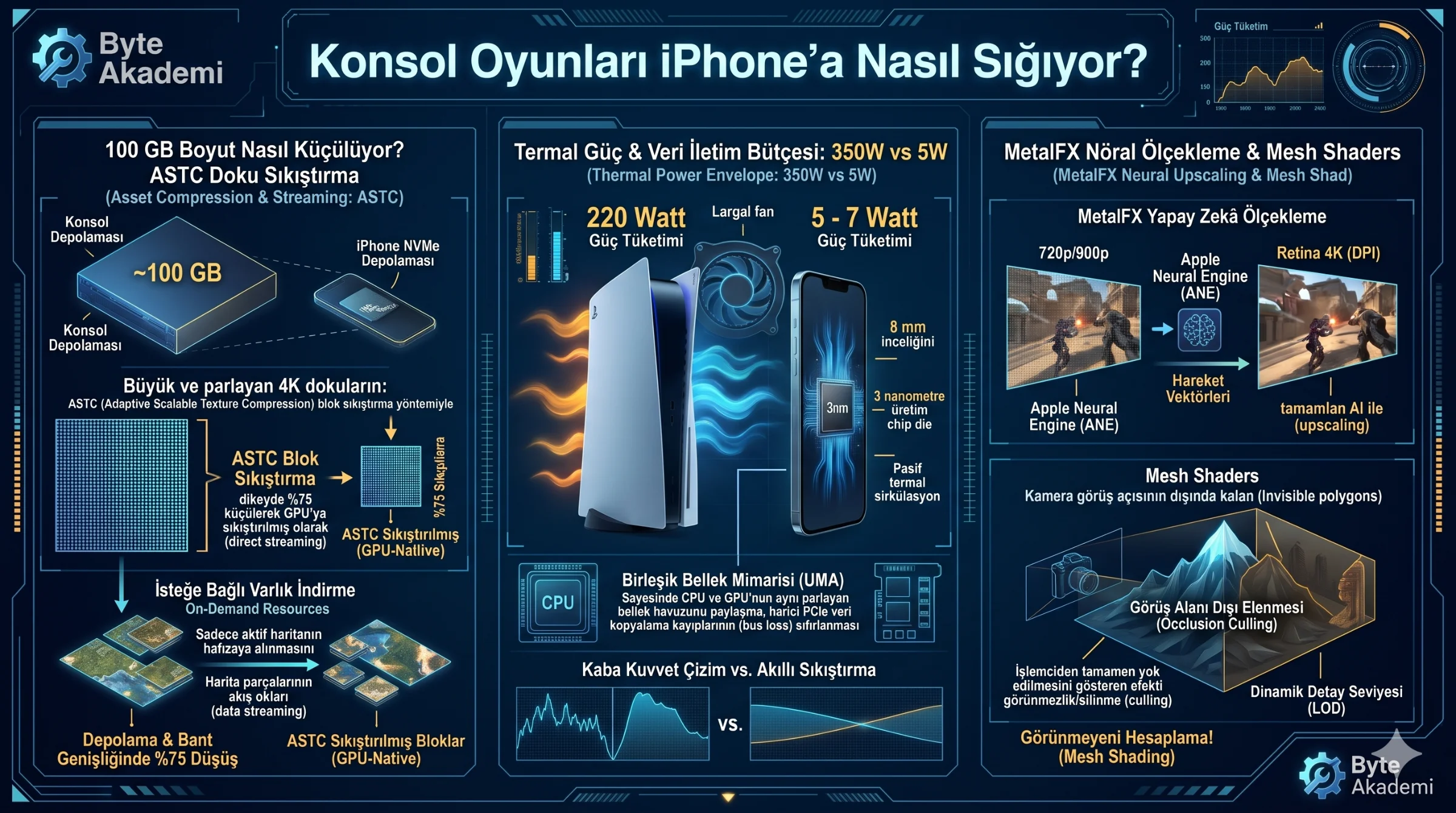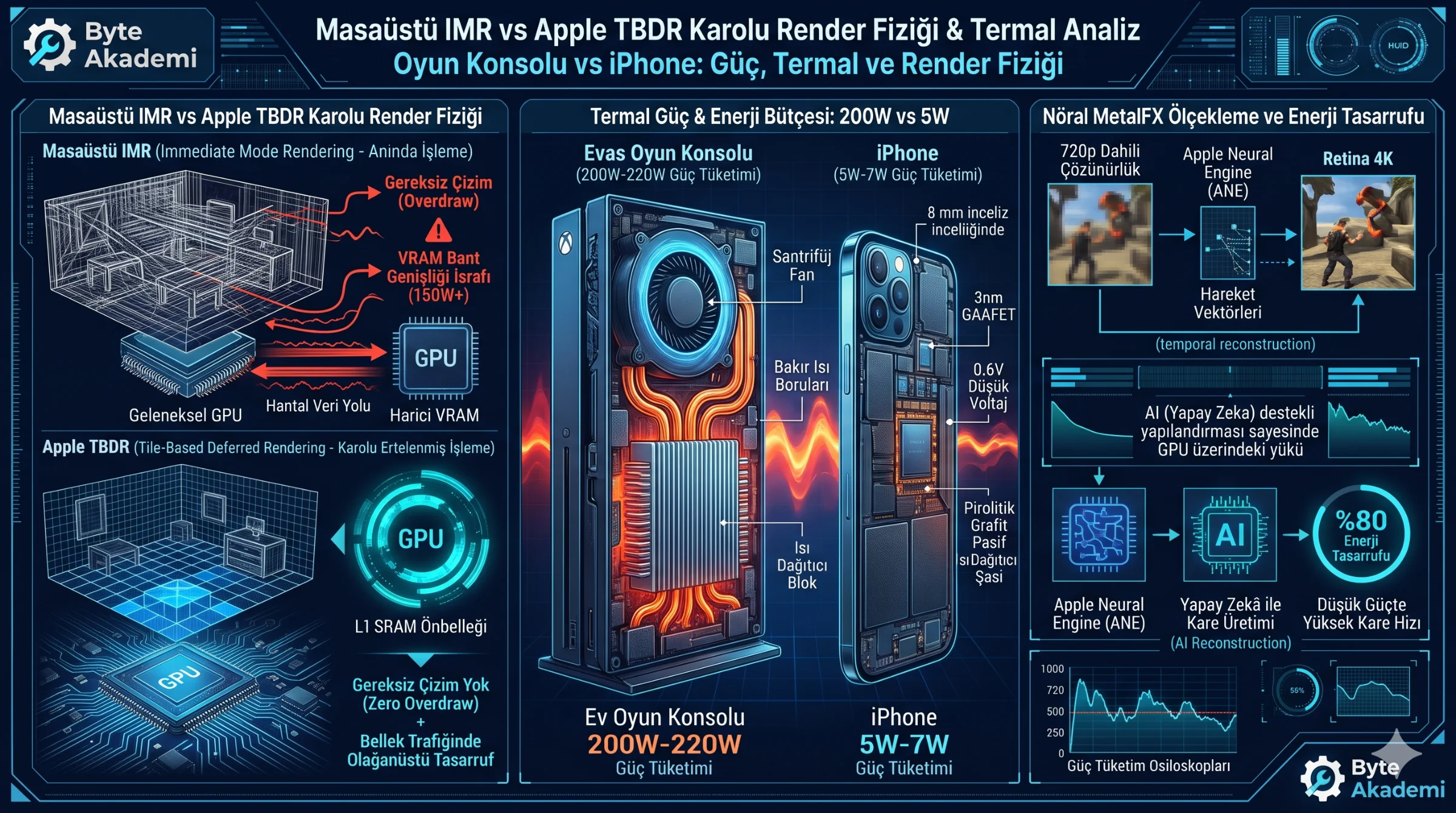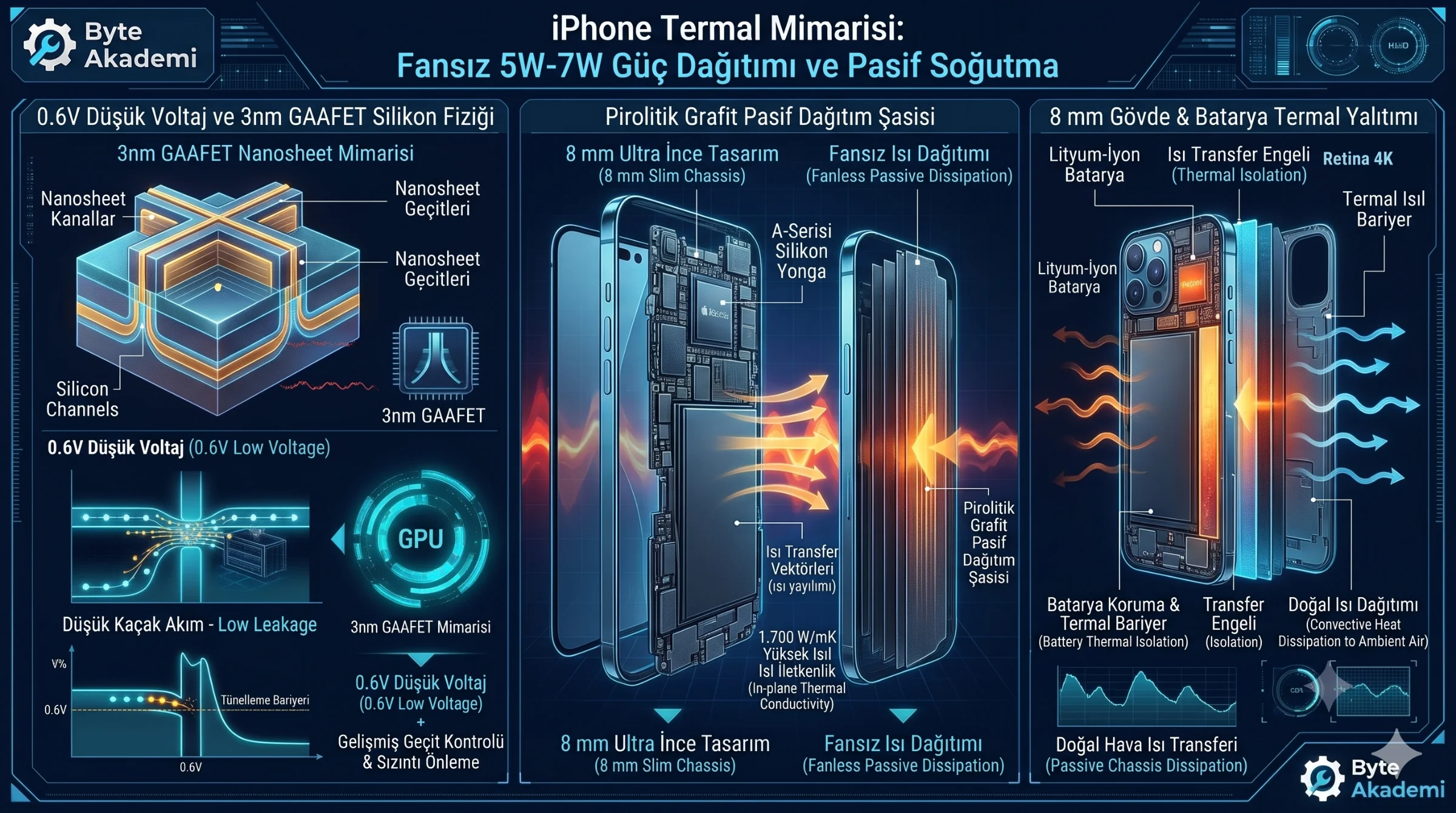
Launching a high-fidelity AAA title on a modern console or desktop PC commands hundreds of watts of power alongside the audible whine of high-RPM cooling fans. Yet running titles like Death Stranding, Resident Evil 4 Remake, or Assassin's Creed Mirage on an iPhone delivers photorealistic lighting, sub-surface scattering, and 4K assets inside a fanless, pocket-sized aluminum-titanium enclosure.
Beyond raw compute clock speeds and transistor densities, Apple's fundamental advantage resides within its graphics software-to-silicon pipeline: the Metal API. By deprecating the legacy overhead of OpenGL ES, Apple engineered a low-level graphics and compute interface purpose-built for its proprietary A-Series and M-Series system-on-chips. This article analyzes the reduction of CPU driver validation bottlenecks, the zero-copy mechanics of Unified Memory Architecture (UMA), and the mathematical framework of hardware-accelerated ray tracing and MetalFX upscaling.
1. Beyond OpenGL ES: Low-Level Direct Silicon Access
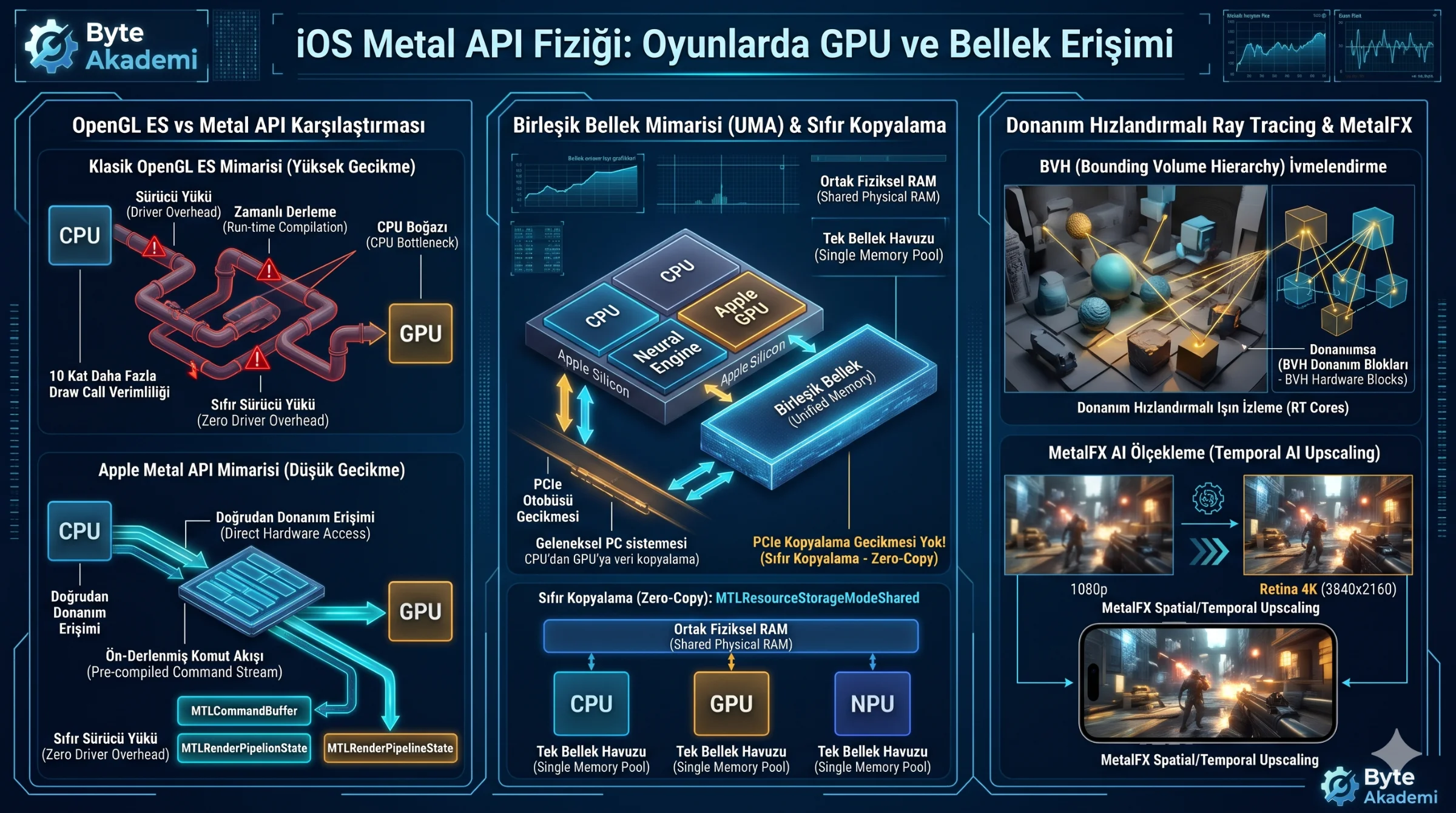
Historically, mobile 3D rendering relied on OpenGL ES. Because OpenGL targeted hundreds of fragmented hardware targets, it operated as a heavy intermediate state machine:
- Excessive Driver Overhead: Draw calls required the CPU to constantly validate state changes, transform structures, and allocate memory buffers at runtime. The CPU spent critical frame time managing driver handshakes rather than advancing game logic and physics.
- Draw Call Bottlenecks: When scenes populated thousands of individual draw calls—dynamic foliage, particle buffers, ambient occlusion passes—OpenGL ES suffered severe draw call starvation, producing visible frame rate stuttering.
- The Metal Architecture: Metal discards runtime driver interpretation. Shaders are pre-compiled into intermediate representations at build time, command buffers encode directly into GPU-native instructions, and draw call throughput increases by more than an order of magnitude.
  [GRAPHICS DRIVER LATENCY PIPELINE COMPARISON]

  Legacy OpenGL ES : [Game Engine] ---> [Heavy Driver Verification] ---> [State Tracking] ---> [GPU Draw] (High Latency)
  Apple Metal API  : [Game Engine] ================= Pre-Compiled Command Stream =================> [Apple GPU] (Zero Overhead)
While conventional architectures burn power copying data across discrete memory buses, Metal API leverages Unified Memory to grant GPU cores instant, zero-copy access directly to raw assets.
2. Unified Memory Architecture (UMA) & Zero-Copy Execution
Discrete PC architectures separate system RAM (DDR5) from dedicated graphics memory (VRAM - GDDR6). Streaming an ultra-high-resolution asset requires redundant staging:
- The asset streams from NVMe storage into main system RAM.
- The host CPU coordinates a secondary transfer across the PCIe bus into discrete VRAM.
- PCIe data marshaling consumes bus bandwidth, introduces latency spikes, and dissipates electrical energy as thermal waste.
Apple silicon replaces discrete buses with an integrated Unified Memory Architecture (UMA), where CPU, GPU, and Neural Engine share an identical physical pool of ultra-wide memory. Metal leverages this via Zero-Copy Storage Modes:
// METAL SHARED STORAGE RESOURCE ALLOCATION

MTLResourceStorageModeShared : CPU and GPU reference an identical physical pointer.
Data Transfer Overhead       : 0 Bytes (Eliminates inter-bus copying)
Memory Bus Latency           : Minimum physical trace transit delay
When an asset loads into memory, Metal grants the GPU a direct pointer to the allocation address. The GPU begins rasterization immediately without intermediate frame buffer duplication, drastically cutting battery draw and thermal saturation.
3. Hardware-Accelerated Ray Tracing & MetalFX Upscaling
Starting with the A17 Pro and M3 families, Metal interfaces directly with dedicated on-die hardware acceleration blocks:
- Dedicated BVH Acceleration: Bounding Volume Hierarchy traversal—the mathematical testing of light ray intersections against bounding boxes and polygons—is computed directly in silicon logic blocks rather than occupying general-purpose execution shader units, delivering up to 4x faster ray tracing throughput.
- MetalFX Temporal & Spatial Upscaling: Native full-resolution rasterization is thermally inefficient on passive mobile chips. Engines render frames internally at lower resolutions (e.g., 720p or 1080p). MetalFX then applies temporal accumulation, tracking motion vectors across successive frames alongside neural filtering to reconstruct an output image matching native 4K display fidelity.
- Mesh Shader Geometry Pipelines: Metal replaces fixed-function vertex fetching with flexible task and mesh shader stages, allowing games to dynamically cull off-screen geometry with sub-millisecond precision before primitives reach the rasterizer.
Unlike Android's fragmented GPU landscape (Adreno, Mali, Immortalis, Xclipse), Apple maintains tightly bounded hardware targets. Game developers optimize shader execution and threadgroup memory directly against Apple's known tile-based deferred rendering (TBDR) architectures.