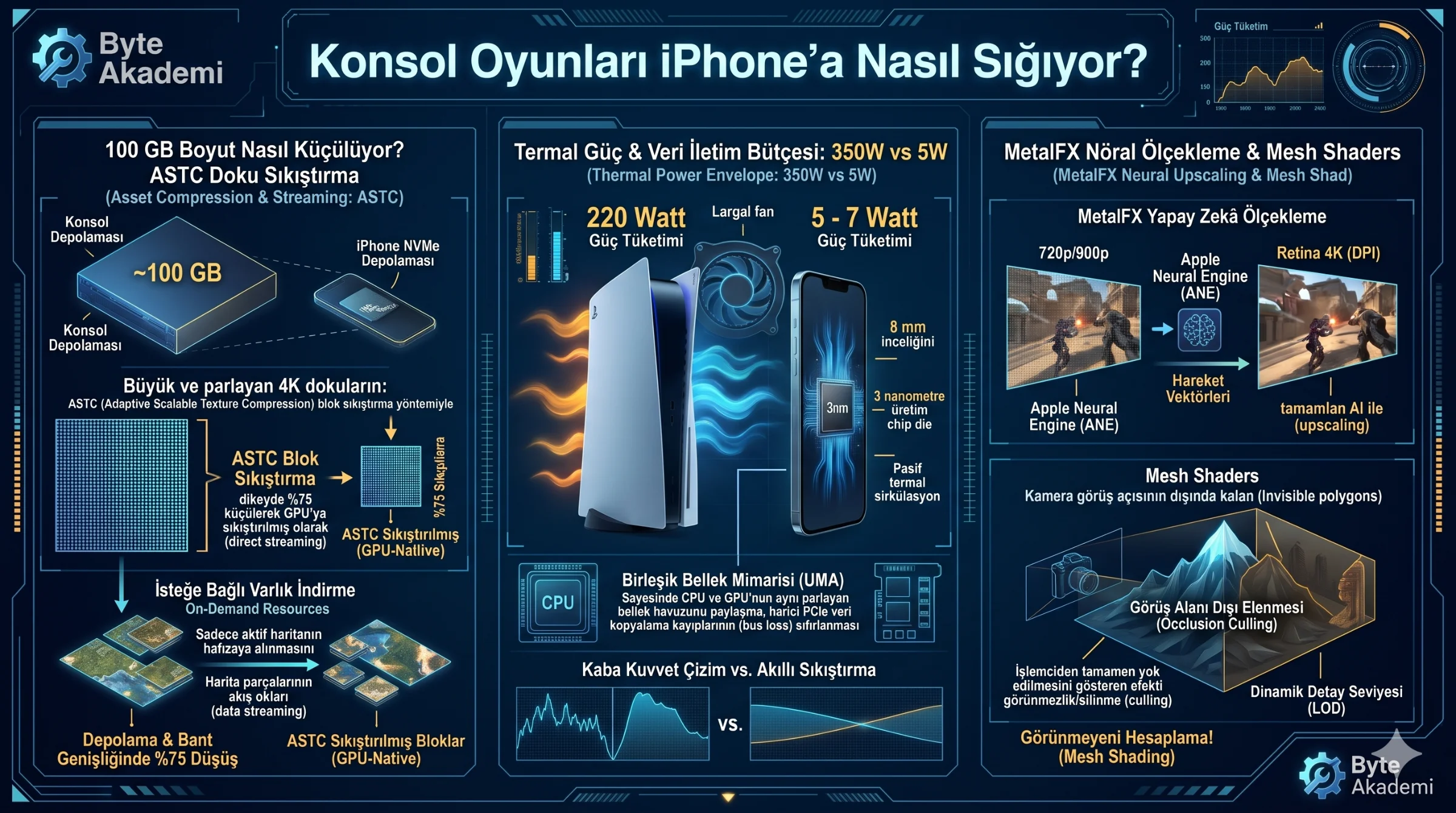
Thermodynamics dictates that electrical current driven through silicon inevitably converts into heat; fail to dissipate that heat, and junction temperatures spike until the silicon fails. A PlayStation 5 demands roughly 200 to 220 watts of continuous wall power, requiring high-RPM centrifugal fans, sintered copper heat pipes, and liquid metal interfaces to evacuate thermal energy. Now contrast that against an 8 mm, fanless, 200-gram iPhone consuming barely 5 to 7 watts under peak gaming load!
By all classical metrics, deploying desktop-grade engines like Resident Evil 4 or Death Stranding on a fanless phone should trigger immediate thermal throttling within seconds. Yet it sustains playable framerates without acoustic noise. Apple engineers did not break thermodynamic laws; they bypassed the structural energy inefficiencies inherent to traditional desktop graphics pipelines. Here is the physical and algorithmic breakdown of scaling 200W workloads into a 5W power envelope.
1. IMR vs. TBDR: Eradicating Desktop VRAM Bandwidth Loss
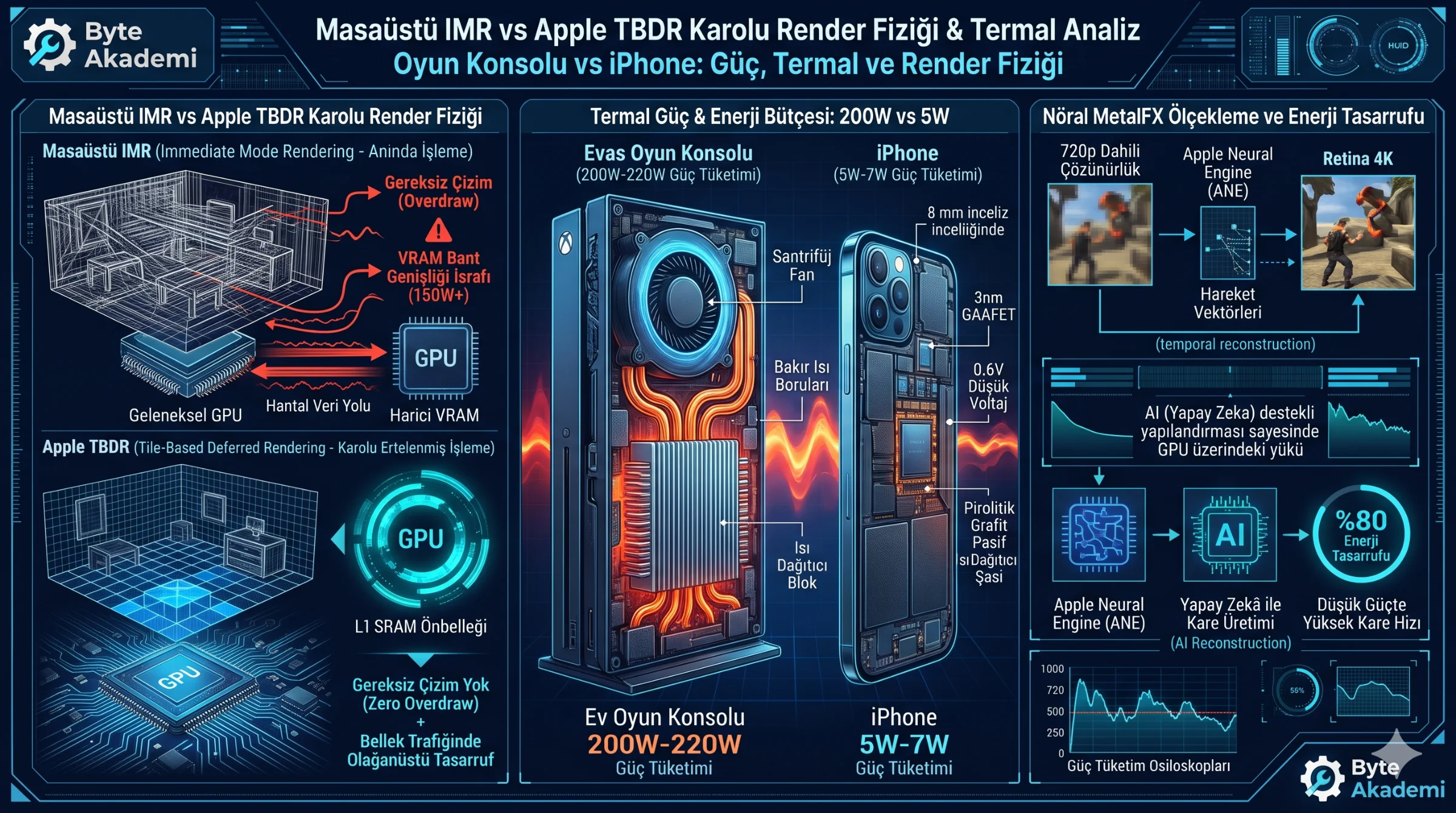
Discrete GPUs from NVIDIA and AMD historically rely on Immediate Mode Rendering (IMR). While computationally flexible, IMR is fundamentally inefficient regarding memory bus thermals:
- Overdraw Penalties: IMR pipelines frequently rasterize occluded geometries. If a game character stands before an interior wall, the GPU may render the background geometry, overwrite it with intermediate objects, and finally paint the character over both passes, wasting compute cycles on occluded fragments.
- External VRAM Bus Draw: Each fragment read/write cycles across discrete high-voltage memory buses to dedicated GDDR6 memory banks. Driving multi-gigabit traces dissipates tens of watts solely as capacitive bus heat.
- Apple's Tile-Based Deferred Rendering (TBDR): Apple's mobile GPU subdivides the screen viewport into microscopic 16x16 pixel tiles. Geometric primitives are sorted into local on-chip L1 SRAM cache. Hardware-native Hidden Surface Removal (HSR) discards occluded fragments before pixel shaders execute. Crucially, intermediate color targets never leave the silicon die; only resolved final pixel colors commit to system memory.
  [DESKTOP IMR PIPELINE vs. APPLE TBDR SILICON]

  Desktop IMR : [Render Hidden Wall] -> [Render Furniture] -> [Render Character] ===> Massive External VRAM Draw (150W+)
  Apple TBDR  : [16x16 Tile Sorting] ---> Rasterize Only Front-Facing Fragments ===> On-Chip SRAM (Zero Bus Waste - 3W)
Desktop architectures burn hundreds of watts brute-forcing invisible background pixels; mobile silicon slices the viewport into microscopic tiles, computing only what reaches the human retina.
2. 3nm Lithography: Dynamic Power Scaling (P = C * V2 * f)
Dynamic power consumption in CMOS gates scales quadratically with voltage: P = C * V^2 * f. Desktop components frequently scale rail voltages between 1.0V and 1.25V to sustain high core clocks.
Fabricated on advanced 3-nanometer nodes, Apple silicon manipulates these physical variables:
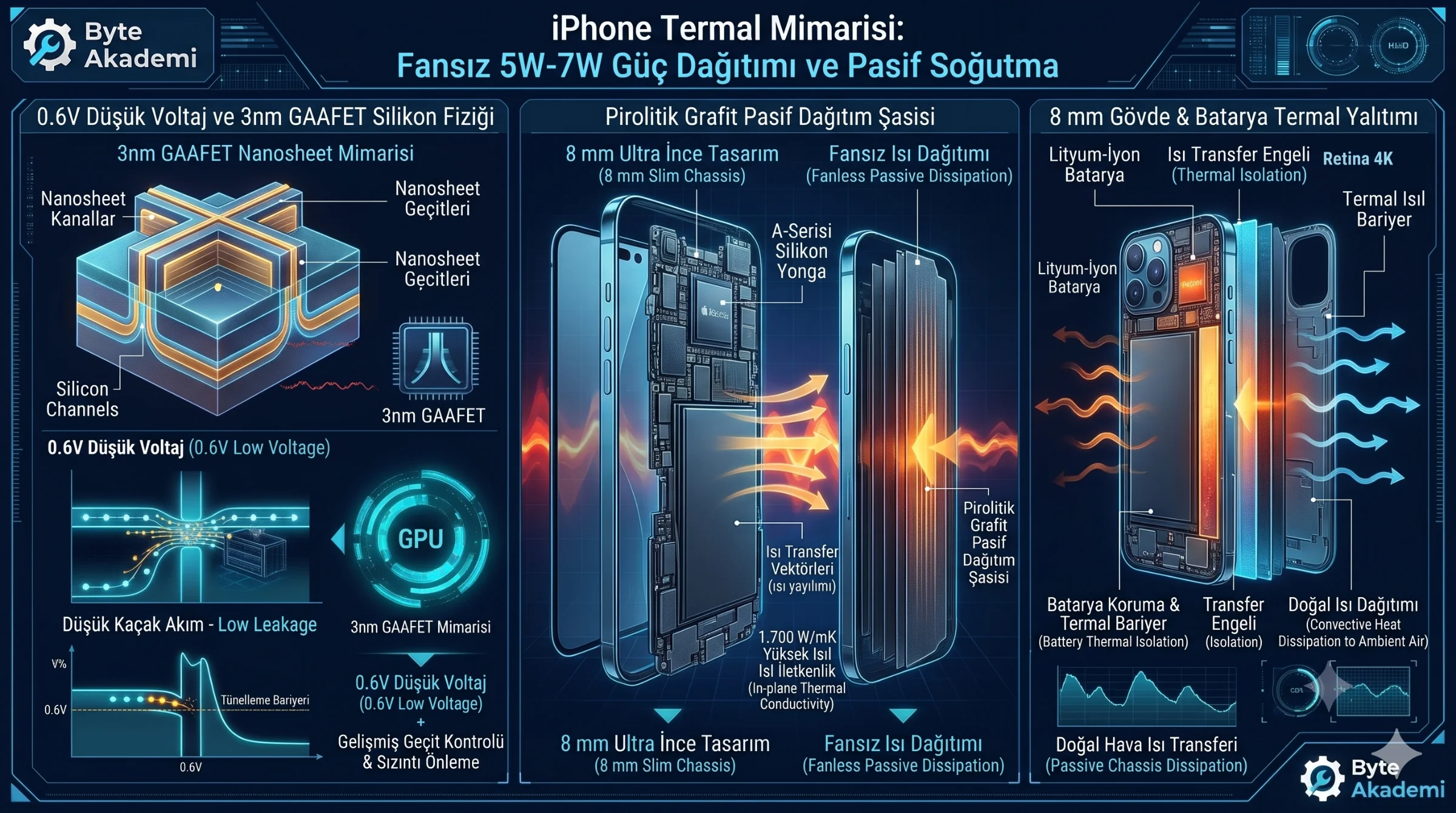
- Sub-0.7V Core Operating Points: Aggressive physical gate miniaturization allows stable switching thresholds between 0.6V and 0.7V. Halving operating voltage slashes dynamic power draw to one-quarter.
- Suppressed Sub-Threshold Leakage: Miniaturized channel lengths risk quantum mechanical electron tunneling across gate oxides. Advanced nanosheet channel architectures isolate capacitive charges, keeping parasitic leakage current within tight microamp budgets.
3. Neural Pixel Synthesis: MetalFX Reconstruction
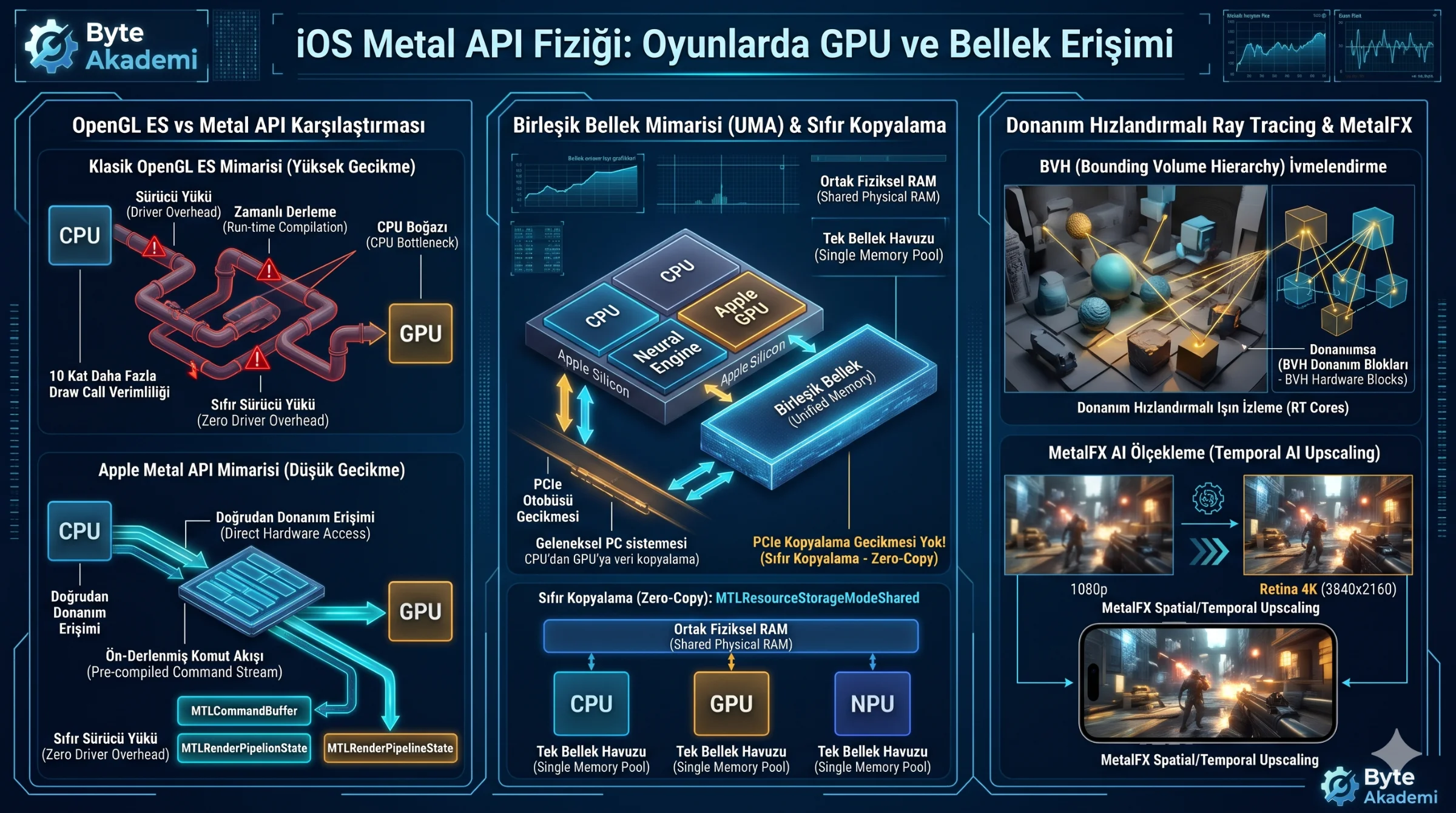
A home console brute-forces native rendering across 8.3 million display pixels (4K). Running identical workloads on mobile silicon would exceed thermal budgets within minutes. Apple counteracts this via neural interpolation:
- Intermediate Resolution Workloads: Games render geometry buffers internally at 720p or 900p, reducing raw triangle and lighting evaluations by up to 75%.
- Neural Engine Temporal Filtering: Instead of loading GPU ALUs with complex spatial anti-aliasing passes, the dedicated 16-core Apple Neural Engine (ANE) samples historical frame buffers alongside motion vectors, reconstructing high-DPI output frames via hardware-accelerated tensor operations.
To evacuate 5W of sustained heat without active fans, internal heat spreaders utilize multi-layered pyrolytic graphite sheets exhibiting in-plane thermal conductivity exceeding copper. Thermal spikes distribute laterally across the titanium perimeter and rear ceramic glass, transforming the chassis into an ambient dissipation plane.