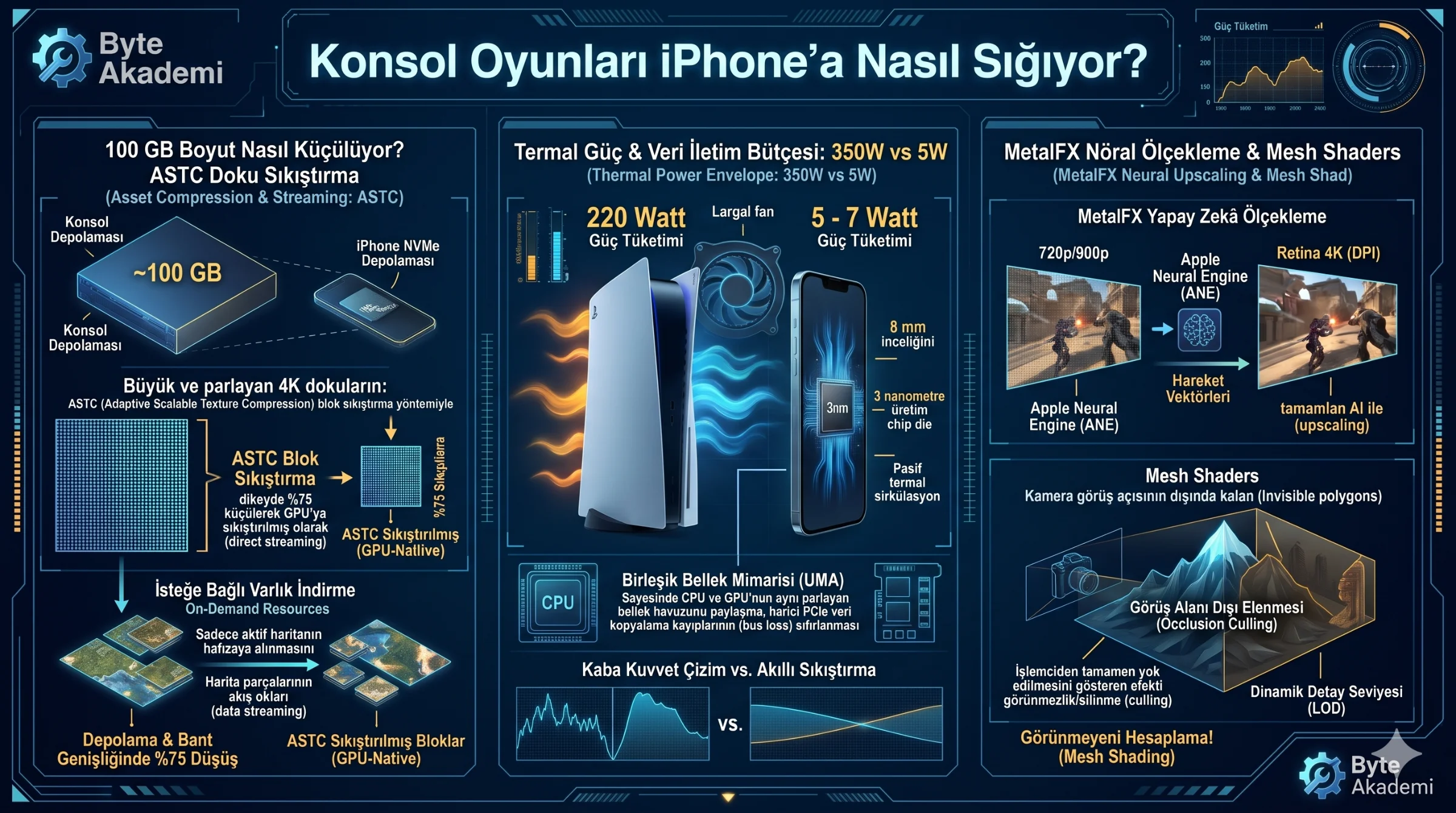
Hold an 8 mm titanium-glass iPhone in your palm[cite: 17]. While billions of transistors execute complex matrix math, you hear zero acoustic whine: zero centrifugal fans, zero moving mechanical assemblies[cite: 17]. Yet executing comparable workloads on laptops immediately spins high-RPM blower assemblies. How does Apple sustain continuous compute performance within a strict 5W to 7W power envelope without thermal saturation[cite: 17]?
This challenge sits at the absolute frontier of mobile thermodynamics. To circumvent aggressive thermal throttling at an 85°C silicon junction, Apple discarded conventional bulk heat sinks. The solution relies on 0.6V gate thresholds, 3nm GAAFET nanosheet lithography, and planar Pyrolytic Graphite Sheets (PGS) integrated throughout the structural chassis[cite: 17]. Here is the physical breakdown of passive heat dissipation within an 8-millimeter envelope[cite: 17].
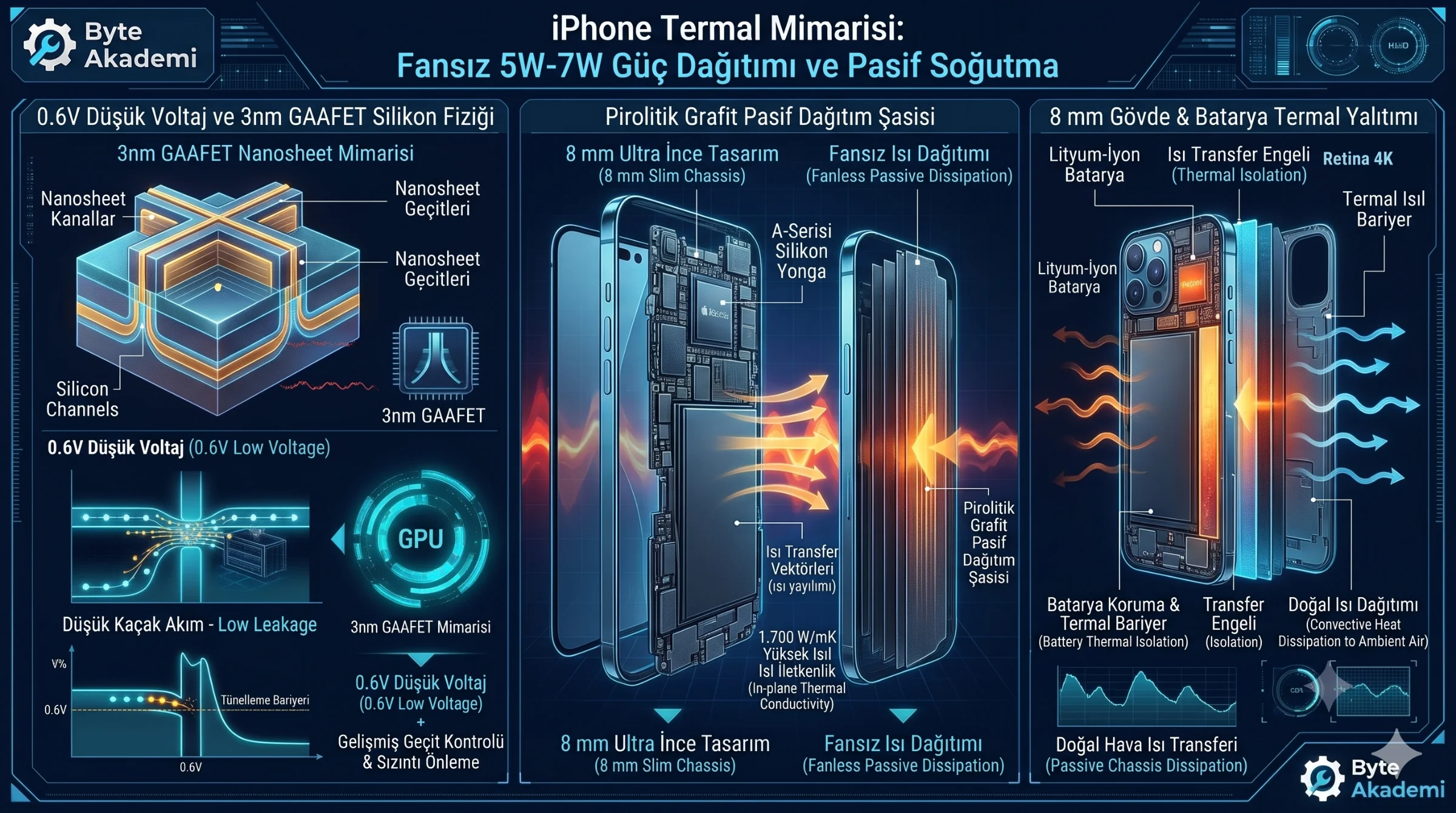
1. 0.6V Sub-Threshold Operation & 3nm GAAFET Physics
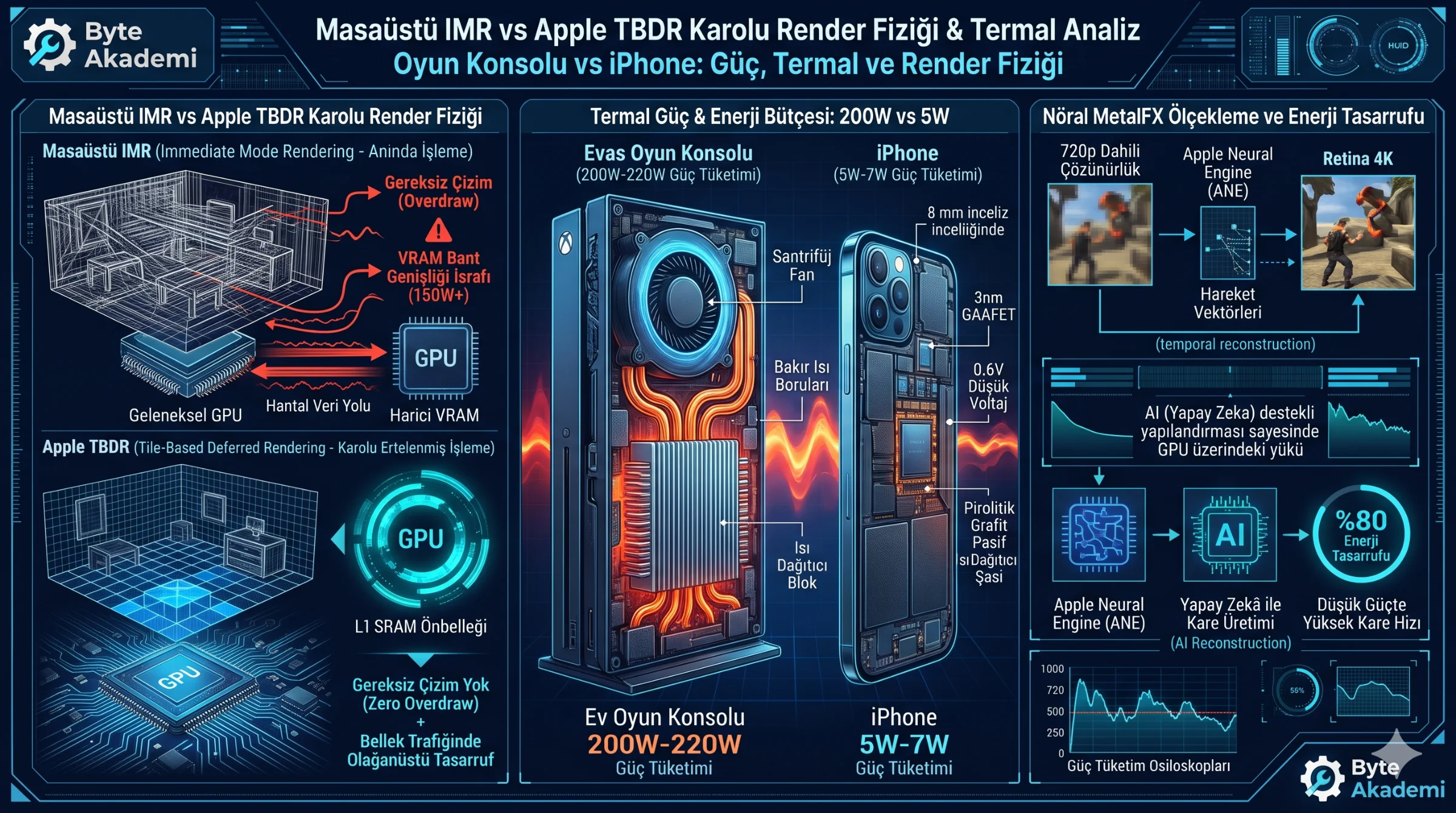
Dynamic processor dissipation is governed by P = C * V^2 * f. Because power scales quadratically with voltage (V2), reducing core rail voltages from conventional desktop levels (1.1V - 1.3V) down to sub-volt levels yields exponential thermal savings.
Apple's A-series silicon achieves this via advanced 3-nanometer Gate-All-Around (GAAFET) nanosheet lithography[cite: 17]:
- 360-Degree Channel Wrap: Unlike legacy FinFETs where gate electrodes wrap around three sides of a silicon fin, GAAFET suspends multiple horizontal nanosheets entirely enclosed by the gate dielectric, maximizing electrostatic gate control.
- 0.6V Threshold Switching: Eliminating sub-surface parasitic leakage paths allows transistors to switch reliably at 0.6V to 0.7V[cite: 17]. Halving the operating potential quarters internal Joule heating (I2R losses).
- Picoamp Idle Leakage: Suppressing quantum mechanical electron tunneling maintains total package draw strictly within the 5W to 7W ceiling under sustained execution loads[cite: 17].
  [CONVENTIONAL SILICON vs. iPHONE 3nm GAAFET THERMAL SCALING]

  Standard Chip : 1.2V Switching ---> Partial Gate Control ---> Elevated Leakage ---> 25W+ Heat Flux
  Apple Silicon : 0.6V Switching ---> 360° GAAFET Enclosure -> Near-Zero Leakage ---> 5W-7W Thermal Envelope
Cooling high-density silicon without fans is not magic; it is the mastery of 0.6V sub-threshold gate physics and planar pyrolytic graphite thermal dispersion.
2. Pyrolytic Graphite Chassis: Two-Dimensional Heat Spreading
Restricting thermal dissipation to 5W resolves only half the equation[cite: 17]; un-evacuated heat originating from a tiny 2 mm2 compute cluster creates severe thermal hotspots capable of destabilizing adjacent components. In a fanless chassis, conduction geometry is paramount[cite: 17].
This is where Pyrolytic Graphite Sheets (PGS) provide an essential thermodynamic advantage[cite: 17]:
- Anisotropic Thermal Conductivity: Pure copper conducts heat isotropically at roughly 400 W/m·K. Pyrolytic graphite consists of highly aligned hexagonal graphene planes. While through-plane conductivity is low, its in-plane thermal conductivity reaches 1,500 to 1,950 W/m·K—nearly quadruple that of oxygen-free copper.
- Hotspot Flattening: High thermal flux generated at the processor die is rapidly shunted across the planar axis of the graphite sheet, converting an intense concentrated hotspot into a distributed, low-density thermal wavefront.
- Chassis Dissipation Surface: The graphite layer interfaces directly with the internal aluminum frame, titanium perimeter, and rear ceramic glass[cite: 17]. The entire external surface functions as a large-area passive convection radiator.
  [PYROLYTIC GRAPHITE THERMAL VECTOR PROFILE]

                 [ 85°C Core Silicon Hotspot ]
                            ||  (Low Through-Plane Flux)
      <=====================  =====================>
      [  Pyrolytic Graphite Plane: 1,700 W/m·K In-Plane Flux  ]
                            ||
      [ Titanium Rail + Aluminum Midframe + Rear Glass Plate ]
      (Uniform Low-Flux Dissipation at 36°C - 38°C Skin Temp)
3. 8mm Enclosure Packaging & Battery Thermal Isolation
Dissipating heat laterally exposes a critical vulnerability: Lithium-Ion Battery Longevity. Sustained exposure to temperatures exceeding 45°C accelerates solid electrolyte interphase (SEI) breakdown and permanent capacity loss.
Within the tight 8 mm enclosure, battery isolation is maintained via structured thermal boundaries[cite: 17]:
- Directional Insulation Barriers: Graphite regions overlapping the battery pack are backed with micro-thin polyimide and aerogel isolation layers, forcing heat fluxes around the cell perimeter toward external chassis rails.
- Sub-OLED Thermal Buffering: Composite copper-graphite films beneath the OLED matrix prevent display panel discoloration while ensuring ambient surface temperatures remain comfortable for touch interaction.
Apple's 8 mm fanless architecture demonstrates that modern mobile computing performance is preserved not through acoustic fans or thick copper blocks, but through sub-0.7V GAAFET electrostatic control, anisotropic pyrolytic carbon films, and solid-state thermal engineering[cite: 17]. Managing 5W of desktop-grade power requires mastering physics at both the atomic and structural levels[cite: 17].