Every digital workflow, autonomous algorithm, and artificial intelligence model relies upon a single core process: The capacity to execute decision matrices. Computers cannot intuitively deduce patterns; they simply analyze evaluated binary conditions at the hardware level within nanoseconds, determining exactly which path the electrical current should traverse. In Python, a basic if block is a structural directive that configurations of gates (AND, OR, NOT) must satisfy on physical hardware.
Conditional logic extends beyond the basic evaluation of greater-than or less-than statements. Analyzing Python's execution pipelines reveals performance optimizations like Short-Circuit Evaluation, strict "Pythonic" indentation rules, and Pattern Matching (Match-Case) introduced in Python 3.10. Moving beyond entry-level syntax examples, this guide analyzes conditional architectures through a systems engineering lens: from interpreter-level Truthy and Falsy parsing to memory-efficient Boolean and Match branch operations.
1. Structural Anatomy: If, Elif, and Else Interoperability
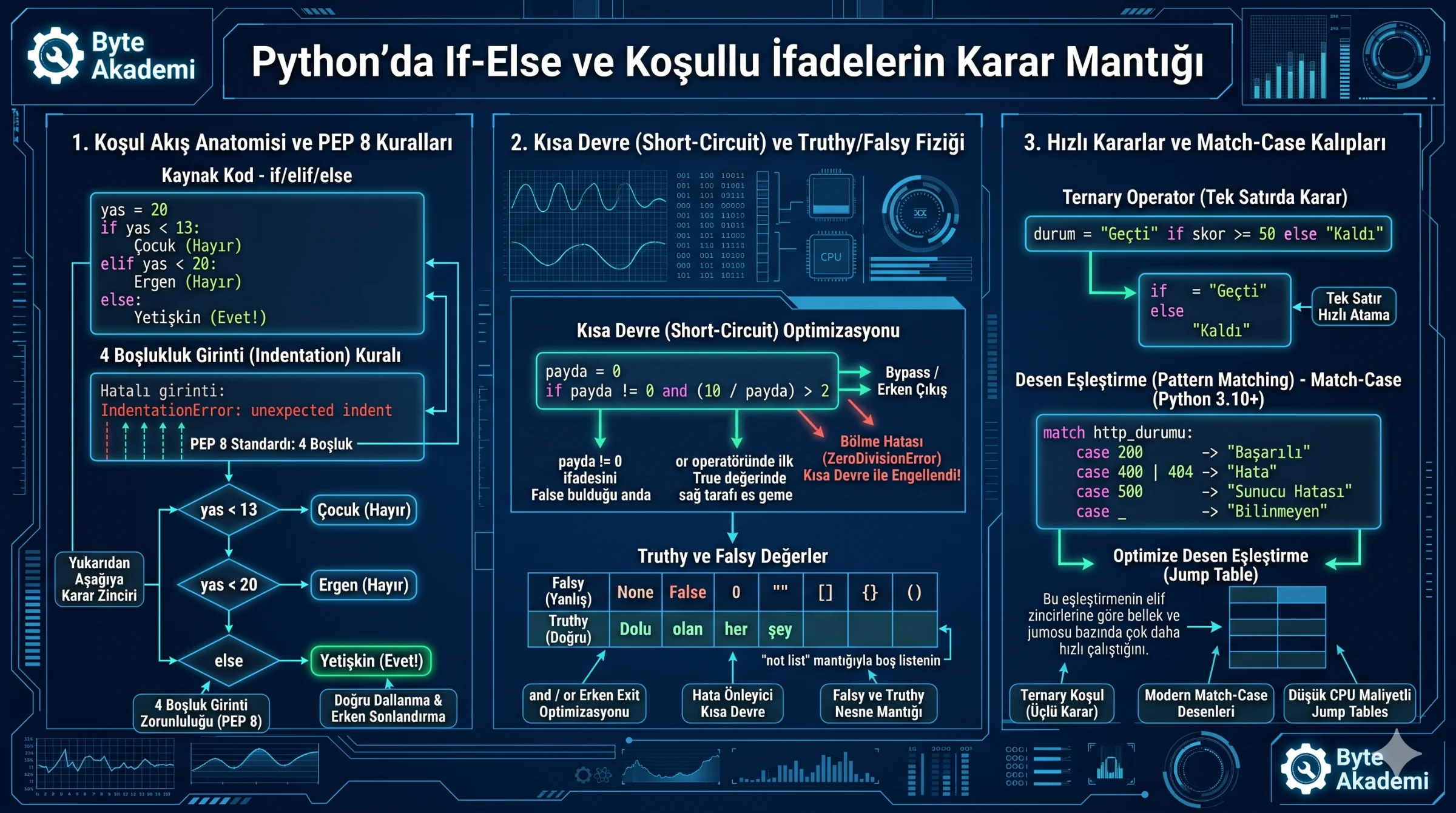
In Python, program execution is guided by if, elif (else if), and else blocks. The interpreter processes these branches top-down, skipping all subsequent branch evaluations once a condition resolves to True:
age = 20

if age < 13:
    print("Child")
elif age < 20:
    print("Teen")
else:
    print("Adult") # The interpreter executes this catch-all branch.
Two essential behaviors dictate this system:
- PEP 8 and Indentation: Python omits enclosing braces
{}or end statement terminators. Branch scope is determined solely by a **4-space indentation**. Failure to align indentation triggers an immediateIndentationError, halting compilation. - Branch Execution Costs: Chaining separate
ifstatements forces the CPU to evaluate each test in sequence, whereasif-elif-elsechains stop evaluating as soon as a single match is made, conserving processor cycles.
Conditional statements are not merely branching mechanisms; through Short-Circuit and Pattern Matching optimization, they dictate exactly which instruction pipelines the CPU can bypass.
2. Mechanical Efficiency: Short-Circuit Evaluation
When multiple Boolean conditions are chained using and or or, the interpreter optimizes evaluating via **Short-Circuit Evaluation**:
The and operator requires all constituent expressions to evaluate to True. Evaluated left-to-right, **as soon as a single operand is found to be False**, the interpreter aborts and skips the remaining evaluations, since the overall expression can no longer be satisfied.
# Safeguarding against ZeroDivisionError:
denominator = 0

# If short-circuiting were absent, evaluating 10 / 0 would raise a fatal exception.
# Since denominator != 0 evaluates to False, the right-hand division is bypassed completely.
if denominator != 0 and (10 / denominator) > 2:
    print("Exceeds Threshold")
else:
    print("Invalid or Below Threshold")
Conversely, the or operator requires only a single True operand. If the first evaluated expression is True, Python short-circuits the remaining pipeline, preventing unnecessary evaluations or functional execution calls.
3. Object Truthiness: Truthy and Falsy Dynamics
Python conditions are not restricted to typical comparison operators like a > 5. Instead, every native Python object carries implicit logical value. Empty, zero, or null-state objects resolve as **Falsy**, while populated, non-zero objects evaluate as **Truthy**.
Falsy Objects: None, False, numeric zeroes (0, 0.0), and empty collections and sequences ("", [], {}, ()).
user_queue = []

# Rather than checking len(user_queue) == 0, evaluate the object's implicit truth value
if not user_queue: # An empty list evaluates as Falsy; prepending "not" yields True.
    print("No active users in queue.")
4. Evaluation Optimization: Ternary Operators
For simple assign-on-condition logic, multiple-line if-else structures can become verbose. Python supports **Ternary Operators (Conditional Expressions)** to execute this in a single line:
# Verbose implementation
if score >= 50:
    outcome = "Pass"
else:
    outcome = "Fail"

# Elegant, "Pythonic" Ternary implementation
outcome = "Pass" if score >= 50 else "Fail"
5. Modern Structural Pattern Matching: Match-Case
Managing extensive elif blocks for multi-condition dispatch can make your codebase messy. Python 3.10+ resolves this by introducing **Match-Case (Pattern Matching)**:
http_status = 404

match http_status:
    case 200:
        print("Success")
    case 400 | 404: # Match multiple patterns using the pipe (|) operator
        print("Client-Side Error")
    case 500:
        print("Server-Side Error")
    case _: # Default catch-all (analogous to 'else')
        print("Unknown Status")
The match-case structure operates more efficiently than traditional chain structures. The compiler optimization matches shapes and values with jump tables and static routing rather than sequential linear comparisons.
| Conditional Strategy | Primary Application | Code Readability | Performance Characteristics |
|---|---|---|---|
| Standard If-Elif-Else | Multi-layered, independent logical branching | High | Linear search based on check depth ($O(N)$ worst-case) |
| Ternary Operator | Simple Inline assignment based on single condition | Very High (Simple logic only) | Instant, low-overhead assignment |
| Match-Case (3.10+) | Structural pattern matching against objects or inputs | Excellent | Highly optimized pattern-matching jump tables |
| Short-Circuit (and/or) | Sequential logic chains, protection checks | High | Early-exit evaluation saves CPU cycles ($O(1)$ early termination) |
Nested "if" structures (the Arrow Anti-Pattern) make code harder to read. To write maintainable Python, utilize early returns or guard clauses to validate and drop invalid states first. This allows your primary business logic to remain flat and readable.