Have you ever thought about the journey that the hundreds of megawatts consumed by AI servers, supercomputers and giant data centres make before they reach the socket? Electrical engineering and computer hardware are usually perceived as two separate worlds. Yet the data processed in the nanometre-scale gates of a microprocessor is directly at the mercy of the giant turbines spinning in a power plant hundreds of kilometres away, and of the huge transformers at the output of those turbines.
The most critical and most expensive component of a power plant, the one that can plunge an entire region into darkness when it fails, is the Generator Step-Up Transformer (GSU) that sits between the generator and the high-voltage transmission line. We look at the little-known engineering secrets behind these giant electromagnetic fortresses, which bear no resemblance to the distribution transformers found in our cities.
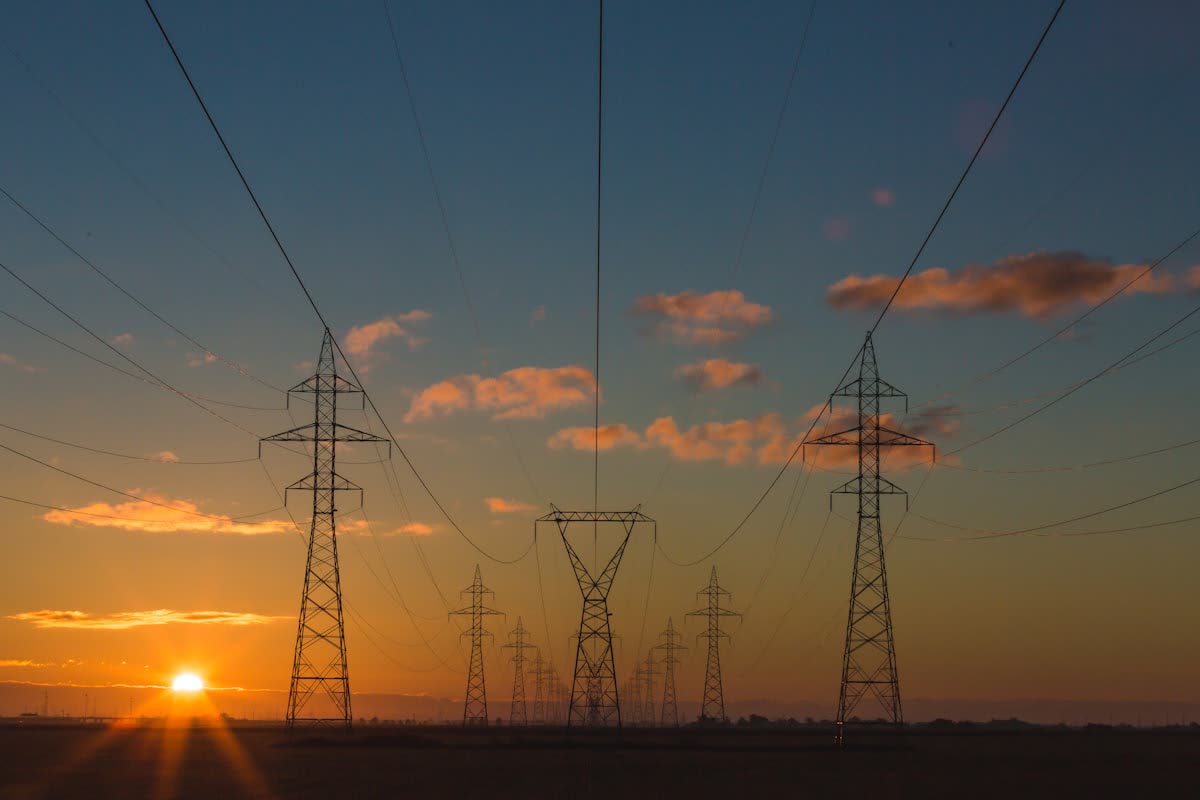
The arteries of the grid: the electromagnetic conversion that squeezes tens of thousands of amperes at the generator terminals into slender conductors.
1. Why Can't We Connect Directly to the Grid? (The I² · R Reality)
A modern nuclear, thermal or hydroelectric plant generator typically produces a voltage between 10.5 kV and 24 kV. Due to the generator's insulation constraints, raising this voltage directly to 154 kV or 380 kV inside the generator itself is physically impossible, because the stator winding insulation would reach enormous dimensions.
But if you try to transmit electricity at 20 kV from a 1000 MVA plant, the current flowing through the line would be around 29,000 Amperes! Joule's Law (P = I² · R), which we examined in the 12VHPWR connector melting case in the hardware world, shows up here with devastating force. A current of 29 kA would melt transmission lines kilometres long within seconds.
"This is where the GSU transformer comes in: it boosts the voltage to 380 kV while bringing the current down to around 1,500 Amperes. Because the current drops 20-fold, the thermal loss on the transmission line (I²) falls by a full 400 times!"
2. The Little-Known Feature: Why Is the YNd11 Vector Group Chosen?
An ordinary electrical technician thinks a transformer only converts voltage. Yet the winding connection geometry (vector group) of a GSU transformer is the lifeline of the plant. Generator step-up transformers almost universally use a Delta-Star (YNd11 or YNd1) configuration.
- Eliminating 3rd Harmonics: The Delta connection on the generator's low-voltage side traps 3rd harmonic currents caused by non-linear loads inside its own winding loop and prevents them from leaking into the high-voltage grid.
- Zero-Sequence Isolation: It blocks single phase-to-earth faults on the grid side from tearing apart the generator windings directly through mechanical resonance.
- Earthed Neutral (YN): The neutral point of the Star connection on the high-voltage side is solidly earthed, minimising phase-to-earth insulation costs on the transmission line.
| Engineering Criterion | Distribution Transformer (Urban) | Power Plant GSU Transformer |
|---|---|---|
| Operating Regime | Variable load (20% - 80%) | Continuous Full Load (100% Baseload) |
| Leakage Impedance (%Z) | Around 4% - 6% | 12% - 18% (Limits short-circuit current) |
| Cooling Architecture | ONAN (Natural Oil / Air) | ODAF / OFAF (Forced Oil Pumps & Fans) |
| Hazardous Condition | Overloading | Volts/Hz Overexcitation |
3. The Silent Danger: The Volts/Hertz Ratio and Magnetic Saturation
The biggest nightmare for GSU transformers is not overvoltage but a disturbed V/Hz (Volts per Hertz) ratio. According to Faraday's Law, the magnetic flux density in the transformer core is directly proportional to voltage and inversely proportional to frequency:
When the plant suddenly disconnects from the grid (Full Load Rejection), the turbine speeds up, the generator voltage shoots up and the frequency fluctuates. If the voltage/frequency ratio exceeds the critical threshold, the transformer's silicon steel core instantly goes into Magnetic Saturation. Once the core saturates, the magnetic flux spills into the air and the steel tank; within seconds the tank temperature rises by hundreds of degrees and burns the winding insulation to ash.
Conclusion: Silicon Is Only as Strong as the Grid
Whether you are building a server farm running AI algorithms or designing a microprocessor, the clean and uninterrupted waveform your hardware needs exists thanks to the electrostatic balance of these hundred-tonne transformers at the plant's output.
It is impossible to separate electrical engineering from computer architecture; after all, even the most advanced AI breathes the electrons delivered by a GSU transformer at a power plant!
Will conventional GSU transformers and transmission grids fall short of the soaring energy demand of AI data centres? When will Solid State Transformers transform the industry? We look forward to your comments!