Mainstream tutorials invariably recite the same superficial premise: "Python is effortless, read it just like standard English!" Yet when you initialize a runtime terminal, the underlying execution environment is far from a trivial toy. Every declaration engages system kernels, dynamically indexes RAM addresses across physical silicon cells, and triggers the structural routines of a sophisticated C-based virtual machine.
Why do modern machine learning frameworks (PyTorch, TensorFlow), orbital telemetry processing engines for the James Webb Space Telescope, and quantitative algorithmic trading systems converge on Python? How does a high-level language balance programmatic simplicity with bare-metal compute execution? Bypassing superficial boilerplate, this guide explores Python through a systems lens: from CPython bytecode parsing to the PyObject memory struct, reference-counted garbage collection, and the mechanics of the Global Interpreter Lock (GIL).
1. Under the Hood: Two-Stage Execution Topology
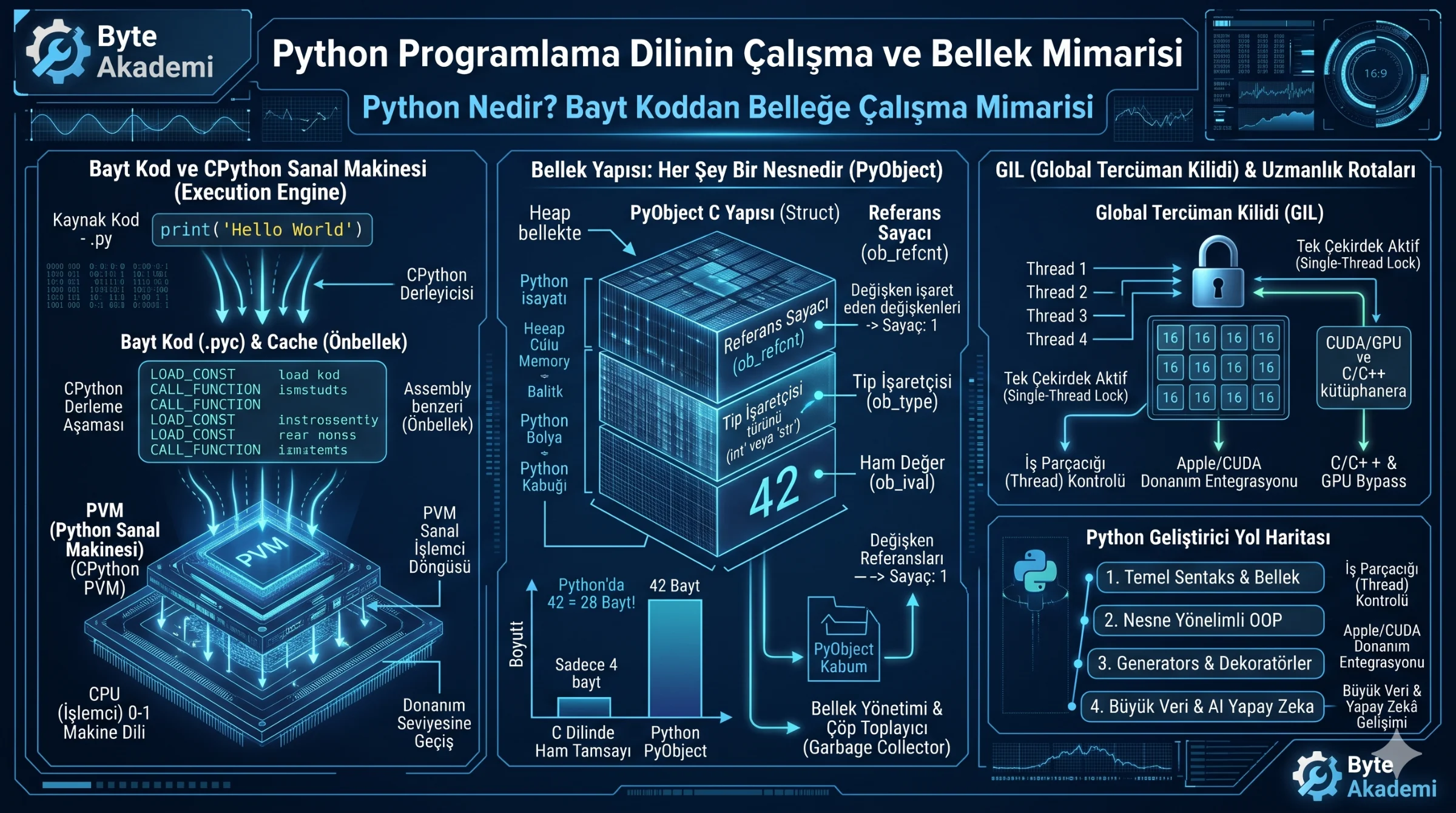
Classifying Python strictly as an interpreted language obscures its actual runtime pipeline. Source code does not interpret directly line-by-line; CPython deploys a two-stage execution sequence:
- Stage 1: Bytecode Compilation: Source files (
.py) compile into an intermediate, architecture-agnostic instruction sequence (Bytecode), serialized within__pycache__as.pycbinaries. - Stage 2: Python Virtual Machine (PVM): A register-emulating software engine written in ANSI C processes these bytecode instructions, mapping them directly to underlying operating system assembly primitives.
  [CPYTHON EXECUTION TRAJECTORY]

  Source Code (.py) ---> [CPython Compiler] ---> Bytecode (.pyc) ---> [Python VM (PVM)] ---> Bare Metal CPU
  "print('Engine')"       AST Parse Tree          LOAD_CONST / PRINT     C Evaluation Loop       Transistor Logic
Learning Python is not merely absorbing syntax rules; it is orchestrating high-level human logic through C-based virtual machines to manipulate raw silicon.
2. Memory Allocation Physics: "Everything Is a PyObject"
In low-level languages like C, declaring an integer allocates a clean 4-byte (32-bit) primitive directly onto the stack. In Python, primitive variables do not exist; every entity is instantiated as a heap-allocated C struct (PyObject).
Instantiating x = 42 allocates a rich memory descriptor containing three distinct structural headers:
- Reference Counter (ob_refcnt): Tracks active pointer references pointing to the heap memory address. When this integer decrements to zero, memory returns to the operating system pool.
- Type Descriptor (ob_type): Points to the type object metadata. This enables Python's dynamic typing: variables remain agnostic, while the underlying heap object explicitly carries its type identity.
- Raw Payload (ob_ival): The primitive integer value. Because of this administrative envelope, a simple integer consumes 28 bytes of RAM rather than 4 bytes, trading localized memory density for broad programmatic flexibility.
3. The Global Interpreter Lock (GIL) Demystified
The Global Interpreter Lock (GIL) is a mutual exclusion mechanism preventing multiple native operating system threads from executing Python bytecode concurrently within a single process space.
While often cited as a concurrency constraint, the GIL prevents race conditions within CPython's reference-counting memory architecture without introducing high single-thread locking penalties. In high-performance computational workloads, numerical libraries like NumPy and PyTorch release the GIL entirely, routing heavy array transformations directly to native C/C++ backends and parallelized CUDA GPU cores.
4. The Systems Engineering Curriculum
  [ENGINEERING ROADMAP: FROM SYNTAX TO SCALED SYSTEMS]

  Phase 1: Lexical Semantics & Memory Bounds
  - Primitive Types, Mutability vs. Immutability, Memory Identity (is vs. ==)
  - Execution Control Graphs and the LEGB Variable Scope Hierarchy

  Phase 2: Object-Oriented System Encapsulation
  - Polymorphism, Class Invariants, and Dual Metaclass Mechanics
  - Data Model Specialization via Dunder Methods (__init__, __repr__, __call__)

  Phase 3: High-Performance Primitives
  - Generator Pipelines and Lazy Memory Evaluation (yield mechanics)
  - Metaprogramming Decorators, Context Handlers, and Async IO Event Loops

  Phase 4: Bare-Metal Computing & Vectorization
  - C-Contiguous Array Transformations (NumPy) and Matrix Structs
- Accelerated Hardware Pipelines (Torch Tensor Graphs, CUDA Parallelism)Python's dominance is anchored in its C Foreign Function Interface (FFI). Developers manipulate complex algorithmic logic through clean, human-readable abstractions, while the underlying engine delegates heavy matrix and tensor computations directly to hardware accelerators. True proficiency lies in understanding how code translates into memory structures and machine instructions.