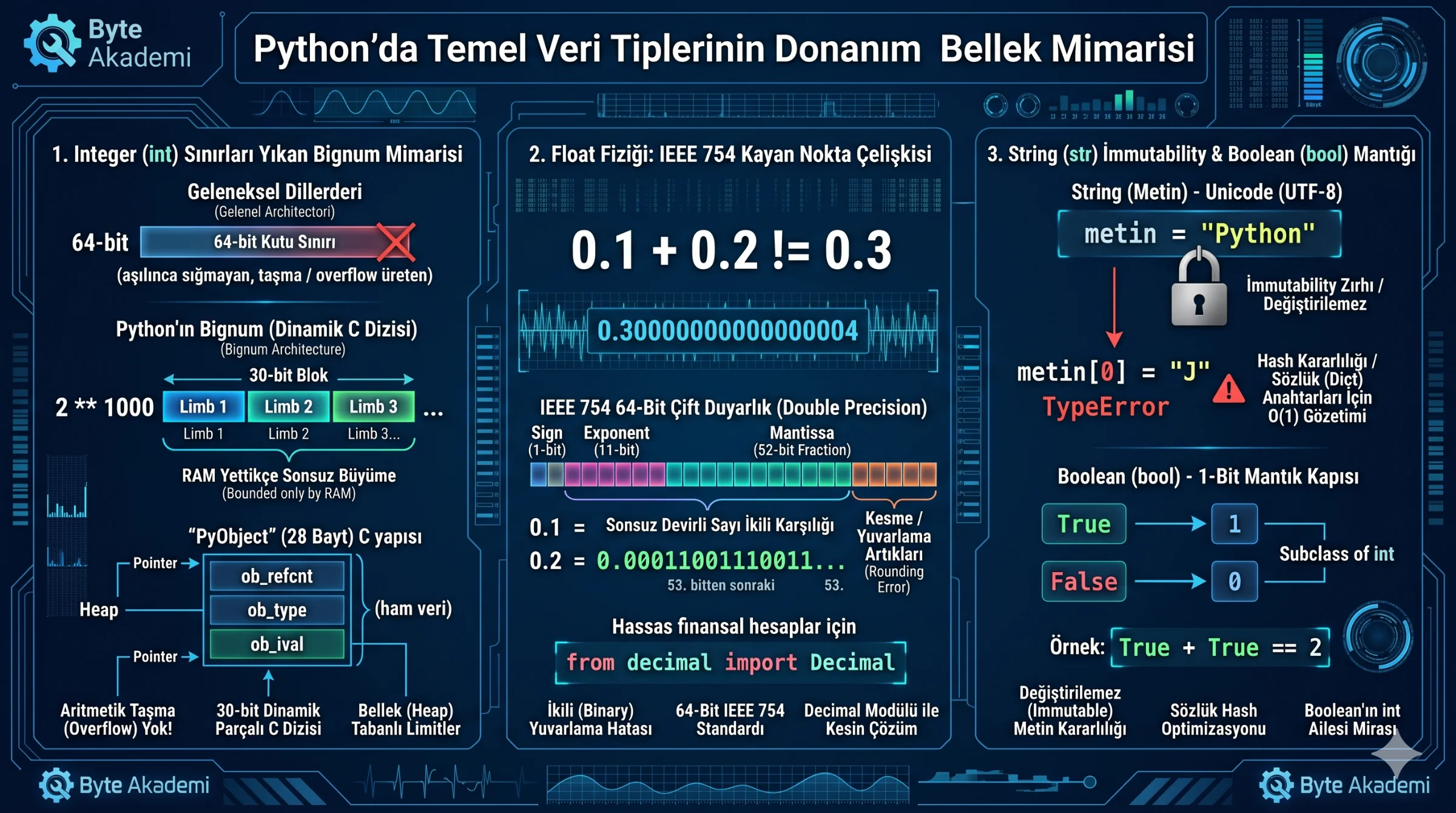
Execute print(0.1 + 0.2) inside a standard Python REPL shell, and the runtime returns: 0.30000000000000004. This is not an engine malfunction; it is the fundamental friction between base-10 human decimal arithmetic and the base-2 binary constraints of physical silicon transistors.
Every programmatic domain relies upon four core primitives: String (str), Integer (int), Float (float), and Boolean (bool). In Python, these abstractions do not merely format variables; they govern low-level memory allocation, CPU register utilization, and hardware-accelerated ALU pipelines. This guide dissects arbitrary-precision integer architectures, IEEE 754 floating-point mechanics, Unicode immutability constraints, and boolean sub-typing directly from a systems engineering viewpoint.
1. Integer (int): Arbitrary-Precision Bignum Mechanics
In statically compiled environments like C or Java, integers map directly to discrete 32-bit or 64-bit hardware registers. Exceeding $2^{63}-1$ triggers an Arithmetic Integer Overflow, cycling the signed bit into negative values.
Python 3 eradicates overflow boundaries entirely by implementing an internal arbitrary-precision Bignum structure:
- Digit Chunking Architecture: CPython decomposes large numbers into dynamic arrays of 30-bit limbs (digits).
- RAM-Bound Limits: Evaluating
2 ** 1000does not crash the interpreter; Python dynamically expands heap allocation to house the required bit-depth, bounding integer capacity solely to available physical system memory.
  [STATIC HARDWARE REGISTERS vs. PYTHON DYNAMIC BIGNUM]

  C / Java (Fixed 64-bit Cell) : [64-bit Register] ---> Exceeds Capacity: HARD OVERFLOW!
  Python Bignum (C Struct Array): [30-bit Limb] + [30-bit Limb] + [30-bit Limb]... (Dynamically Scaled)
The fact that 0.1 + 0.2 fails to yield an exact 0.3 is not a software bug; it is an unavoidable consequence of mapping infinite decimal fractions onto finite binary floating-point hardware.
2. Float: Binary Fractions & IEEE 754 Precision Loss
Python floats conform to standard IEEE 754 Double-Precision (64-bit) binary formatting, allocating: 1 bit for the sign, 11 bits for the exponent, and 52 bits for the mantissa (fractional precision).
While base-10 fractional systems cleanly express numbers whose denominators share prime factors of 10 (2 and 5), base-2 registers can only terminate fractions whose denominators are pure powers of 2. Decimal 0.1 represents an infinite repeating binary sequence: 0.0001100110011.... Truncating this sequence at 53 bits introduces unavoidable precision drift, accumulating as microscopic residuals (e.g., ...0004).
# Financial and Mission-Critical Mitigation
from decimal import Decimal

# Using floats introduces rounding artifacts:
print(0.1 + 0.2 == 0.3) # Evaluates to False

# Using exact Decimal arbitrary-precision:
print(Decimal('0.1') + Decimal('0.2') == Decimal('0.3')) # Evaluates to True
3. String (str): Unicode Buffers & The Invariant of Immutability
Python strings represent sequences of immutable Unicode characters. Under PEP 393, CPython optimizes memory layouts dynamically via three distinct internal representations (Latin-1, UCS-2, or UCS-4), allocating 1, 2, or 4 bytes per character based on the highest code point within the string buffer.
Strings are strictly Immutable. Once allocated on the heap, character cells cannot be overwritten in place:
buffer = "Python"
# buffer[0] = "J" # Raises TypeError: 'str' object does not support item assignment
This immutability guarantees a stable hash value across the lifecycle of the string, ensuring constant-time $O(1)$ lookups when serving as keys in Python dictionary hash tables.
4. Boolean (bool): Integer Inheritance and Bit Logic
The bool datatype in Python is not an isolated binary type; it is an explicit architectural subclass of int:
Trueevaluates numerically as integer1.Falseevaluates numerically as integer0.
# Demonstrating integer polymorphism
print(True + True)            # Output: 2
print(isinstance(True, int))  # Output: True
print(issubclass(bool, int))  # Output: True
5. Primitive Datatype Comparison & Memory Overhead
Measuring memory footprints via sys.getsizeof() illustrates the administrative overhead of Python's rich object wrappers:
| Datatype | Internal Class | Baseline Size | Immutability | Type Conversion Syntax |
|---|---|---|---|---|
| Integer | int |
28 Bytes | Immutable | int("42") -> 42 |
| Float | float |
24 Bytes | Immutable | float("3.14") -> 3.14 |
| String | str |
49 Bytes + char payload | Immutable | str(100) -> "100" |
| Boolean | bool |
28 Bytes | Immutable | bool(1) -> True |
Data primitives are physical instructions configuring transistor logic. Selecting between discrete integers, binary floating points, immutable string buffers, and boolean subclasses dictates numeric accuracy, cache performance, and algorithmic execution across system runtimes.